The Storm on the Sea of Galilee by Rembrandt: Vibrant Color Edit
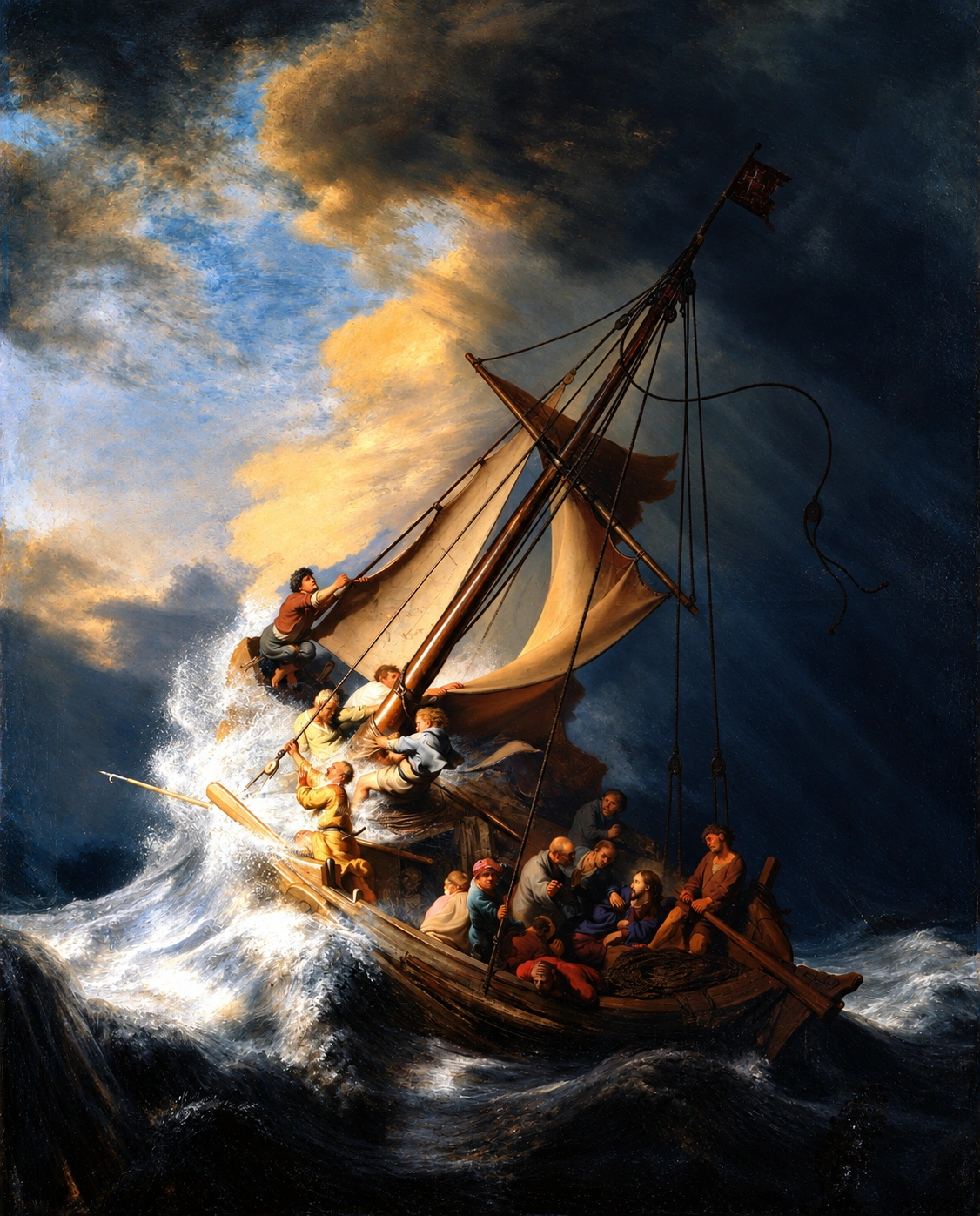
Free to Download & Reuse: You are welcome to use this image! If you republish or share it online, you must include a direct link back to this webpage for attribution.
Original Image Source: wikiart.org
Introduction
Rembrandt van Rijn’s 1633 painting The Storm on the Sea of Galilee is one of the most dramatic interpretations of a biblical episode produced during the Dutch Golden Age. Based on the Gospel account of Christ calming a violent storm, the painting transforms a familiar religious story into an immediate experience of fear, movement, uncertainty, and faith. Rather than presenting Christ as an obviously dominant divine figure, Rembrandt places him within a crowded boat whose passengers appear frighteningly vulnerable to the forces of nature.
The painting is particularly remarkable because Rembrandt combines religious storytelling with the visual language of a maritime disaster. Towering waves, violent wind, torn rigging, heavy clouds, and a dangerously tilted boat create a scene that appears almost physically unstable. Yet beneath this surface drama lies a carefully constructed meditation on human reactions to danger, ranging from panic and desperation to concentration, prayer, and quiet trust.
The Biblical Story Behind the Painting
The Storm on the Sea of Galilee illustrates an episode described in the New Testament in which Jesus and his disciples cross the Sea of Galilee by boat. A sudden storm threatens to overwhelm the vessel while Christ sleeps. Terrified, the disciples awaken him, and Christ responds by calming the wind and water, demonstrating his authority over nature.
Rembrandt does not show the peaceful moment after the miracle. Instead, he selects the most uncertain and psychologically intense part of the story, when the storm is still raging and the disciples do not yet know what will happen. This choice allows the artist to concentrate on fear and human vulnerability while leaving the coming miracle suspended in the viewer’s imagination.
A Composition Filled with Movement
The composition of The Storm on the Sea of Galilee is dominated by strong diagonal lines. The boat rises sharply from the lower left toward the upper right, while the mast continues this upward movement into the dark sky. These diagonals make the vessel seem unstable, as though it could overturn at any moment.
The mast, sails, ropes, and bodies of the disciples create additional crossing lines that intensify the confusion. Nothing feels completely secure or horizontal. Rembrandt effectively turns the entire composition into a visual representation of instability, forcing the viewer’s eye to move constantly through the scene.
The placement of the boat also increases the sense of danger. It occupies much of the canvas, bringing the figures close enough for their individual reactions to remain visible. Instead of observing the storm from a safe distance, the viewer seems to be positioned close to the struggling vessel.
Rembrandt’s Dramatic Use of Light
Light plays a crucial role in the emotional power of the painting. The left side is illuminated by a dramatic break in the storm clouds, while much of the right side disappears into deep brown and blue-black shadows. This contrast creates a powerful division between brightness and darkness.
The brightest light falls across the turbulent water and several figures struggling near the front of the boat. White foam catches the illumination, making the waves appear energetic and almost luminous. Against these brilliant highlights, the darker sections of the sea appear deeper and more threatening.
Rembrandt’s use of light also carries symbolic possibilities. The illuminated portion of the painting can suggest hope or divine presence, while the surrounding darkness evokes danger, uncertainty, and fear. However, the symbolism is not simplistic because Christ himself is not surrounded by an obvious supernatural glow. His power is expressed through the narrative rather than through conventional signs of divinity.
The Power of the Storm
The sea is not merely a background element in this painting. It functions almost like another character, confronting the disciples with an overwhelming force that they cannot control. Waves crash against the boat while spray rises around the men attempting to keep the vessel afloat.
The sky contributes equally to the threatening atmosphere. Heavy clouds dominate the upper half of the composition, creating a sense of enormous weight above the relatively small human figures. The contrast between the scale of the storm and the vulnerability of the boat reinforces one of the painting’s central themes: the fragility of human beings when confronted by forces greater than themselves.
Rembrandt avoids presenting the water as a smooth or decorative landscape feature. Instead, he emphasizes its physical violence through sweeping brushwork, irregular highlights, and sharply changing values. The viewer can almost imagine the boat rising and falling with each wave.
The Disciples and Their Different Reactions
One of the most fascinating aspects of The Storm on the Sea of Galilee is the variety of reactions among the figures. Some disciples struggle with the sails and rigging, attempting to solve the crisis through physical effort. Others cling desperately to the boat, while several gather around Christ seeking help.
These different responses turn the painting into a study of human behavior under extreme pressure. Fear does not produce a single reaction. Rembrandt shows action, helplessness, concentration, confusion, sickness, and spiritual dependence occurring simultaneously within the confined space of the vessel.
This variety also encourages viewers to identify with particular figures. Someone might recognize themselves in the disciples trying desperately to control the situation, while another viewer might relate more closely to those turning toward Christ. In this way, the biblical event becomes psychologically accessible rather than distant or idealized.
Christ as the Quiet Center
Christ is positioned toward the lower right section of the boat, surrounded by several disciples. Compared with the violent movement elsewhere in the composition, his presence is relatively restrained. This contrast makes him an important psychological center even though he is not the largest or brightest figure.
The difference between Christ and the surrounding chaos reinforces the central message of the biblical story. The disciples perceive the storm as an overwhelming threat, while Christ possesses an authority that they have not yet fully understood. Rembrandt therefore creates tension between what the figures see in the moment and what the viewer knows will eventually happen.
This tension makes the painting more compelling than a straightforward representation of Christ performing the miracle. By depicting uncertainty rather than resolution, Rembrandt allows fear and faith to coexist within the same image.
Color and Atmosphere
The painting’s color palette is dominated by deep browns, muted blues, gray-green tones, and warm earth colors. These restrained hues create a convincing storm atmosphere while allowing the lighter areas of the sea and sky to become especially prominent. Small areas of red, orange, and yellow clothing introduce warmth among the figures without weakening the overall darkness.
The contrast between the cold sea and the warmer tones of the passengers also helps separate human life from the threatening environment. The figures feel fragile yet vivid against the surrounding darkness. Rembrandt uses color not simply to describe objects, but to strengthen the emotional division between danger and human presence.
Baroque Drama and Rembrandt’s Style
Painted in 1633, The Storm on the Sea of Galilee reflects many characteristics associated with Baroque art. Strong contrasts of light and shadow, diagonal compositions, heightened emotion, and the depiction of a climactic moment all contribute to its dramatic effect. Yet Rembrandt’s approach is distinguished by his extraordinary interest in individual psychology.
Instead of idealizing the disciples, he portrays them as ordinary people responding imperfectly to an extraordinary crisis. Their gestures and expressions give the painting an emotional realism that makes the ancient story feel immediate. Rembrandt’s religious paintings frequently rely on this human dimension, allowing sacred events to unfold through believable physical and emotional experiences.
The artist also avoids creating a perfectly balanced or serene composition. The disorder is intentional. Ropes cross unpredictably, figures overlap, the sail appears strained by the wind, and the boat seems dangerously overloaded, all of which contribute to the sensation that the viewer is witnessing a genuine emergency.
Meaning and Symbolism
At its deepest level, The Storm on the Sea of Galilee can be interpreted as a painting about faith during uncertainty. The storm represents a situation in which ordinary human ability appears insufficient. The disciples can pull ropes, control sails, and attempt to stabilize the boat, but their efforts alone cannot guarantee their survival.
The boat itself has traditionally carried symbolic associations with the Christian community navigating a dangerous world. Within Rembrandt’s painting, this interpretation becomes especially powerful because the passengers are shown reacting in different ways while remaining trapped within the same crisis. Their shared vulnerability unites them even as their individual responses differ.
The painting can also be understood more broadly as a reflection on human existence. Fear often arises precisely because the outcome of a crisis remains unknown. Rembrandt captures that uncertain moment before resolution, making the work emotionally meaningful even outside its specifically biblical context.
Why The Storm on the Sea of Galilee Remains So Powerful
The enduring strength of The Storm on the Sea of Galilee comes from Rembrandt’s ability to combine spectacle with psychological depth. The enormous waves and dramatic lighting immediately attract attention, but the painting becomes more compelling when the viewer begins examining the individual passengers and their varied reactions.
Rembrandt ultimately transforms a story about a miraculous command over nature into a complex image of fear, faith, vulnerability, and hope. The storm creates the visual drama, but the human figures provide the emotional meaning. By freezing the narrative at its moment of greatest uncertainty, Rembrandt invites viewers to experience the disciples’ fear before contemplating the miracle that will follow.
More than three centuries after its creation, the painting remains one of Rembrandt’s most memorable religious compositions because it feels both monumental and deeply personal. The Storm on the Sea of Galilee presents humanity as small before the immense power of nature, yet it also suggests that despair is not the final outcome. The result is a work in which physical danger and spiritual meaning become inseparable, demonstrating Rembrandt’s exceptional ability to turn a biblical narrative into a universal exploration of the human condition.