Belshazzar’s Feast by Rembrandt: Vibrant Color Edit
Free to Download & Reuse: You are welcome to use this image! If you republish or share it online, you must include a direct link back to this webpage for attribution.
Original Image Source: wikiart.org
Belshazzar's Feast by Rembrandt: An Analysis
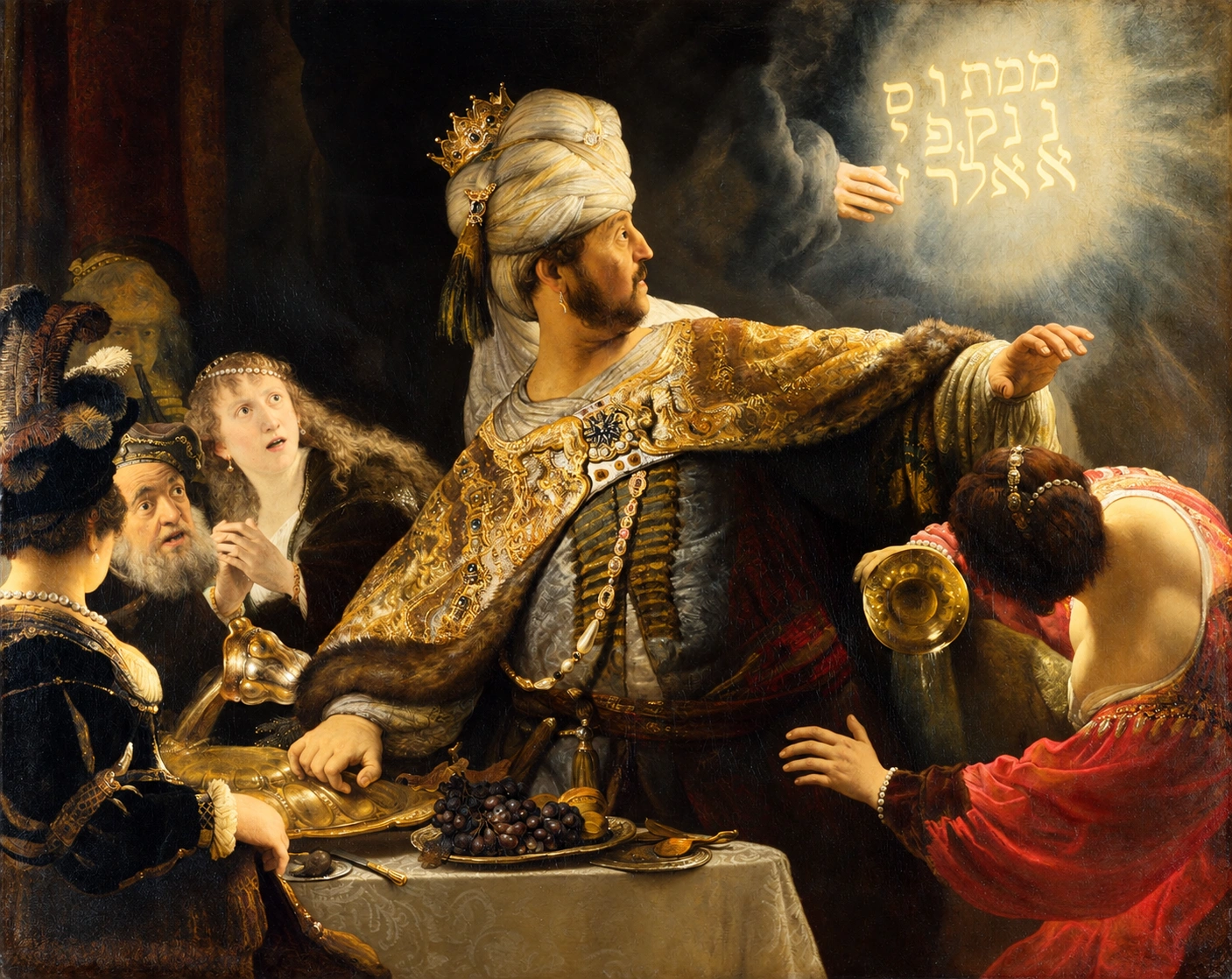
Rembrandt’s Belshazzar’s Feast, painted around 1635, is one of the most dramatic religious history paintings of the Dutch Golden Age. Rather than presenting the biblical episode as a distant historical event, Rembrandt transforms it into an immediate moment of shock, confusion, and supernatural intervention. The scene captures the exact instant when a lavish banquet is interrupted by mysterious writing appearing on the wall, announcing the downfall of the Babylonian king Belshazzar.
The painting is based on the Book of Daniel in the Old Testament. Belshazzar is described as holding an extravagant feast during which he orders sacred vessels taken from the Temple in Jerusalem to be used for drinking. His act of disrespect is suddenly answered by the appearance of a supernatural hand that writes an ominous message on the wall. Rembrandt concentrates all of the narrative’s tension into this single moment, allowing light, gesture, facial expression, and theatrical composition to communicate the king’s sudden realization that something far greater than worldly power has entered the room.
The Biblical Story Behind Belshazzar's Feast
According to the biblical account, Belshazzar hosts a feast for a thousand nobles and drinks wine with his guests. During the celebration, he commands that the gold and silver vessels taken from the Jerusalem Temple be brought into the banquet so that the king, his nobles, his wives, and his concubines can drink from them. The objects are therefore transformed from sacred vessels into symbols of Belshazzar’s arrogance.
A mysterious hand then appears and writes the words “Mene, Mene, Tekel, Upharsin” on the palace wall. Unable to understand the message, Belshazzar eventually summons Daniel, who interprets the inscription as a divine judgment. Belshazzar’s kingdom has been numbered, weighed, found wanting, and destined to be divided.
Rembrandt chooses not to depict Daniel interpreting the words or the later consequences of the prophecy. Instead, he selects the most visually explosive instant, when the writing first appears and Belshazzar recoils in terror. This decision turns the painting into a study of sudden psychological collapse.
Belshazzar as the Center of the Composition
Belshazzar dominates the center of the painting. His large figure, elaborate clothing, jeweled ornaments, and imposing turban immediately establish his royal status. Yet Rembrandt deliberately shows this powerful ruler at a moment when his authority has become meaningless.
The king twists sharply toward the supernatural inscription while extending his right arm outward. His body appears caught between retreat and reaction, creating a strong sense of unstable movement. His face is turned toward the glowing writing, and his expression suggests disbelief mixed with fear.
This physical instability is essential to the meaning of the painting. Moments earlier, Belshazzar would have appeared to control the feast, surrounded by luxury and obedient guests. Now his elaborate costume seems almost ironic because none of his wealth can protect him from the judgment announced on the wall.
Rembrandt heightens this contrast by making Belshazzar’s clothing extraordinarily rich. Gold embroidery, precious stones, fur, decorative chains, and shimmering fabric cover his body. The material splendor draws the viewer toward him, but it also emphasizes how quickly earthly magnificence can become powerless.
Light and the Supernatural Writing
Light is one of the most important dramatic devices in Belshazzar’s Feast. Much of the background remains in deep shadow, while the supernatural inscription produces a brilliant illumination that spreads across the upper right portion of the composition. The contrast between darkness and light creates an atmosphere of revelation.
The writing does not simply appear on the wall as ordinary text. It seems to radiate light into the surrounding space. Belshazzar’s face, turban, clothing, and extended hand are partially illuminated by its glow, suggesting that divine judgment has physically entered the banquet.
Rembrandt was especially skilled at using chiaroscuro, the dramatic opposition between light and darkness, to direct attention and create emotional intensity. Here, darkness surrounds the human figures while supernatural light interrupts the scene. The effect makes the inscription feel both mysterious and unavoidable.
The disembodied hand emerging from the darkness is especially unsettling. Only a portion of the arm and hand is visible, allowing the viewer to perceive the divine presence without seeing an entire supernatural figure. Rembrandt therefore preserves the mystery of the event while giving it a striking visual form.
The Hebrew Inscription
One of the most distinctive features of Belshazzar’s Feast is the Hebrew writing on the wall. Rembrandt took unusual care with the inscription, reflecting the broader interest in Hebrew language and biblical scholarship present in seventeenth-century Amsterdam.
The words are arranged vertically rather than simply written across the wall in an ordinary horizontal sequence. This unusual arrangement contributes to the mysterious nature of the message. It visually separates the inscription from normal written communication and makes it appear almost like a divine code.
For viewers familiar with the biblical story, the writing represents the moment when Belshazzar’s fate becomes irreversible. The king does not yet understand the message, but the audience may already know what it means. This creates dramatic irony because the viewer understands that the feast has effectively become the beginning of Belshazzar’s downfall.
Gesture, Movement, and Human Reaction
Almost every figure in the painting reacts differently to the miraculous event. Rembrandt uses these contrasting responses to transform the biblical story into a convincing scene of human confusion. Some guests stare upward, others recoil, and others appear frozen by what they have witnessed.
The woman on the right bends dramatically over the table while holding a large vessel. Her body curves downward in a sudden movement that contrasts with Belshazzar’s upward turn toward the writing. Her posture helps create a circular rhythm of movement around the king.
Another figure on the left looks upward with an open mouth and widened eyes. This expression of astonishment reinforces the supernatural character of the event. The emotional reactions of the guests allow viewers to imagine how extraordinary the appearance of the writing would have seemed.
Rembrandt’s interest is not limited to theological meaning. He is equally fascinated by how human beings physically react when confronted with something impossible. Surprise is communicated through hands, turned heads, widened eyes, leaning bodies, and interrupted actions.
The Banquet and Its Symbols of Luxury
The objects scattered across the table are essential to the narrative. Metal vessels, fruit, plates, jewelry, textiles, and other luxurious items establish the wealth of Belshazzar’s court. Their carefully painted surfaces also demonstrate Rembrandt’s ability to represent contrasting materials.
The golden vessels carry particular significance because they refer directly to the sacred objects removed from the Temple in Jerusalem. Their beauty therefore has a double meaning. They represent both worldly luxury and the religious offense that causes Belshazzar’s judgment.
The tipped containers and disrupted tableware also suggest that order is breaking apart. A formal royal banquet is becoming chaotic within seconds. Material abundance remains everywhere, yet it suddenly seems fragile and insignificant compared with the glowing message above.
This contrast between luxury and mortality appears frequently in seventeenth-century European painting. Wealth can create the appearance of security, but it cannot prevent judgment, death, or historical change. Rembrandt uses the banquet setting to turn this idea into a dramatic visual experience.
Rembrandt's Use of Color
The color palette of Belshazzar’s Feast combines deep blacks, warm browns, golds, reds, whites, and muted flesh tones. Rather than spreading bright colors evenly throughout the painting, Rembrandt concentrates the strongest areas of color around the principal figures. This technique strengthens the sense that the surrounding darkness is closing around the illuminated banquet.
Belshazzar’s costume is dominated by gold, cream, brown, and white. These colors connect him visually with the glowing inscription while also emphasizing his royal magnificence. The woman at the lower right wears rich red fabric, introducing a powerful warm accent that balances the gold tones surrounding the king.
The dark background is equally important. It removes unnecessary architectural detail and prevents the viewer’s attention from wandering away from the crisis. Figures emerge selectively from the darkness, making the scene feel theatrical without losing its psychological intensity.
Composition and Dramatic Tension
The composition is built around strong diagonals and opposing movements. Belshazzar’s torso turns toward the right, his arm extends outward, and the glowing inscription occupies the upper corner. These elements create a visual path connecting the king directly with the supernatural message.
At the same time, surrounding figures move in different directions. The woman on the right bends downward, the figures on the left look upward, and the king twists across the center. This variety of gestures produces controlled chaos, perfectly matching the sudden disruption of the banquet.
Rembrandt avoids creating a calm or symmetrical arrangement. Instead, the composition feels unstable, almost as though the entire scene has been knocked off balance by the appearance of the writing. That instability allows the viewer to experience the event emotionally rather than merely observe it.
Power, Pride, and Judgment
At its deepest level, Belshazzar’s Feast is a painting about the limits of human power. Belshazzar surrounds himself with wealth, royal clothing, precious objects, and an impressive court, yet none of these things matter once the divine message appears.
The painting does not need to show Belshazzar losing his kingdom. His psychological defeat has already begun. The moment he turns toward the writing, the balance of power shifts from the king to the unseen force represented by the mysterious hand.
This transformation makes the painting particularly compelling. Belshazzar remains physically large and richly dressed, but emotionally he has become vulnerable. Rembrandt captures the instant when confidence becomes fear and worldly authority encounters a judgment it cannot control.
Why Belshazzar's Feast Remains So Powerful
Belshazzar’s Feast remains memorable because Rembrandt combines biblical storytelling with intense psychological observation. The viewer does not simply learn what happened to Belshazzar. Instead, the painting makes the sudden interruption of the feast feel immediate.
The glowing inscription, twisting figure of the king, startled guests, overturned objects, and deep surrounding darkness all contribute to a sense of suspended time. Everything appears to happen within a fraction of a second. Rembrandt captures that brief instant and transforms it into a meditation on pride, uncertainty, judgment, and the instability of earthly power.
The painting also demonstrates Rembrandt’s extraordinary ability to unite spectacle with human emotion. The jeweled fabrics and supernatural effects attract attention, but the real drama lies in the faces and gestures of the people who realize that the world around them has suddenly changed. In Belshazzar’s Feast, visual richness serves a moral and psychological purpose, making the work one of Rembrandt’s most striking interpretations of a biblical event.