The Art of Painting by Johannes Vermeer: Vibrant Color Edit
Free to Download & Reuse: You are welcome to use this image! If you republish or share it online, you must include a direct link back to this webpage for attribution.
Original Image Source: wikiart.org
Introduction to The Art of Painting by Johannes Vermeer
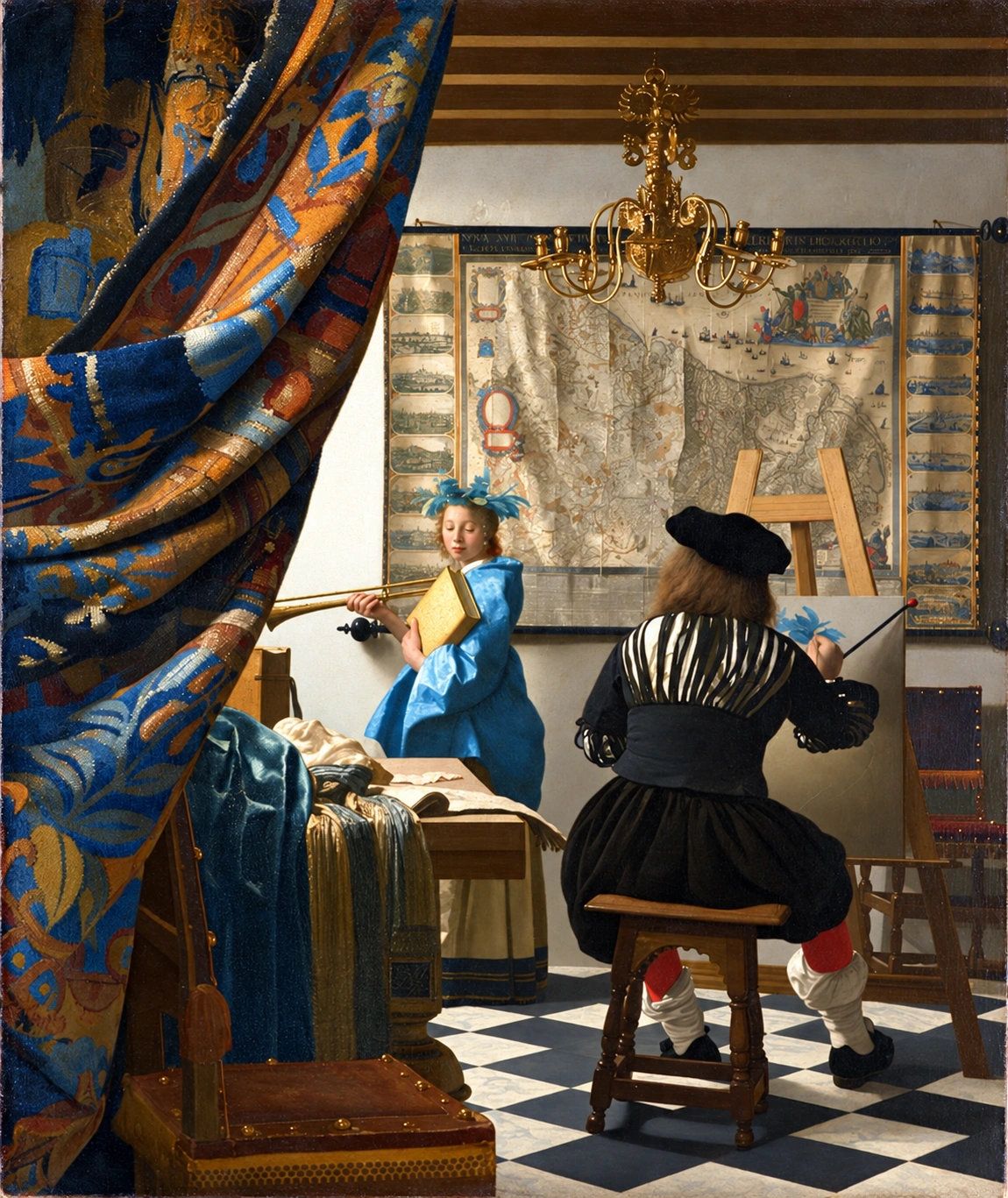
The Art of Painting, created around 1666 to 1668 by Dutch master Johannes Vermeer, is one of the most sophisticated and mysterious paintings of the Dutch Golden Age. Also known as The Allegory of Painting or The Painter’s Studio, this remarkable masterpiece offers a fascinating exploration of artistic creation, history, symbolism, and the relationship between reality and illusion. Through his extraordinary attention to detail, masterful manipulation of light, and carefully constructed composition, Vermeer transforms an ordinary artist’s studio into a profound meditation on the nature of painting itself.
Unlike many of Vermeer’s intimate domestic scenes, The Art of Painting carries an ambitious allegorical meaning that extends beyond its beautifully rendered interior. The painting presents an artist working at his easel while a young woman, dressed in an elaborate costume, poses before him. Every element within the composition, from the magnificent chandelier to the enormous wall map, contributes to a carefully orchestrated celebration of artistic achievement and cultural identity.
Historical Context and the Dutch Golden Age
Johannes Vermeer painted The Art of Painting during the height of the Dutch Golden Age, a period characterized by economic prosperity, international commerce, scientific discoveries, and extraordinary artistic innovation. The Dutch Republic had established itself as a major European commercial power, and its wealthy merchant class supported a flourishing market for paintings depicting domestic interiors, landscapes, portraits, and everyday activities. Artists increasingly explored the visual possibilities of ordinary life, transforming familiar environments into compelling works of art.
Vermeer, who spent his life in Delft, developed a distinctive artistic language based on quiet interiors, carefully arranged figures, and luminous natural light. His paintings frequently portray women reading letters, playing musical instruments, or performing domestic activities, yet these apparently simple subjects often contain subtle emotional and symbolic dimensions. In The Art of Painting, Vermeer expands this approach by making the creative process itself the central subject.
The painting’s ambitious scale and elaborate symbolism suggest that Vermeer considered it particularly important within his artistic career. It remained in his possession until his death in 1675, an unusual circumstance that has encouraged scholars to interpret it as a personal statement about his profession. Rather than depicting painting as a mechanical craft, Vermeer presents it as an intellectual and imaginative discipline worthy of recognition and admiration.
Composition and the Theatrical Arrangement of Space
One of the most striking characteristics of The Art of Painting is its sophisticated composition, which invites viewers to enter a carefully staged interior. A large, richly patterned curtain occupies the left foreground, partially revealing the scene behind it. This theatrical device creates the impression that viewers are witnessing a private moment normally concealed from public observation.
The curtain also establishes a dramatic relationship between concealment and revelation, suggesting that painting possesses the power to uncover hidden truths. Its heavy folds and intricate textile patterns contrast beautifully with the illuminated room beyond, establishing a visual transition between the viewer’s space and the fictional world represented on the canvas.
Near the center of the composition, an artist sits with his back toward the viewer, concentrating on the painting positioned before him. His dark costume, decorated with contrasting details, creates a strong visual presence without distracting from the young woman standing farther into the room. By concealing the artist’s face, Vermeer shifts attention away from individual identity and toward the universal process of artistic creation.
The composition achieves remarkable depth through overlapping objects, carefully controlled perspective, and contrasting areas of illumination. The tiled floor directs the viewer’s gaze into the room, while the table, chairs, and hanging chandelier establish a believable architectural environment. Every element appears deliberately positioned to create an atmosphere of balance, elegance, and quiet concentration.
The Allegorical Figure of Clio
The young woman standing beside the table is generally identified as Clio, the muse of history in classical mythology. Her costume and attributes closely correspond to traditional representations of this mythological figure, making her central to the painting’s allegorical significance. Through Clio, Vermeer establishes a connection between artistic creation, historical memory, and the enduring reputation of great achievements.
The woman wears a blue garment and a wreath of laurel leaves, symbols traditionally associated with glory, honor, and artistic distinction. In one hand, she holds a trumpet, an instrument representing fame and the proclamation of important accomplishments. In the other, she carries a book, commonly interpreted as a historical volume that reinforces her identity as the muse of history.
These symbolic attributes transform the model into something more meaningful than an ordinary studio assistant. She represents the idea that painting can preserve historical memory and communicate achievements across generations. By depicting an artist painting Clio, Vermeer suggests that visual art participates in the creation and preservation of cultural immortality.
Her contemplative expression and downward gaze contribute to the composition’s restrained emotional atmosphere. Rather than adopting an exaggerated theatrical pose, she appears calm and introspective, allowing the symbolic meaning of her costume to emerge naturally. This combination of realism and allegory reflects Vermeer’s exceptional ability to unite everyday appearances with sophisticated intellectual themes.
The Artist at Work and the Celebration of Painting
The seated painter occupies an essential position within the composition, even though his face remains hidden. His elegant clothing, including a distinctive black-and-white doublet, suggests a figure of refinement and professional dignity. Rather than presenting the artist as a humble laborer, Vermeer emphasizes the intellectual and cultural importance of his activity.
The painter holds his brush before a canvas on which the earliest stages of the model’s representation are visible. This detail allows viewers to observe the transformation of reality into artistic representation, emphasizing the relationship between the physical world and the painter’s interpretation. The contrast between the living model and her emerging image becomes a visual demonstration of art’s creative power.
Interestingly, the painting also introduces a subtle ambiguity between Vermeer himself and the anonymous artist depicted within the scene. Although the figure is sometimes interpreted as a symbolic self-portrait, there is no definitive evidence that Vermeer intended a literal representation of his appearance. Nevertheless, the scene can be understood as a reflection on his own artistic identity and professional aspirations.
Light, Color, and Vermeer's Extraordinary Technique
Light plays a fundamental role in the visual beauty and emotional atmosphere of The Art of Painting. Entering from an unseen window on the left, soft daylight illuminates the young woman’s face, her blue costume, and the various objects distributed throughout the room. This controlled illumination creates delicate transitions between brightness and shadow, giving the interior an extraordinary sense of realism.
Vermeer’s handling of color is equally sophisticated, particularly in his use of blue, yellow, black, and warm earth tones. The model’s luminous blue clothing becomes a focal point against the subdued colors of the surrounding furniture and architectural elements. Meanwhile, the richly colored curtain introduces a contrasting decorative complexity that reinforces the painting’s luxurious atmosphere.
The textures throughout the composition reveal Vermeer’s remarkable observational abilities. The polished chandelier, heavy tapestry, smooth floor tiles, wooden furniture, and soft fabric of the model’s clothing are rendered with distinctive visual qualities. These differences demonstrate how painting can recreate the appearance of materials through carefully controlled relationships of light, color, and surface.
The Wall Map and the Symbolism of Dutch Identity
The enormous map covering the rear wall is among the painting’s most historically significant elements. It depicts the Seventeen Provinces of the Low Countries, reflecting the region’s political and cultural geography before the separation between the northern Dutch Republic and the southern Netherlands. Its inclusion introduces themes of history, national identity, and collective memory into the otherwise intimate studio setting.
The map also reinforces the allegorical significance of Clio, whose association with history complements the geographical representation behind her. Together, these elements suggest that painting can preserve not only individual appearances but also the historical achievements and identities of entire societies. In this interpretation, artistic creation becomes a means of connecting the present with the past.
The chandelier hanging prominently above the scene provides another intriguing symbolic detail. Its elaborate metallic structure demonstrates Vermeer’s technical skill while contributing to the room’s atmosphere of refinement. The absence of visible candles emphasizes its decorative presence, allowing it to function as both a realistic object and a possible reference to historical traditions and cultural prestige.
Perspective, Illusion, and the Relationship Between Art and Reality
Vermeer’s mastery of perspective is particularly evident in the arrangement of the tiled floor, furniture, and architectural elements. These carefully coordinated features establish a convincing spatial environment, encouraging viewers to experience the painted interior as an extension of their own physical surroundings. The resulting illusion demonstrates the extraordinary capabilities of seventeenth-century Dutch painting.
The painting also explores the boundaries between observation and representation through its depiction of an artist creating another image. Viewers encounter several layers of visual experience: the real painting by Vermeer, the fictional studio represented within it, the model posing for the artist, and the unfinished portrait on the easel. This arrangement encourages reflection on how images are constructed and how artists transform visible reality into lasting cultural objects.
The partially opened curtain strengthens this relationship between art and illusion. By suggesting that the studio has been revealed specifically for the viewer, Vermeer creates an intimate encounter with the creative process. The result is a painting that simultaneously demonstrates artistic mastery and invites contemplation of painting’s deeper purpose.
The Lasting Significance of The Art of Painting
The Art of Painting remains one of Johannes Vermeer’s most ambitious achievements because it combines technical brilliance with an unusually complex intellectual message. Its carefully balanced composition, luminous colors, convincing textures, and layered symbolism reveal an artist deeply concerned with the cultural significance of his profession. Every major element contributes to a unified celebration of painting as a means of preserving beauty, history, and human achievement.
Today, the masterpiece is housed in the Kunsthistorisches Museum in Vienna, where it continues to attract admiration for its extraordinary craftsmanship and mysterious atmosphere. Its influence extends beyond the Dutch Golden Age, offering later generations a compelling example of how visual realism can communicate abstract ideas. The painting’s remarkable ability to transform a quiet studio into a meditation on artistic immortality explains its enduring importance within European art history.
Ultimately, The Art of Painting by Johannes Vermeer is much more than a representation of an artist at work. It is a sophisticated statement about creativity, historical memory, and the capacity of images to transcend the limitations of time. Through the harmonious integration of realism and allegory, Vermeer created a masterpiece that celebrates not only the beauty of painting but also its lasting contribution to human civilization.