Woman Holding a Balance by Johannes Vermeer: Vibrant Color Edit
Free to Download & Reuse: You are welcome to use this image! If you republish or share it online, you must include a direct link back to this webpage for attribution.
Original Image Source: wikiart.org
Introduction to Woman Holding a Balance by Johannes Vermeer
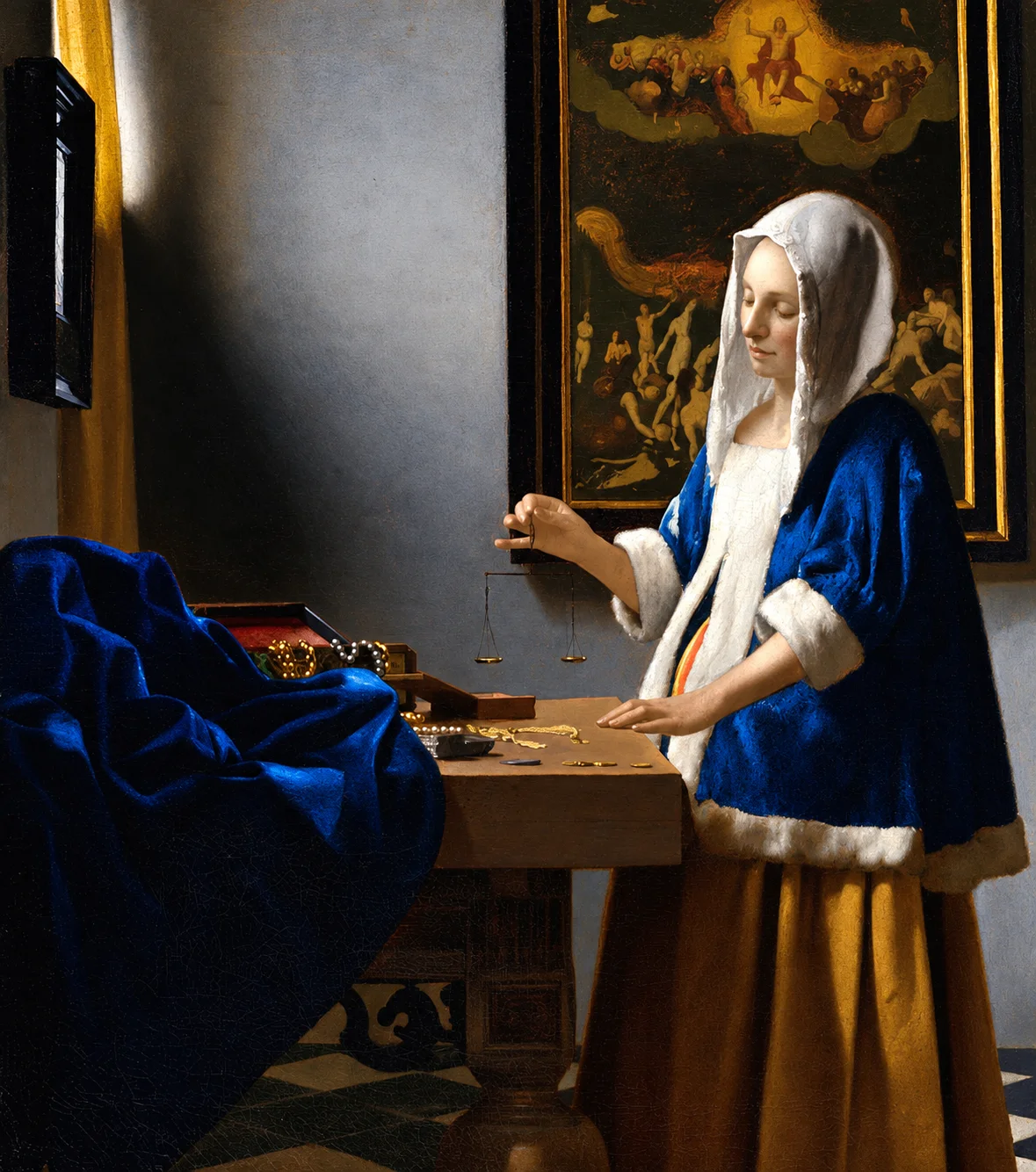
Woman Holding a Balance, painted around 1665 by Johannes Vermeer, is one of the most contemplative and symbolically rich paintings of the Dutch Golden Age. Through its delicate treatment of light, carefully arranged composition, and subtle religious symbolism, Vermeer transforms an ordinary domestic moment into a profound meditation on balance, morality, and human existence. The painting depicts a young woman standing quietly before a table, holding a small balance in her right hand while surrounded by objects associated with material wealth.
What initially appears to be a simple scene of everyday life gradually reveals a complex relationship between earthly possessions and spiritual judgment. Vermeer’s extraordinary ability to communicate meaning through silence allows the painting to invite reflection without imposing a single interpretation. Every element, from the woman’s serene expression to the dramatic religious painting behind her, contributes to an atmosphere of extraordinary stillness and psychological depth.
The Composition and Arrangement of the Scene
The composition of Woman Holding a Balance demonstrates Vermeer’s remarkable understanding of spatial harmony and visual organization. At the center stands a young woman dressed in a blue jacket trimmed with white fur, her attention directed toward the delicate balance suspended from her fingers. Her slightly bowed head and relaxed posture establish an atmosphere of peaceful concentration, suggesting that she is engaged in an activity requiring patience and careful consideration.
The surrounding objects are arranged with extraordinary precision, creating a visual relationship between the woman’s physical surroundings and the symbolic meaning of her actions. A table covered with a richly colored cloth occupies the foreground, supporting a jewelry box, pearls, and gold ornaments that represent the material pleasures of seventeenth-century Dutch society. These luxurious possessions introduce a subtle contrast between worldly abundance and the woman’s apparent emotional detachment.
Behind the figure hangs a large painting depicting the Last Judgment, a traditional Christian subject involving the final assessment of human souls. Its placement directly behind the woman creates a powerful connection between her small handheld balance and the divine judgment represented in the background. Through this arrangement, Vermeer transforms the domestic interior into a space where ordinary life and eternal spiritual concerns appear inseparably connected.
The Symbolism of the Balance
The balance held by the woman provides the painting with its central symbolic meaning. Although the surrounding jewelry might initially suggest that she is weighing valuable objects, the two pans of the balance are actually empty. This important detail shifts the interpretation away from a straightforward domestic activity and toward a more philosophical examination of judgment, moderation, and moral responsibility.
In European artistic traditions, scales frequently symbolize justice, fairness, and the weighing of human actions. Their association with divine judgment becomes particularly meaningful when considered alongside the religious painting hanging behind the woman. The small balance in her hand can therefore be understood as a visual counterpart to the spiritual judgment awaiting humanity.
However, Vermeer avoids presenting the woman as a stern moral authority. Her gentle expression and composed posture suggest an inward search for equilibrium rather than an attempt to condemn or evaluate others. The painting encourages viewers to consider whether genuine balance can be achieved by reconciling material prosperity with spiritual awareness.
The Significance of the Last Judgment Painting
The large religious painting occupying the background introduces one of the most important interpretive dimensions of Woman Holding a Balance. Although partially obscured by the woman’s figure, its imagery refers to the Christian belief that every individual will eventually face divine judgment. The dramatic subject contrasts sharply with the quiet domestic activity taking place before it.
This contrast produces a striking relationship between two different conceptions of time. The woman exists within a fleeting moment of everyday life, while the Last Judgment represents an eternal event extending beyond ordinary human experience. By placing these subjects together, Vermeer suggests that seemingly insignificant daily actions may possess lasting moral significance.
The woman’s position also strengthens the relationship between earthly and heavenly judgment. Her head appears beneath the central region of the religious composition, visually linking her personal moment of contemplation with the larger spiritual narrative. Rather than illustrating religious doctrine directly, Vermeer allows the background painting to deepen the meaning of an otherwise familiar interior scene.
The Masterful Use of Light and Shadow
Light plays an essential role in establishing the emotional atmosphere of Woman Holding a Balance. Entering through a window on the left, soft daylight illuminates the woman’s face, hands, and upper body while leaving much of the surrounding room in gentle shadow. This controlled distribution of brightness directs the viewer’s attention toward the balance and the quiet concentration of its holder.
Vermeer’s treatment of light is especially remarkable for its subtlety. The illumination does not create harsh theatrical contrasts but instead moves gradually across surfaces, revealing the textures of fabric, skin, metal, and pearls. Small highlights on the jewelry introduce delicate points of brightness that complement the softer illumination surrounding the woman.
The light also carries potential symbolic significance. Its gentle presence can be interpreted as an expression of spiritual clarity, suggesting an unseen source of wisdom illuminating the woman’s private contemplation. Yet the painting remains firmly grounded in the observation of natural daylight, demonstrating Vermeer’s ability to unite visual realism with philosophical meaning.
Color, Texture, and the Beauty of the Interior
The restrained color palette contributes significantly to the painting’s serene character. Vermeer combines deep blues, warm yellows, muted browns, and soft whites to create a harmonious interior in which no single color overwhelms the composition. The woman’s blue jacket provides a particularly important visual anchor, establishing a calm focal point against the darker background.
The luxurious fabrics and carefully rendered jewelry reveal the artist’s fascination with material textures. The white fur trimming of the jacket appears exceptionally soft, while the pearls and metallic ornaments possess delicate reflections that suggest their individual surfaces. These details communicate the prosperity associated with Dutch domestic life during the seventeenth century.
Nevertheless, the objects never become independent displays of luxury. Their visual beauty is carefully integrated into the larger meditation on material possessions and spiritual moderation. Vermeer allows viewers to appreciate the richness of the physical world while simultaneously questioning the importance assigned to wealth.
The Woman's Expression and Psychological Stillness
One of the painting’s most compelling qualities is the woman’s profound sense of inner calm. Her lowered gaze, relaxed shoulders, and delicate hand movements suggest a moment of complete absorption in her activity. Unlike figures engaged in dramatic gestures or emotional exchanges, she appears almost entirely withdrawn into her private thoughts.
This psychological stillness encourages viewers to imagine what might be passing through her mind. She may be considering the value of the objects before her, reflecting on personal responsibilities, or simply waiting for the balance to settle. Vermeer deliberately leaves her thoughts inaccessible, allowing the painting to sustain several possible interpretations.
Her apparent serenity also contrasts with the dramatic implications of the Last Judgment. While the background evokes humanity’s ultimate spiritual reckoning, the foreground presents a woman who seems entirely at peace. This relationship suggests that moderation and thoughtful self-examination may offer a path toward inner harmony.
Historical Context and Dutch Golden Age Society
Woman Holding a Balance was created during the Dutch Golden Age, a period characterized by commercial prosperity, expanding international trade, and remarkable artistic achievement. Wealthy households increasingly acquired paintings, fine textiles, jewelry, and other luxury goods as expressions of economic success and social standing. Vermeer’s domestic interiors reflect this prosperous environment while frequently exploring the private experiences of individuals living within it.
The painting’s combination of luxurious possessions and religious symbolism reflects the moral questions surrounding wealth in seventeenth-century Dutch society. Material prosperity could be celebrated as evidence of commercial achievement, but excessive attachment to possessions also raised concerns about vanity and spiritual distraction. Vermeer’s composition explores these tensions without explicitly condemning either wealth or domestic comfort.
The painting additionally reveals the importance of women within Dutch genre painting. Female figures frequently appeared in intimate interiors, engaged in activities such as reading, writing, music, and household management. Vermeer distinguishes his subject by presenting her quiet concentration as an experience worthy of serious artistic and philosophical attention.
The Enduring Meaning of Woman Holding a Balance
The enduring fascination of Woman Holding a Balance lies in its ability to transform a modest domestic moment into a timeless reflection on human values. Through the relationship between empty scales, luxurious jewelry, and the Last Judgment, Vermeer raises questions about the proper relationship between material possessions and spiritual responsibility. His carefully balanced composition reinforces these ideas through visual harmony rather than explicit moral instruction.
The painting remains remarkably relevant because the tensions it explores continue to shape human experience. Questions about wealth, personal priorities, judgment, and inner peace are not confined to seventeenth-century Dutch society. Viewers can recognize something of their own lives in the woman’s quiet attempt to maintain equilibrium amid competing values.
Ultimately, Woman Holding a Balance stands as one of Johannes Vermeer’s most sophisticated achievements. Its extraordinary treatment of light, restrained emotional atmosphere, and carefully constructed symbolism demonstrate how a seemingly ordinary scene can contain profound philosophical significance. By inviting viewers to pause before an image of perfect stillness, Vermeer reminds us that genuine balance may emerge not from the accumulation of possessions but from the thoughtful examination of what truly matters.