The Lacemaker by Johannes Vermeer: Vibrant Color Edit
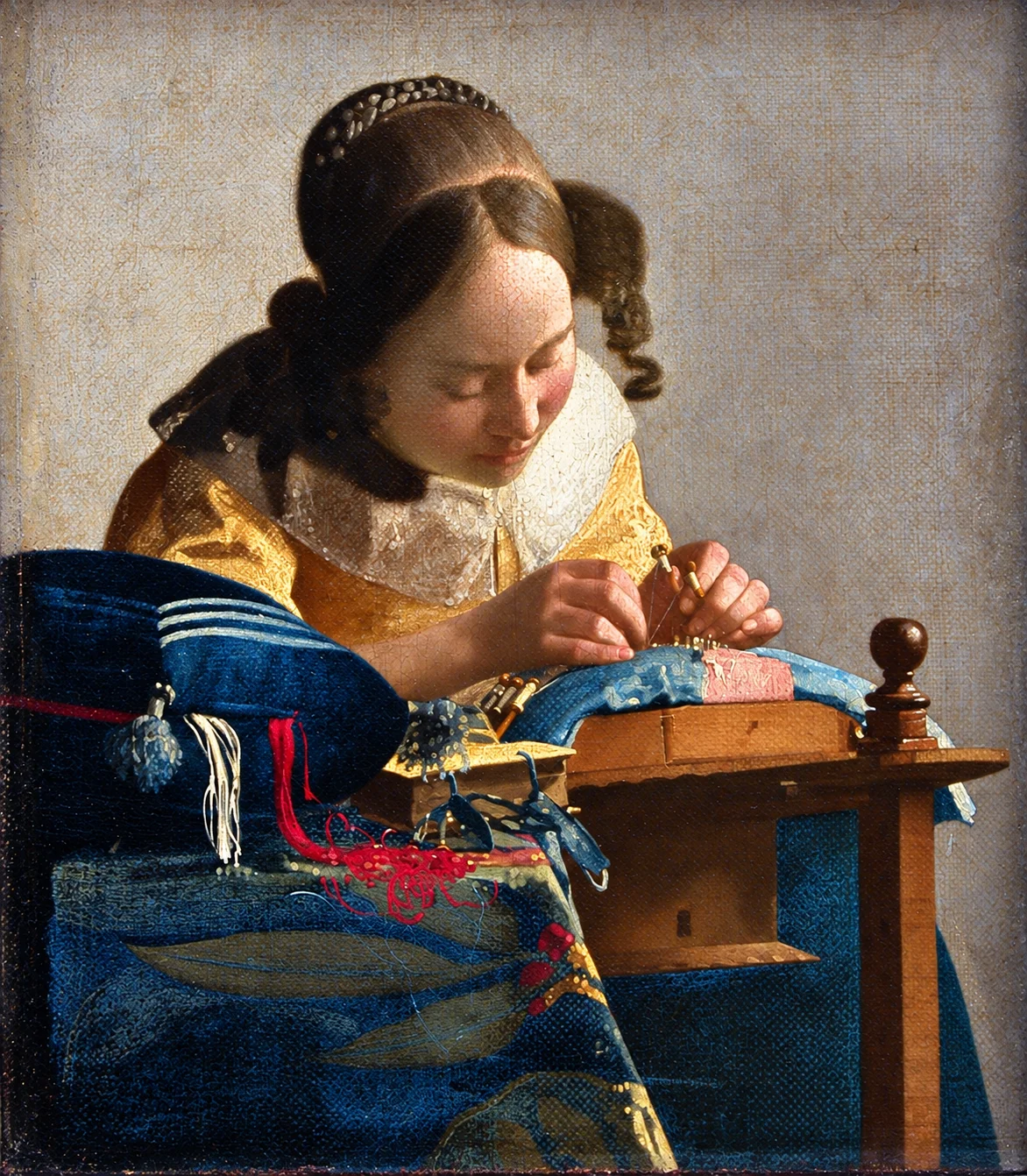
Free to Download & Reuse: You are welcome to use this image! If you republish or share it online, you must include a direct link back to this webpage for attribution.
Original Image Source: wikiart.org
Introduction to The Lacemaker by Johannes Vermeer
The Lacemaker, painted around 1669 to 1670 by the Dutch master Johannes Vermeer, is one of the most intimate and captivating paintings of the Dutch Golden Age. Despite its remarkably small dimensions, the artwork demonstrates Vermeer’s extraordinary ability to transform an ordinary domestic activity into a scene of quiet beauty and psychological depth. Through his delicate treatment of light, carefully balanced colors, and remarkable attention to detail, Vermeer invites viewers to appreciate the dignity of everyday labor and the peaceful intensity of human concentration.
The painting depicts a young woman absorbed in the intricate process of making lace, a skilled craft that required patience, precision, and considerable manual dexterity. Rather than presenting an elaborate interior or a dramatic narrative, Vermeer focuses almost entirely on the woman’s activity, creating an unusually close relationship between the viewer and the subject. This simplicity gives The Lacemaker its enduring appeal, demonstrating how a seemingly insignificant moment can become a profound artistic statement.
Historical Context of The Lacemaker
Johannes Vermeer created The Lacemaker during the later years of his artistic career, when the Dutch Republic was experiencing remarkable economic prosperity and cultural development. The seventeenth century witnessed a flourishing of Dutch painting, with artists increasingly turning their attention toward domestic interiors, everyday activities, and scenes of middle-class life. These subjects reflected the growing importance of private households and the appreciation of ordinary experiences within Dutch society.
Lacemaking was a particularly significant activity during this period, as finely crafted lace was a fashionable and valuable commodity. Producing lace required exceptional concentration and considerable time, making it both a practical skill and a symbol of patience and discipline. Young women were frequently taught needlework and related crafts as part of their domestic education, and these activities could carry associations with diligence, virtue, and respectable behavior.
Vermeer’s decision to portray a lacemaker reflects his broader fascination with women engaged in quiet domestic pursuits. Other paintings, including The Milkmaid and Woman Holding a Balance, similarly elevate ordinary activities through carefully constructed compositions and subtle psychological observation. In The Lacemaker, however, Vermeer moves closer to his subject than in many of his other works, creating an especially intimate portrait of focused human activity.
Composition and the Intimacy of the Scene
One of the most striking characteristics of The Lacemaker is its tightly concentrated composition. The young woman occupies much of the pictorial space, seated behind a small worktable with her body leaning slightly forward. Her lowered head and attentive expression direct the viewer’s gaze toward the delicate work unfolding beneath her hands.
Unlike many of Vermeer’s interior paintings, which feature windows, tiled floors, furniture, and carefully arranged architectural elements, The Lacemaker contains almost no distracting background details. The pale wall behind the figure provides a neutral setting that emphasizes her silhouette and strengthens the sense of intimacy. This restrained approach allows the viewer to concentrate entirely on the woman’s expression, posture, and delicate movements.
The composition is organized around a subtle downward movement, beginning with the woman’s head and continuing through her shoulders toward her working hands. Her fingers become the visual center of the painting, surrounded by small tools, threads, and the partially completed lace. This carefully controlled arrangement creates a sense of harmony between the woman’s physical posture and her mental concentration.
Vermeer also introduces a fascinating contrast between the rounded forms of the woman’s head and shoulders and the angular structure of the worktable. These opposing shapes establish a balanced composition without disrupting the painting’s peaceful atmosphere. Every element contributes to the impression that the viewer is witnessing a private moment of extraordinary stillness.
The Use of Light and Color
Light plays an essential role in establishing the delicate atmosphere of The Lacemaker. Vermeer employs soft, diffused illumination that gently defines the woman’s face, clothing, and hands without creating harsh contrasts. This subtle lighting gives the painting a warm, natural appearance while reinforcing the sense of quiet concentration.
The woman’s yellow bodice is particularly important to the painting’s visual identity. Its rich golden tones create a luminous focal point against the pale background, bringing warmth and vitality to the otherwise restrained composition. The fabric’s carefully observed folds suggest Vermeer’s fascination with the relationship between light, color, and material texture.
Deep blue accents along the woman’s clothing provide a beautiful contrast with the yellow fabric. This combination of complementary visual elements gives the painting a distinctive richness while maintaining its overall harmony. Vermeer’s careful distribution of color ensures that no individual detail overwhelms the central subject.
Small touches of red introduce another important dimension to the composition. The red threads spilling from the sewing cushion in the foreground provide a vivid accent that draws attention toward the woman’s working area. Their irregular arrangement creates a dynamic contrast with the controlled precision of the lacemaking process.
The Remarkable Representation of Concentration
Perhaps the most compelling aspect of The Lacemaker is Vermeer’s extraordinary ability to portray concentration. The young woman’s eyes are lowered toward her work, while her slightly inclined head suggests complete absorption in the delicate task before her. Her expression is neither theatrical nor emotionally exaggerated, yet it communicates an unmistakable sense of mental engagement.
The woman’s hands are equally important to this psychological portrayal. Positioned close together, they suggest the careful manipulation of threads and tools required to create intricate lace patterns. Vermeer captures a moment when physical skill and intellectual attention appear perfectly united.
This emphasis on concentration distinguishes The Lacemaker from conventional portraits of fashionable women or idealized domestic scenes. The subject is not concerned with her appearance or with acknowledging the viewer’s presence. Instead, she exists entirely within her own activity, creating the impression of an authentic moment observed without interruption.
There is something deeply contemplative about this representation of skilled labor. The woman’s concentration suggests patience, discipline, and a quiet determination that transcends the immediate task. Through this understated psychological observation, Vermeer transforms a domestic craft into a meditation on human attention and dedication.
Vermeer's Painting Technique and Attention to Detail
The technical sophistication of The Lacemaker becomes especially apparent when examining Vermeer’s treatment of different surfaces and textures. Although the painting is relatively small, measuring approximately 24.5 by 21 centimeters, it contains an extraordinary variety of painterly effects. Vermeer combines carefully defined forms with areas of remarkably loose and expressive brushwork.
The woman’s face and hands receive delicate modeling that establishes their importance within the composition. Subtle transitions between light and shadow create a convincing sense of volume, while restrained highlights suggest the softness of human skin. These carefully controlled effects demonstrate Vermeer’s ability to communicate physical presence through minimal visual information.
In contrast, the threads and textiles in the foreground are rendered with a surprisingly fluid technique. The red and white threads appear as small streams of paint, suggesting their movement and texture without defining every individual strand. This approach creates a fascinating contrast between the precision of the woman’s activity and the apparent spontaneity of Vermeer’s brushwork.
Scholars have frequently discussed Vermeer’s possible use of optical devices, including the camera obscura, to study light and visual perception. Certain passages in The Lacemaker, particularly the softly blurred foreground details, have encouraged comparisons with optical effects produced by lenses. Although the exact role of such devices in Vermeer’s working process remains debated, the painting clearly demonstrates his exceptional sensitivity to the behavior of light and focus.
Symbolism and the Meaning of Lacemaking
Beyond its immediate depiction of domestic craftsmanship, The Lacemaker carries several possible symbolic interpretations. In seventeenth-century Dutch culture, needlework and lacemaking were often associated with feminine virtue, patience, and disciplined behavior. A woman diligently engaged in such work could therefore represent ideals of industriousness and domestic responsibility.
The woman’s complete absorption in her task reinforces these associations. Her modest posture, restrained expression, and careful movements suggest an individual devoted to productive activity rather than frivolous entertainment. Vermeer’s portrayal can consequently be understood as a celebration of diligence and the moral value traditionally attached to skilled domestic labor.
Nevertheless, the painting’s meaning extends beyond conventional interpretations of feminine virtue. By presenting the lacemaker with such dignity and artistic seriousness, Vermeer elevates her activity into something worthy of sustained contemplation. The painting encourages viewers to recognize beauty in concentration itself, regardless of the apparent simplicity of the task being performed.
The intricate threads also offer a possible metaphor for artistic creation. Just as the lacemaker transforms individual strands into a complex and harmonious pattern, Vermeer organizes colors, shapes, and brushstrokes into a unified visual composition. Both activities demand patience, technical mastery, and a sensitivity to subtle relationships between individual elements.
The Relationship Between Art and Everyday Life
A defining achievement of Johannes Vermeer’s art is his ability to reveal extraordinary beauty within ordinary human experiences. The Lacemaker exemplifies this artistic philosophy by presenting an activity that might otherwise pass unnoticed. Through careful observation and compositional refinement, Vermeer transforms a domestic moment into an enduring work of art.
The painting also creates an interesting relationship between the viewer and the young woman. Because she is completely absorbed in her work, viewers can observe her without encountering a returning gaze. This absence of direct interaction establishes a contemplative atmosphere, encouraging patient observation rather than emotional confrontation.
The stillness of the composition contributes to its remarkable sense of timelessness. Although the clothing and lacemaking equipment belong to seventeenth-century Dutch society, the experience of becoming deeply absorbed in a demanding activity remains universally recognizable. This connection between historical specificity and enduring human experience helps explain the painting’s continued relevance.
The Legacy and Artistic Importance of The Lacemaker
Today, The Lacemaker belongs to the collection of the Louvre Museum in Paris, where it is admired as one of Vermeer’s most refined achievements. Its intimate scale distinguishes it from many larger masterpieces, yet its artistic sophistication demonstrates that physical dimensions have little relationship to emotional or aesthetic significance. The painting remains a celebrated example of the Dutch master’s ability to combine technical brilliance with profound sensitivity toward ordinary life.
Vermeer’s reputation experienced a significant revival during the nineteenth century, when art historians and collectors began to recognize the exceptional quality of his relatively small surviving body of work. Paintings such as The Lacemaker attracted admiration for their luminous colors, carefully controlled compositions, and extraordinary representation of quiet psychological states. These qualities continue to influence interpretations of Vermeer as one of the most perceptive observers of domestic life in European art.
The painting also anticipates later artistic interests in visual perception and selective focus. Its blurred foreground threads, precise central details, and delicate transitions between colors demonstrate an approach to representation that feels remarkably sophisticated even by modern standards. Vermeer’s willingness to combine optical observation with expressive brushwork contributes to the painting’s lasting fascination.
Conclusion: The Enduring Beauty of The Lacemaker
The Lacemaker by Johannes Vermeer is a masterpiece of intimacy, concentration, and understated elegance. Through its harmonious composition, luminous yellow and blue palette, delicate lighting, and extraordinary representation of skilled craftsmanship, the painting transforms an everyday domestic activity into a profound celebration of human attention. Its beauty emerges not from dramatic events or elaborate symbolism, but from the quiet dignity of a young woman completely absorbed in her work.
The painting ultimately reminds viewers that artistic significance can be discovered in the smallest moments of ordinary existence. Vermeer’s extraordinary sensitivity to light, texture, and psychological presence allows the lacemaker’s simple activity to acquire a timeless quality. More than three centuries after its creation, The Lacemaker continues to captivate audiences through its remarkable combination of visual delicacy, technical mastery, and peaceful contemplation.