The Music Lesson by Johannes Vermeer: Vibrant Color Edit
Free to Download & Reuse: You are welcome to use this image! If you republish or share it online, you must include a direct link back to this webpage for attribution.
Original Image Source: wikiart.org
Introduction to The Music Lesson by Johannes Vermeer
The Music Lesson, painted around 1662 to 1665 by the Dutch master Johannes Vermeer, is one of the most captivating examples of seventeenth-century Dutch genre painting. Known for his extraordinary ability to capture light, atmosphere, and quiet moments of everyday life, Vermeer transforms a seemingly ordinary musical encounter into a sophisticated exploration of human relationships. Through carefully arranged objects, subtle gestures, and remarkable attention to perspective, the artist invites viewers into an elegant domestic interior filled with mystery and unspoken emotion.
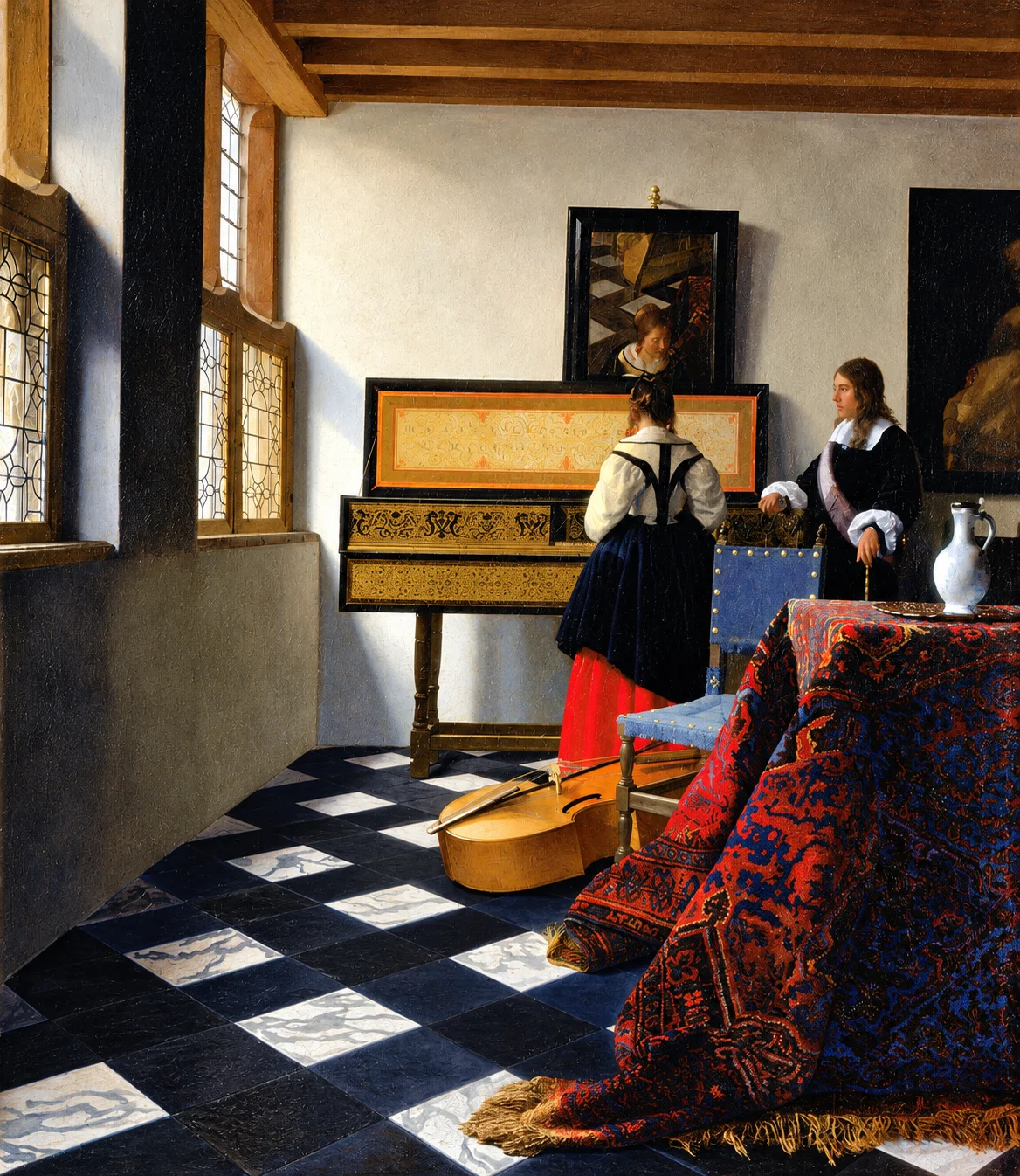
At first glance, the painting depicts a young woman playing a virginal, a keyboard instrument popular in wealthy Dutch households, while a gentleman stands beside her. However, beneath this peaceful scene lies a complex interplay of romantic symbolism, social conventions, and artistic illusion. Every element, from the marble floor to the mirror above the instrument, contributes to the painting’s fascinating psychological atmosphere.
The Composition and Arrangement of the Interior
One of the most striking characteristics of The Music Lesson is its carefully structured composition, which guides the viewer’s attention toward the two figures positioned near the back wall. Vermeer places the observer at a considerable distance from the musicians, creating an impression of quietly witnessing a private moment. This spatial separation enhances the painting’s intimacy while introducing an intriguing sense of emotional restraint.
The composition relies heavily on geometric relationships, particularly the strong diagonal lines formed by the tiled floor and the positioning of the furniture. These architectural elements draw the eye toward the virginal, where the young woman stands with her back partially turned toward the viewer. Meanwhile, the gentleman’s upright posture establishes a visual contrast with the woman’s absorbed concentration.
In the foreground, a richly patterned carpet covers a substantial table, introducing texture and visual complexity into the otherwise orderly room. A white ceramic jug rests upon a silver tray, providing another focal point that balances the distant human figures. Together, these carefully positioned objects demonstrate Vermeer’s mastery of arranging ordinary household possessions into a harmonious visual structure.
The Masterful Use of Natural Light
Light plays a central role in The Music Lesson, as it does throughout Vermeer’s artistic career. Sunlight enters through the windows on the left, illuminating the room with a soft, diffused glow that gently reveals architectural details and the surfaces of objects. Rather than creating dramatic contrasts, Vermeer uses controlled illumination to establish an atmosphere of serenity and contemplation.
The light falls particularly beautifully across the white wall, where subtle variations in brightness create a convincing impression of depth. The polished floor reflects portions of the surrounding interior, further emphasizing the artist’s fascination with the interaction between illumination and physical surfaces. Even the dark clothing of the gentleman contains delicate tonal variations that prevent his figure from appearing flat or disconnected from the surrounding space.
Vermeer’s treatment of light also contributes to the painting’s emotional character. The gentle illumination suggests the passage of an ordinary afternoon, yet its carefully orchestrated beauty elevates the moment beyond everyday experience. Through this transformation, the artist demonstrates how familiar domestic scenes can become profound meditations on perception and human connection.
The Symbolism of Music and Romantic Relationships
During the Dutch Golden Age, music frequently appeared in paintings as a symbol of harmony, courtship, and romantic attraction. In The Music Lesson, the presence of the virginal suggests more than an educational activity, potentially alluding to the developing emotional relationship between the two figures. The gentleman’s attentive presence beside the young woman encourages viewers to consider whether their interaction involves musical instruction, romantic interest, or both.
The inscription on the virginal introduces another layer of meaning. Translated from Latin, its message suggests that music accompanies joy and provides comfort during sorrow, connecting musical expression with the broader emotional experiences of human life. This sentiment reinforces the possibility that the painting explores the relationship between affection, emotional harmony, and personal happiness.
Nevertheless, Vermeer deliberately avoids providing a definitive explanation of the figures’ relationship. Their restrained gestures and lack of obvious physical contact preserve an atmosphere of ambiguity that invites interpretation. This uncertainty is essential to the painting’s enduring fascination, allowing viewers to discover different emotional narratives within the same quiet scene.
The Mirror and the Mystery of Perception
Among the painting’s most intriguing details is the rectangular mirror hanging above the virginal. Although the young woman faces away from the viewer, the mirror reveals a partial reflection of her face, creating an unexpected connection between the visible and hidden aspects of the scene. This clever compositional device demonstrates Vermeer’s sophisticated understanding of reflection and visual perception.
The mirror also raises questions about the relationship between appearances and reality. While the woman’s posture suggests concentration on her musical performance, her reflected face introduces a more complicated psychological dimension. The viewer becomes aware that the painting contains perspectives and emotional possibilities that cannot be understood through direct observation alone.
Furthermore, the mirror reflects part of the room, including a portion of the artist’s carefully constructed spatial environment. This subtle visual effect reinforces the painting’s exploration of representation itself. Vermeer encourages viewers to recognize that a painting is simultaneously a convincing illusion of reality and a deliberately arranged artistic creation.
Color, Texture, and Material Beauty
Vermeer’s restrained but sophisticated color palette is another defining feature of The Music Lesson. Warm golden tones, muted browns, delicate whites, and cool bluish shadows establish a harmonious relationship between the figures and their surroundings. Rather than overwhelming the composition with intense colors, the artist relies on carefully balanced tonal relationships to create visual richness.
The contrasting textures of the interior reveal Vermeer’s exceptional observational abilities. The marble floor appears smooth and polished, while the richly woven carpet displays a heavier, more tactile quality. The woman’s clothing, the gentleman’s dark attire, and the reflective surfaces of the musical instrument each receive distinctive treatment appropriate to their materials.
The painting’s decorative objects also suggest the prosperity of the household. Imported carpets, elegant furnishings, and musical instruments were associated with cultivated taste and financial comfort in seventeenth-century Dutch society. By including these possessions, Vermeer situates the scene within a refined domestic environment while subtly exploring the relationship between material wealth and cultural accomplishment.
Perspective and the Illusion of Space
The extraordinary sense of depth in The Music Lesson reflects Vermeer’s careful attention to linear perspective. The black-and-white floor tiles establish a geometric framework that directs the viewer’s gaze toward the rear of the room. Their diminishing proportions create a convincing illusion of distance, making the painted interior appear almost physically accessible.
The placement of the table in the foreground strengthens this spatial effect by establishing several distinct planes within the composition. Between the observer and the musicians lies a substantial area of open floor, emphasizing the separation between the viewer’s world and the private activity unfolding beyond it. This arrangement creates a subtle sense of theatrical staging without sacrificing the naturalism of the scene.
Scholars have frequently discussed Vermeer’s possible use of optical devices, particularly the camera obscura, to assist his observations of light and perspective. Although the precise extent of his reliance on such instruments remains uncertain, The Music Lesson demonstrates an extraordinary sensitivity to optical effects. Its carefully controlled geometry and luminous atmosphere reveal an artist deeply interested in the relationship between vision and artistic representation.
The Social and Cultural Context of the Dutch Golden Age
The Music Lesson reflects the cultural sophistication of the Dutch Republic during the seventeenth century, when growing commercial prosperity encouraged an expanding market for domestic paintings. Wealthy merchants and educated households increasingly commissioned or purchased artworks depicting everyday activities, elegant interiors, and scenes of refined leisure. Vermeer’s paintings belong to this artistic tradition while distinguishing themselves through their unusual stillness and psychological subtlety.
Music occupied an important position in the social lives of prosperous Dutch families. Learning to play an instrument was considered a desirable accomplishment, particularly for young women whose education often included artistic and cultural pursuits. The virginal therefore represents both personal refinement and participation in the social expectations of the period.
However, Vermeer’s treatment of the subject extends beyond a straightforward celebration of domestic accomplishment. By introducing an enigmatic relationship between the musicians, he transforms a familiar social activity into a scene charged with emotional possibilities. The resulting painting reflects both the visible customs of Dutch society and the less easily understood experiences of individuals living within those conventions.
The Emotional Atmosphere and Vermeer's Artistic Genius
Perhaps the most remarkable quality of The Music Lesson is its ability to communicate emotional intensity through apparent stillness. Neither figure engages in an exaggerated gesture, and the room contains no obvious dramatic event. Nevertheless, the carefully arranged composition produces a quiet tension that encourages prolonged contemplation.
The distance separating the viewer from the figures contributes significantly to this atmosphere. We observe the encounter without participating in it, much as someone might glimpse a private interaction through an open doorway. This sense of separation makes the painting feel both intimate and inaccessible, suggesting that the emotional lives of others can never be completely understood.
Vermeer’s artistic genius lies in his capacity to transform such uncertainty into beauty. Through the interplay of light, perspective, symbolism, and restrained human expression, he creates a scene that remains psychologically compelling centuries after its creation. The painting demonstrates that even the simplest domestic encounter can contain extraordinary emotional and philosophical depth.
The Lasting Significance of The Music Lesson
Today, The Music Lesson is among the celebrated works in the British Royal Collection, where it continues to attract admiration for its technical refinement and mysterious atmosphere. Its enduring appeal rests not only on Vermeer’s remarkable craftsmanship but also on his ability to suggest complex human experiences without explicitly describing them. The painting rewards careful observation, revealing new relationships between its figures, objects, and architectural details.
As a masterpiece of Dutch Golden Age painting, The Music Lesson embodies Vermeer’s distinctive approach to representing domestic life. Its luminous interior, precise perspective, and subtle romantic implications demonstrate how carefully composed visual elements can communicate meanings that extend far beyond their immediate appearance. The work remains an extraordinary testament to the artist’s sensitivity to light, space, and human emotion.
Ultimately, The Music Lesson invites viewers to contemplate the delicate relationship between music, intimacy, and the mysteries of personal connection. Its serene atmosphere conceals a world of possible emotions, reminding us that moments of apparent simplicity can carry profound significance. Through his exceptional artistic vision, Johannes Vermeer transforms a quiet musical encounter into a timeless reflection on beauty, perception, and the unspoken language of human relationships.