The Little Street by Johannes Vermeer: Vibrant Color Edit
Free to Download & Reuse: You are welcome to use this image! If you republish or share it online, you must include a direct link back to this webpage for attribution.
Original Image Source: wikiart.org
Introduction to The Little Street by Johannes Vermeer
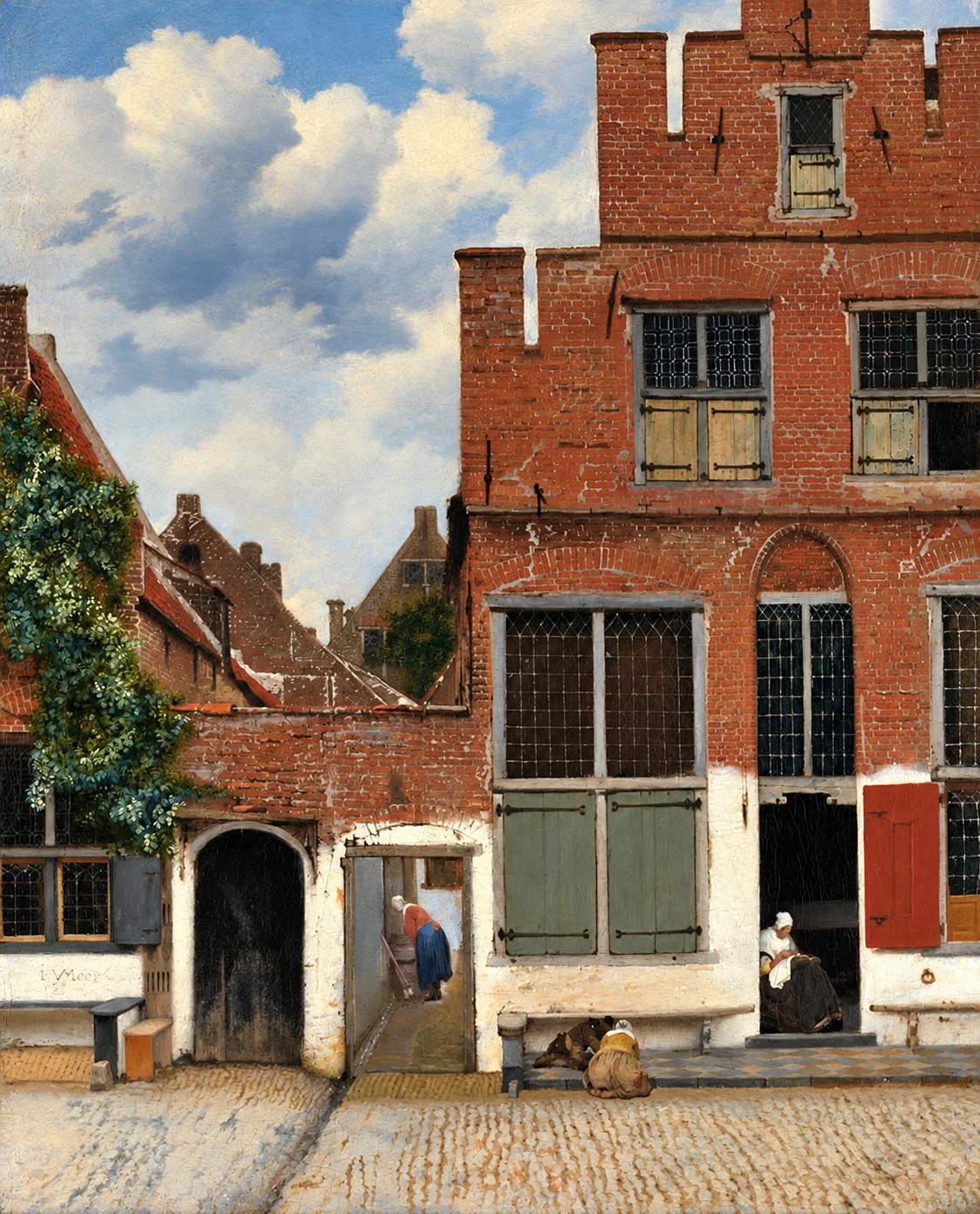
The Little Street, painted around 1658 by Johannes Vermeer, is one of the most remarkable examples of Dutch Golden Age painting. Known in Dutch as Het Straatje, this intimate masterpiece captures an ordinary residential street in Delft, transforming a seemingly unremarkable scene into a profound meditation on domestic life, architecture, and the passage of time. Through his extraordinary attention to light, texture, and composition, Vermeer reveals the quiet beauty hidden within everyday surroundings.
Unlike many of Vermeer’s celebrated interior paintings, which portray women engaged in private activities, The Little Street takes viewers outdoors. Nevertheless, the painting retains the same atmosphere of tranquility, intimacy, and psychological depth that characterizes his finest works. Its combination of architectural precision and subtle human presence creates a compelling portrait of seventeenth-century Dutch urban life.
Historical Context and the Dutch Golden Age
Johannes Vermeer created The Little Street during a period of remarkable economic prosperity and artistic achievement in the Dutch Republic. Throughout the seventeenth century, Dutch cities experienced significant commercial growth, supported by international trade, maritime expansion, and a thriving merchant class. This prosperity encouraged a flourishing art market in which paintings depicting domestic interiors, landscapes, cityscapes, and everyday activities became increasingly popular.
Delft, Vermeer’s hometown, was particularly celebrated for its distinctive architecture, picturesque canals, and artistic traditions. The city’s narrow streets, red-brick buildings, and carefully maintained residences reflected the values of its inhabitants, including their appreciation for cleanliness, domestic order, and civic responsibility. These characteristics are beautifully expressed in The Little Street, where ordinary architecture becomes the central subject of artistic contemplation.
Vermeer was approximately twenty-six years old when he painted this work, making it an important achievement in his early artistic development. Although he would eventually become famous for his luminous interior scenes, The Little Street demonstrates his equally remarkable ability to capture the atmosphere of an outdoor environment. Alongside his celebrated View of Delft, it remains one of his rare surviving paintings devoted primarily to the urban landscape.
Composition and Architectural Structure
The composition of The Little Street is distinguished by its apparent simplicity and carefully balanced arrangement of architectural forms. Two adjoining buildings dominate the scene, their weathered brick facades extending vertically across much of the canvas. The structures create a strong geometric framework, while their irregular surfaces and varied architectural details prevent the composition from appearing rigid or artificial.
On the left, a smaller building with a whitewashed facade contrasts with the larger red-brick house occupying the right side. The juxtaposition of these structures introduces an appealing diversity of colors, textures, and proportions. Their windows, doorways, and rooflines establish a subtle visual rhythm that guides the viewer’s attention across the painting.
The narrow passageway between the buildings introduces a sense of depth and mystery. Rather than revealing the entire neighborhood, Vermeer allows the passage to disappear into a secluded courtyard, encouraging viewers to imagine the domestic spaces beyond. This carefully controlled perspective creates an intimate relationship between the visible street and the hidden world of private life.
The painting’s composition also reflects Vermeer’s sophisticated understanding of visual balance. The vertical emphasis of the buildings is counteracted by the horizontal divisions of windows, brickwork, and pavement. These intersecting lines establish an underlying harmony that gives the seemingly spontaneous scene its remarkable stability.
The Masterful Use of Light and Color
One of the most captivating features of The Little Street is Vermeer’s delicate treatment of natural light. Unlike dramatic Baroque painters who frequently employed intense contrasts between illumination and darkness, Vermeer presents a softer, more diffused atmosphere. The gentle daylight reveals architectural details without overwhelming the scene or creating theatrical effects.
The dominant color palette consists of earthy reds, warm browns, muted whites, and subdued grays. These restrained tones contribute to the painting’s atmosphere of calm familiarity, while subtle variations in color bring the brick surfaces and surrounding structures to life. The reddish masonry appears particularly rich against the pale sky and whitewashed architectural elements.
Vermeer’s handling of texture is equally extraordinary. Individual bricks, irregular mortar lines, and weathered surfaces are suggested through delicate variations of pigment and carefully placed highlights. Rather than describing every architectural detail with mechanical precision, he creates a convincing impression of material reality through selective observation.
The sky occupies a relatively modest portion of the composition, yet it plays an essential role in establishing the painting’s atmosphere. Its soft, cloudy appearance provides a gentle contrast to the dense architectural forms beneath it. This understated treatment of the sky reinforces the impression of an ordinary day unfolding peacefully in Delft.
Everyday Life and the Human Figures
Although architecture dominates The Little Street, the presence of several small human figures gives the painting warmth and emotional resonance. A woman sits near an open doorway, apparently occupied with needlework or another domestic task. Her quiet concentration introduces a sense of peaceful routine, suggesting the familiar rhythms of household life.
Two children can be seen near the building’s entrance, absorbed in their own activities. Their modest presence contributes to the painting’s atmosphere of intimacy without interrupting its overall tranquility. Vermeer does not present them as dramatic protagonists, but as natural inhabitants of the environment.
Another woman appears within the narrow passageway, engaged in an ordinary household activity. Her partially concealed position creates a connection between the public street and the private courtyard beyond. Together, these figures suggest a community whose daily existence unfolds quietly within the surrounding architecture.
The absence of dramatic gestures or obvious narrative tension is particularly significant. Vermeer invites viewers to appreciate everyday life without requiring an extraordinary event to justify artistic attention. In doing so, he elevates domestic routine into a subject worthy of careful observation and lasting admiration.
Symbolism and the Meaning of Domestic Life
The Little Street can be interpreted as a celebration of domestic stability, community, and the enduring relationship between people and their surroundings. The modest houses, carefully maintained entrances, and quietly occupied inhabitants suggest a world organized around familiar responsibilities. These elements reflect values frequently associated with seventeenth-century Dutch domestic culture.
The weathered brickwork also introduces a subtle awareness of time. Cracks, uneven surfaces, and architectural repairs suggest that these buildings have experienced years of use and gradual transformation. Their imperfections give the painting historical depth, reminding viewers that ordinary places accumulate meaning through generations of human activity.
The distinction between open and closed doorways creates another intriguing dimension. Some entrances reveal glimpses of domestic activity, while others remain inaccessible to the viewer. This interplay between visibility and concealment reflects Vermeer’s recurring fascination with the boundaries separating public observation from private experience.
Nevertheless, the painting does not demand a single symbolic interpretation. Its emotional power emerges largely from the extraordinary dignity Vermeer grants to familiar surroundings. The scene encourages viewers to recognize that beauty and significance can exist within the simplest aspects of everyday existence.
Vermeer's Painting Technique and Artistic Precision
Vermeer’s technical mastery is evident in his ability to combine convincing architectural representation with a remarkably painterly surface. The brick facades display a combination of delicate detail and broader applications of pigment, creating a lively interplay between precision and suggestion. This approach allows the architecture to appear realistic without sacrificing the visual richness of the painted surface.
His treatment of perspective is especially sophisticated. Although the buildings are presented almost frontally, slight variations in architectural alignment and the recession of the passageway establish a believable sense of spatial depth. The resulting composition feels both immediate and carefully organized.
Vermeer also demonstrates exceptional sensitivity to the interaction between light and materials. Brick, plaster, wood, and stone respond differently to illumination, and these distinctions are subtly communicated through variations in color and brushwork. The result is a convincing representation of physical reality that remains unified by the painting’s harmonious atmosphere.
The artist’s ability to transform architectural irregularities into aesthetically pleasing patterns is particularly impressive. Uneven brickwork, asymmetrical windows, and worn surfaces become essential components of the composition’s beauty. Through this transformation, Vermeer demonstrates that artistic perfection does not necessarily require flawless or idealized subjects.
The Emotional Atmosphere of The Little Street
Perhaps the greatest achievement of The Little Street is its remarkable ability to evoke an atmosphere of stillness and quiet reflection. Nothing extraordinary appears to be happening, yet the painting possesses an unmistakable emotional presence. The combination of familiar architecture, gentle daylight, and modest human activity creates a powerful sense of belonging.
The scene feels almost timeless despite its unmistakably seventeenth-century setting. Viewers can recognize the universal qualities of neighborhood life, including children playing, household tasks being completed, and familiar buildings providing shelter. These ordinary experiences connect the historical world of Vermeer with contemporary ideas of home and community.
There is also a subtle melancholy in the painting’s presentation of aging architecture. The weathered surfaces suggest that buildings, like their inhabitants, are subject to gradual change. Nevertheless, the overall atmosphere remains reassuring, emphasizing continuity rather than decline.
This emotional complexity distinguishes Vermeer from painters who approached architectural subjects primarily as exercises in perspective or topographical documentation. His buildings are not simply structures occupying physical space, but places shaped by human presence and memory. Their quiet dignity gives The Little Street its enduring poetic character.
The Legacy and Significance of The Little Street
Today, The Little Street is housed in the Rijksmuseum in Amsterdam, where it is regarded as one of Vermeer’s most important masterpieces. Its reputation rests on the extraordinary combination of technical sophistication, architectural observation, and emotional subtlety. Despite its modest subject, the painting has become an iconic representation of Dutch Golden Age art.
The artwork also occupies a distinctive position within Vermeer’s surviving body of work. While his celebrated interior scenes frequently concentrate on individual figures illuminated by windows, The Little Street explores similar themes of domestic intimacy through an architectural setting. This connection demonstrates the remarkable consistency of his artistic interests across different subjects.
The painting continues to fascinate historians and art enthusiasts interested in identifying the exact location represented. Research has proposed a site on Vlamingstraat in Delft, although discussions surrounding the painting’s architectural history have contributed to its enduring scholarly appeal. These investigations demonstrate how Vermeer’s seemingly simple composition continues to inspire curiosity centuries after its creation.
Conclusion: Finding Extraordinary Beauty in Ordinary Places
Johannes Vermeer’s The Little Street remains an extraordinary celebration of everyday beauty, domestic tranquility, and the intimate character of urban life. Through carefully balanced architecture, delicate natural light, and understated human activity, Vermeer transforms an ordinary Delft street into a scene of remarkable emotional richness. Its enduring appeal lies in the artist’s ability to make the familiar appear quietly extraordinary.
The painting also reveals Vermeer’s profound sensitivity to the passage of time and the relationship between people and their surroundings. Weathered bricks, open doorways, and modest domestic activities suggest lives unfolding within buildings that preserve traces of earlier generations. These details create a sense of continuity that extends beyond the immediate moment depicted.
Ultimately, The Little Street reminds viewers that artistic beauty does not depend on grandeur, spectacle, or dramatic events. Sometimes, the most meaningful subjects are found in the quiet streets and ordinary homes that shape everyday existence. Through his extraordinary vision, Vermeer transforms such a place into an enduring masterpiece of observation, harmony, and humanity.