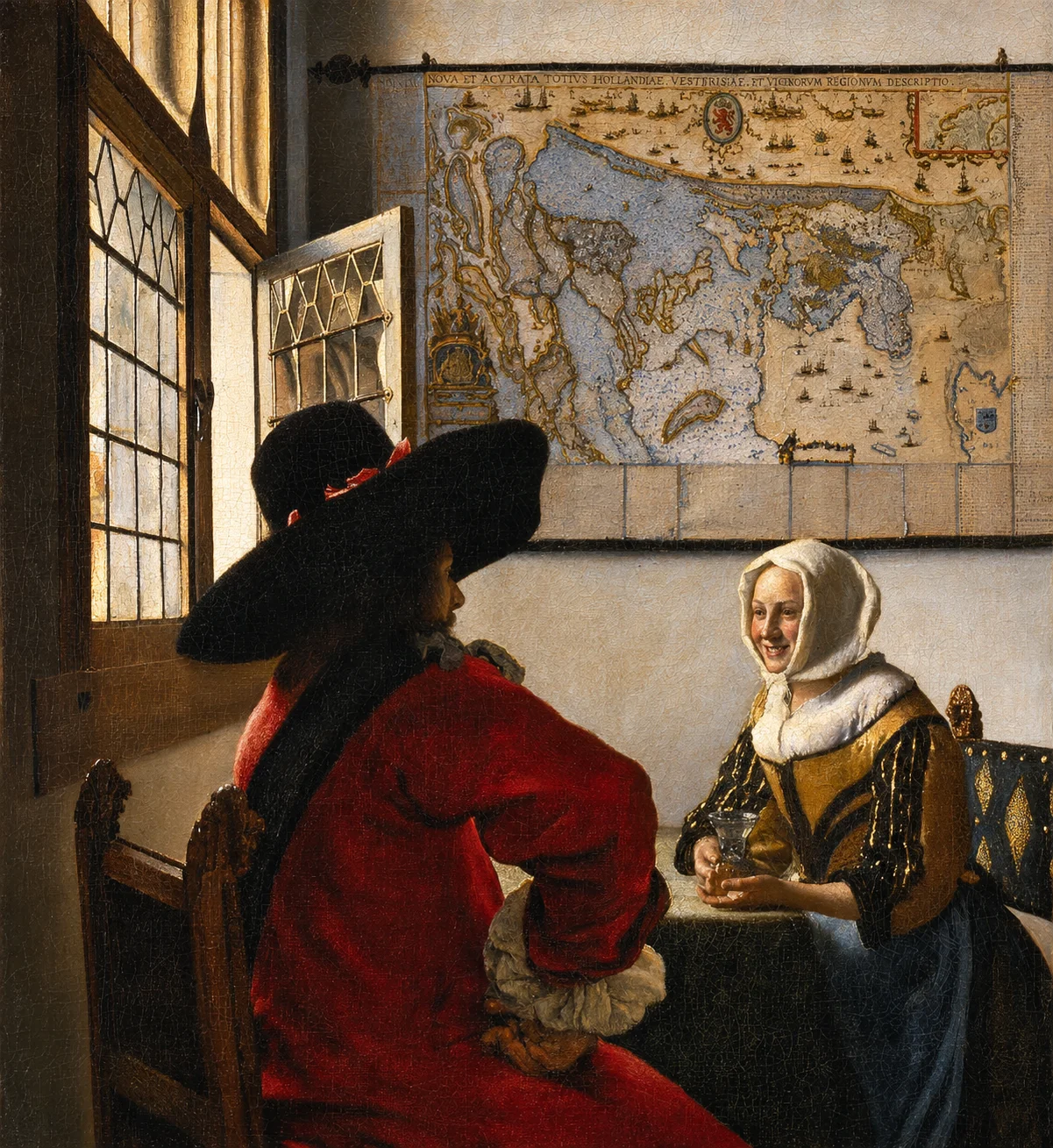
Officer and Laughing Girl by Johannes Vermeer: Vibrant Color Edit
Free to Download & Reuse: You are welcome to use this image! If you republish or share it online, you must include a direct link back to this webpage for attribution.
Original Image Source: wikiart.org
Introduction to Officer and Laughing Girl by Johannes Vermeer
Officer and Laughing Girl, painted around 1657 by Johannes Vermeer, is a remarkable example of Dutch Golden Age painting. Through his extraordinary mastery of light, perspective, and intimate human interactions, Vermeer transforms an apparently ordinary encounter into a scene filled with warmth, curiosity, and subtle psychological complexity. The painting captures a moment between a young woman and a military officer seated at a table, inviting viewers to imagine the conversation unfolding between them.
Unlike grand historical paintings or elaborate religious compositions, Vermeer’s work celebrates the beauty of everyday life. His carefully constructed interior demonstrates how ordinary domestic spaces can become settings for sophisticated artistic exploration. The mysterious relationship between the two figures, combined with the painting’s delicate lighting and intricate details, makes Officer and Laughing Girl one of the most engaging works of Vermeer’s early career.
Historical Context of Officer and Laughing Girl
Johannes Vermeer created Officer and Laughing Girl during the Dutch Golden Age, a period of remarkable economic prosperity, cultural development, and artistic innovation in the Netherlands. During the seventeenth century, the Dutch Republic emerged as a major commercial power, supported by international trade, maritime expansion, and a growing wealthy merchant class. This prosperity encouraged demand for paintings depicting domestic interiors, landscapes, portraits, and scenes from everyday life.
Vermeer lived and worked in Delft, a city known for its thriving artistic community and distinctive architectural character. His paintings frequently explore intimate domestic settings, where carefully arranged objects and figures suggest narratives without explicitly explaining them. In Officer and Laughing Girl, the artist draws upon the popular tradition of genre painting while introducing his distinctive approach to light, spatial relationships, and psychological observation.
The painting also reflects the social customs of seventeenth-century Dutch society, particularly the interactions between men and women in domestic environments. Military officers frequently appeared in Dutch genre paintings, sometimes representing courtship, wealth, or masculine confidence. Vermeer uses this familiar subject to create a more ambiguous encounter, allowing the viewer to interpret the relationship through facial expressions and body language.
Composition and Perspective in Officer and Laughing Girl
One of the most striking characteristics of Officer and Laughing Girl is its unusual composition. The officer occupies much of the foreground, his large silhouette dominating the left side of the painting. His back faces the viewer, creating the sensation that we have entered the room and are observing the conversation from a nearby position.
The young woman sits farther into the composition, appearing considerably smaller than the officer. This dramatic difference in scale demonstrates Vermeer’s sophisticated understanding of perspective and spatial depth. By placing the officer so close to the viewer, Vermeer creates an immersive experience that emphasizes the physical distance between the figures while maintaining their emotional connection.
The composition also relies on carefully balanced geometric relationships. The rectangular window, the map on the wall, and the horizontal table establish a structured architectural environment. Against these stable forms, the curved outlines of the officer’s hat and the woman’s clothing introduce movement and visual softness.
The officer’s broad hat partially interrupts the illuminated background, producing a dramatic contrast between dark and light. Meanwhile, the woman’s face becomes the natural focal point because of its brightness and expressive animation. These compositional decisions guide the viewer’s attention toward the interaction rather than the surrounding objects.
The Masterful Use of Light and Shadow
Light plays a central role in Officer and Laughing Girl, demonstrating the technical brilliance that would become synonymous with Johannes Vermeer’s paintings. Sunlight enters through the window on the left, illuminating the woman’s face, white head covering, and portions of her clothing. The soft illumination creates a convincing atmosphere while revealing subtle variations in color and texture.
The officer remains largely in shadow, establishing a striking contrast with the brightly illuminated woman. His dark silhouette frames the scene and intensifies the visual prominence of her expression. This contrast also introduces an intriguing psychological dimension, suggesting that the viewer has greater access to the woman’s emotions than to those of her companion.
Vermeer carefully observes how natural light interacts with different materials. The woman’s white linen reflects the incoming daylight, while the darker fabric of her dress absorbs much of the illumination. The window panes and surrounding wooden surfaces display delicate variations in brightness, reinforcing the sensation of a real interior filled with filtered sunlight.
Rather than relying on theatrical lighting effects, Vermeer achieves drama through subtle observation. The natural progression from illuminated surfaces to deep shadows produces a remarkably convincing sense of space. His treatment of light elevates the domestic encounter into a poetic meditation on perception and human presence.
The Officer: A Mysterious Figure in the Foreground
The officer is among the most visually commanding elements of the painting, despite the fact that his face remains largely concealed. His brilliant red coat and expansive black hat immediately attract attention, establishing his identity as a fashionable and potentially prosperous gentleman. The strong contrast between his clothing and the surrounding interior gives him considerable visual weight.
His seated posture suggests confidence and familiarity with his surroundings. Leaning toward the woman, he appears engaged in conversation, although his expression remains inaccessible to the viewer. This deliberate concealment contributes to the painting’s narrative ambiguity, encouraging speculation about his intentions.
Military figures often carried associations of adventure, courtship, and worldly experience in seventeenth-century Dutch art. The officer’s fashionable attire may suggest that he wishes to impress the young woman, particularly through his confident appearance and social presence. Nevertheless, Vermeer avoids presenting him as an unmistakable romantic hero or threatening intruder.
Instead, the officer functions as both participant and compositional device. His imposing silhouette directs attention toward the woman while creating a sense of intimacy between the viewer and the scene. By withholding his facial expression, Vermeer ensures that the emotional interpretation of the encounter depends largely on the young woman’s response.
The Laughing Girl: Expression and Psychological Depth
The young woman provides the emotional center of Officer and Laughing Girl. Her cheerful expression, animated eyes, and relaxed posture suggest that she is enjoying the conversation. Her smile introduces warmth and spontaneity into an otherwise carefully organized interior.
Vermeer’s depiction of her face demonstrates his remarkable sensitivity to fleeting human emotions. Rather than portraying a rigid or idealized expression, he captures what appears to be a moment of genuine amusement. This naturalness makes the figure approachable and gives the painting its enduring charm.
Her clothing combines modest domestic elegance with carefully observed decorative details. The white head covering frames her face, while the dark bodice and golden-toned fabric create a sophisticated interplay of colors. Her illuminated hands and the glass she holds further emphasize the relaxed social atmosphere.
The precise meaning of her laughter remains uncertain. She may be responding to a humorous remark, enjoying flirtatious conversation, or expressing simple pleasure in companionship. Vermeer deliberately leaves the narrative unresolved, allowing the woman’s expression to remain both immediately understandable and psychologically mysterious.
The Wall Map and Its Symbolic Meaning
The large map hanging behind the figures is one of the painting’s most distinctive background elements. It depicts Holland and West Friesland, reflecting the seventeenth-century Dutch fascination with geography, cartography, and international commerce. Maps were valued objects in prosperous Dutch households, serving both practical and decorative purposes.
Within Officer and Laughing Girl, the map contributes to the painting’s historical authenticity while introducing broader cultural associations. It evokes the Dutch Republic’s commercial achievements and the increasing importance of geographical knowledge during the Golden Age. Its intricate details also contrast with the simplicity of the human interaction taking place beneath it.
The map may additionally suggest connections between the intimate domestic environment and the wider world. The officer’s military identity potentially reinforces associations with travel, political authority, and experiences beyond the household. However, such interpretations remain possibilities rather than definitive explanations of Vermeer’s intentions.
Visually, the map provides an elaborate textured surface that balances the relatively plain walls and furniture. Its muted colors complement the woman’s clothing and contrast with the officer’s vivid red coat. Vermeer integrates this complex object into the composition without allowing it to distract from the figures.
Color and Texture in Vermeer's Painting
The color palette of Officer and Laughing Girl combines rich, saturated accents with restrained neutral tones. The officer’s red coat provides the strongest color statement, contrasting dramatically with his black hat and the subdued surroundings. This striking combination establishes a powerful foreground presence while enhancing the visual depth of the composition.
The woman’s clothing introduces warmer golden and earthy colors, softened by the brilliant white of her head covering. These tones harmonize with the pale wall, wooden furniture, and muted colors of the map. Vermeer’s careful distribution of color creates unity between the figures and their environment.
Texture also contributes significantly to the painting’s realism. The delicate folds of linen, heavy fabric of the officer’s clothing, and polished surfaces of the drinking vessels receive distinct treatments. These observations demonstrate Vermeer’s ability to suggest the physical qualities of materials through controlled transitions of light and color.
The painting’s surface reveals an artist interested in both precise observation and visual atmosphere. Details remain recognizable without overwhelming the composition, allowing the entire scene to feel cohesive. This balance between realism and artistic selection became a defining characteristic of Vermeer’s mature work.
The Influence of Dutch Genre Painting
Officer and Laughing Girl belongs to the tradition of Dutch genre painting, which frequently depicted ordinary social interactions within domestic interiors. Artists such as Gerard ter Borch and Pieter de Hooch explored similar themes of courtship, conversation, and everyday behavior. These paintings appealed to collectors interested in recognizable scenes filled with subtle social meanings.
Vermeer developed his distinctive artistic language within this broader tradition. Although the encounter between a fashionable gentleman and a young woman was a familiar subject, his approach emphasizes spatial perception and emotional ambiguity. The dramatic foreground figure and luminous female subject demonstrate his growing interest in sophisticated compositional effects.
The painting also reveals Vermeer’s transition toward the quiet interior scenes that would define his artistic reputation. His attention to natural light, carefully positioned figures, and domestic architecture anticipates later masterpieces such as The Milkmaid and Woman Holding a Balance. These connections make Officer and Laughing Girl particularly important for understanding his artistic development.
The Lasting Significance of Officer and Laughing Girl
Officer and Laughing Girl remains a captivating achievement because of its ability to transform an ordinary conversation into an enduring visual mystery. Vermeer provides enough information to establish a believable social encounter while withholding the details necessary to explain it completely. The viewer becomes an imaginative participant, interpreting the interaction through gestures, expressions, and spatial relationships.
The painting also demonstrates Vermeer’s remarkable talent for combining technical precision with emotional subtlety. His controlled lighting, dramatic perspective, and carefully balanced colors create a scene that feels both intimate and monumental. Every visual element contributes to the atmosphere without diminishing the apparent spontaneity of the woman’s laughter.
Today, Officer and Laughing Girl is housed in the Frick Collection in New York, where it remains an important example of seventeenth-century Dutch painting. Its enduring appeal lies in the tension between the familiar and the mysterious, inviting viewers to discover new possibilities within a seemingly simple moment. Through his extraordinary sensitivity to light and human interaction, Johannes Vermeer transformed a fleeting encounter into a timeless celebration of everyday life.