The Surrender of Breda by Diego Velázquez: Vibrant Color Edit
Free to Download & Reuse: You are welcome to use this image! If you republish or share it online, you must include a direct link back to this webpage for attribution.
Original Image Source: wikiart.org
Introduction to The Surrender of Breda by Diego Velázquez
The Surrender of Breda, painted by Diego Velázquez in 1635, is one of the most celebrated historical paintings of the Spanish Golden Age. Also known as Las Lanzas or The Lances, this monumental artwork depicts a significant military victory during the Eighty Years’ War between Spain and the Dutch Republic. Rather than presenting a conventional celebration of conquest, Velázquez transforms the surrender of a defeated city into a powerful meditation on honor, compassion, and the dignity of both victors and vanquished.
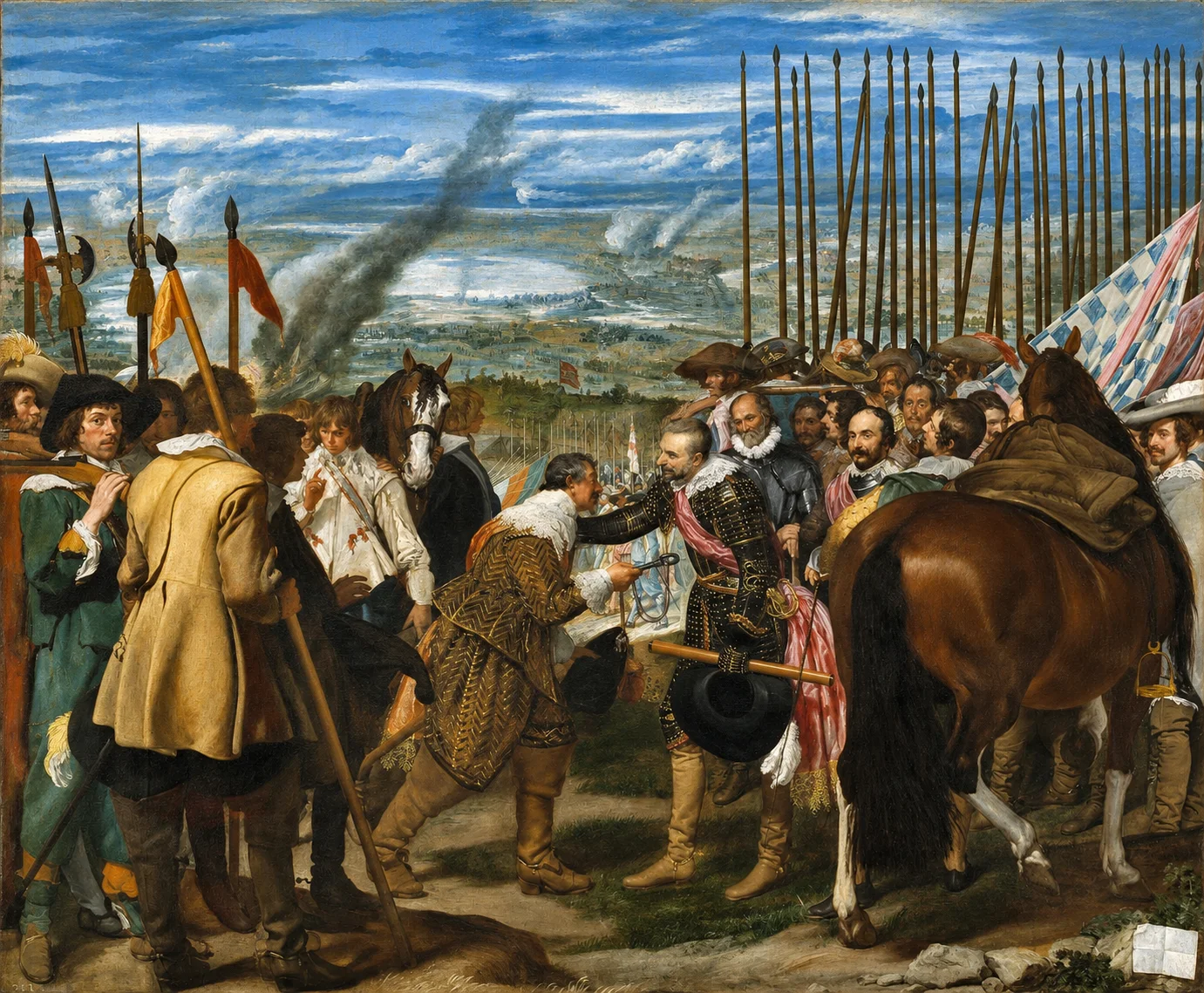
The painting captures the moment when Justinus van Nassau, the Dutch commander defending Breda, presents the city’s keys to Ambrogio Spinola, the victorious Spanish general. Through carefully orchestrated gestures, sophisticated composition, and extraordinary attention to human expression, Velázquez elevates this historical encounter beyond military triumph. The result is a remarkably humane portrayal of warfare that continues to distinguish The Surrender of Breda from other seventeenth-century battle paintings.
Historical Background: The Siege of Breda in 1625
The historical event represented in The Surrender of Breda occurred in June 1625, ten years before Velázquez completed the painting. Breda, a strategically important fortified city in the Netherlands, had been besieged by Spanish forces under the command of Ambrogio Spinola. The siege formed part of the prolonged conflict between the Spanish monarchy and the Dutch provinces struggling to maintain their independence.
After approximately nine months of resistance, the Dutch defenders were forced to surrender because of dwindling supplies and the increasingly desperate conditions within the city. Nevertheless, their determination earned considerable respect from their Spanish opponents. Spinola reportedly treated the defeated garrison with unusual generosity, allowing its soldiers to leave with military honors.
For the Spanish monarchy, the capture of Breda represented an important political and military achievement. King Philip IV sought to commemorate such victories through an ambitious decorative program for the Hall of Realms in Madrid’s Buen Retiro Palace. Velázquez’s painting was created for this prestigious setting, where it celebrated Spanish military power while emphasizing the virtues of honorable leadership.
Composition and the Dramatic Meeting of Two Commanders
One of the most remarkable aspects of The Surrender of Breda is its carefully balanced composition. Velázquez organizes the crowded scene around the intimate encounter between Justinus van Nassau and Ambrogio Spinola, positioning their interaction near the center of the canvas. Although numerous soldiers, horses, weapons, and banners surround them, the viewer’s attention naturally settles on the exchange between the two commanders.
Justinus van Nassau bends forward while offering the keys to Breda, acknowledging the defeat of his forces. Spinola responds with a surprisingly gentle gesture, placing his hand on the Dutch commander’s shoulder as though discouraging excessive humiliation. This physical interaction transforms what might have been a scene of submission into an image of mutual respect.
The contrast between the commanders’ postures establishes the painting’s emotional foundation. Nassau’s lowered body communicates surrender, while Spinola’s welcoming movement suggests generosity and restraint. Rather than glorifying the victor through exaggerated dominance, Velázquez presents military greatness as inseparable from compassion.
The Symbolism of the Lances and Military Power
The tall vertical lances rising behind the Spanish soldiers constitute one of the painting’s most recognizable visual features. Their striking arrangement gives the composition its alternative title, Las Lanzas, emphasizing their importance within the overall design. These weapons create a powerful visual rhythm that contrasts with the more irregular arrangement of banners and arms on the Dutch side.
The Spanish lances stand almost perfectly upright, suggesting discipline, organization, and military strength. Their repetition produces an imposing background that reinforces the authority of Spinola’s victorious army. By comparison, the Dutch soldiers occupy a visually less orderly space, where angled weapons and varied postures suggest the exhaustion and disruption associated with defeat.
Nevertheless, Velázquez avoids reducing the Dutch soldiers to powerless figures. Their individualized faces, dignified clothing, and composed expressions preserve their humanity. The painting therefore communicates Spanish superiority without denying the courage or personal worth of the opposing forces.
Light, Color, and the Artistic Technique of Velázquez
Velázquez’s exceptional command of light and color contributes enormously to the painting’s visual sophistication. The foreground contains rich combinations of earthy browns, muted golds, silvery whites, and dark greens, while the distant landscape dissolves into delicate shades of blue and gray. This restrained palette produces a convincing atmosphere and prevents the crowded composition from becoming visually overwhelming.
Light falls selectively across the central figures, illuminating their faces, clothing, and gestures. Nassau’s intricately patterned coat and Spinola’s dark armor demonstrate Velázquez’s ability to distinguish contrasting materials through subtle variations in texture and reflected light. The luminous highlights surrounding the commanders further emphasize the symbolic importance of their meeting.
The artist’s brushwork combines careful observation with remarkable freedom. Certain passages contain detailed descriptions of fabric, metal, and human features, while distant soldiers and buildings are represented through increasingly loose applications of paint. This variation creates a natural sense of depth and anticipates qualities that later artists, particularly the Impressionists, would admire in Velázquez’s technique.
The Landscape and Atmospheric Perspective
Beyond the assembled soldiers stretches an expansive landscape marked by military activity, fortifications, drifting smoke, and distant terrain. This background establishes the geographical and historical context of the surrender while demonstrating Velázquez’s sophisticated understanding of atmospheric perspective. The battlefield gradually disappears beneath a luminous, cloud-filled sky, creating an extraordinary sense of spatial distance.
The rising smoke provides a reminder of the violence that preceded the peaceful exchange in the foreground. Although the central scene emphasizes reconciliation, the distant landscape reveals the destructive consequences of prolonged warfare. Velázquez therefore maintains an important tension between the immediate humanity of the commanders and the broader devastation surrounding them.
The enormous sky also contributes to the painting’s emotional atmosphere. Its shifting clouds and subdued illumination introduce a sense of calm after conflict, suggesting that the surrender represents a moment of transition rather than merely the conclusion of a military campaign. Through this atmospheric treatment, the artist gives the historical event an almost contemplative quality.
Human Dignity and the Meaning of Victory
The central theme of The Surrender of Breda is the relationship between military victory and human dignity. Unlike many traditional depictions of conquest, which celebrate domination through humiliation or violence, Velázquez emphasizes the moral responsibility of the victorious commander. Spinola’s respectful treatment of Nassau becomes the defining action of the painting.
This interpretation reflects the ideals of honorable warfare promoted within aristocratic military culture during the seventeenth century. Courage, generosity, self-control, and respect for worthy opponents were considered essential qualities of distinguished commanders. Velázquez presents these values through natural human gestures rather than elaborate allegorical symbols.
The painting also invites viewers to consider the shared humanity of opposing armies. Despite their political differences, the Spanish and Dutch soldiers appear as individuals experiencing the consequences of the same conflict. Their varied expressions suggest fatigue, pride, uncertainty, and relief, transforming a historical victory into a broader reflection on the emotional realities of war.
Portraiture, Realism, and Individual Character
Another distinctive feature of The Surrender of Breda is Velázquez’s extraordinary ability to give individual personalities to the figures surrounding the central encounter. Rather than treating the soldiers as anonymous decorative elements, he presents them with recognizable expressions, distinctive clothing, and convincing physical presence. Several figures look outward toward the viewer, establishing a subtle connection between the historical event and the audience observing it.
The soldier at the far left, wearing a dark hat and looking directly toward the viewer, is particularly memorable. His attentive expression interrupts the narrative and encourages viewers to imagine themselves witnessing the surrender. This technique strengthens the painting’s realism and prevents the scene from feeling like a distant theatrical reconstruction.
Velázquez’s sensitivity to character reflects his wider achievements as a portrait painter at the Spanish royal court. His ability to capture psychological complexity through seemingly effortless observation gives the commanders and soldiers an unusual degree of authenticity. Even within a monumental historical composition, individual humanity remains central to his artistic vision.
The Surrender of Breda and Spanish Golden Age Painting
Created during the height of Spain’s artistic Golden Age, The Surrender of Breda demonstrates the extraordinary sophistication of seventeenth-century Spanish painting. Velázquez combines the grandeur expected of royal commissions with an innovative approach to historical storytelling. Instead of relying on exaggerated heroism, dramatic violence, or supernatural symbolism, he grounds the painting in believable human interaction.
The artwork also reveals the influence of European artistic traditions, particularly the naturalism associated with Caravaggio and the monumental compositions of Renaissance masters. Nevertheless, Velázquez develops a distinctive visual language characterized by atmospheric subtlety, restrained emotion, and remarkable psychological insight. These qualities distinguish his work from more theatrical examples of Baroque history painting.
Today, The Surrender of Breda belongs to the collection of the Museo del Prado in Madrid, where it remains among the institution’s most admired masterpieces. Its historical importance, artistic innovation, and profound emotional sensitivity continue to attract visitors and scholars from around the world.
Conclusion: The Enduring Legacy of The Surrender of Breda
Diego Velázquez’s The Surrender of Breda stands as one of the greatest achievements of historical painting. Through its masterful composition, atmospheric landscape, expressive figures, and sophisticated symbolism, the artwork transforms a seventeenth-century military victory into a timeless exploration of honor and compassion. Every element, from the disciplined Spanish lances to the respectful exchange between the commanders, contributes to its remarkable narrative power.
What makes the painting particularly memorable is its refusal to portray victory solely through domination. Velázquez recognizes that genuine greatness can emerge through generosity toward a defeated opponent, presenting restraint and mutual respect as qualities worthy of celebration. Nearly four centuries after its creation, The Surrender of Breda continues to demonstrate how art can preserve historical events while revealing universal truths about human dignity, leadership, and the consequences of war.