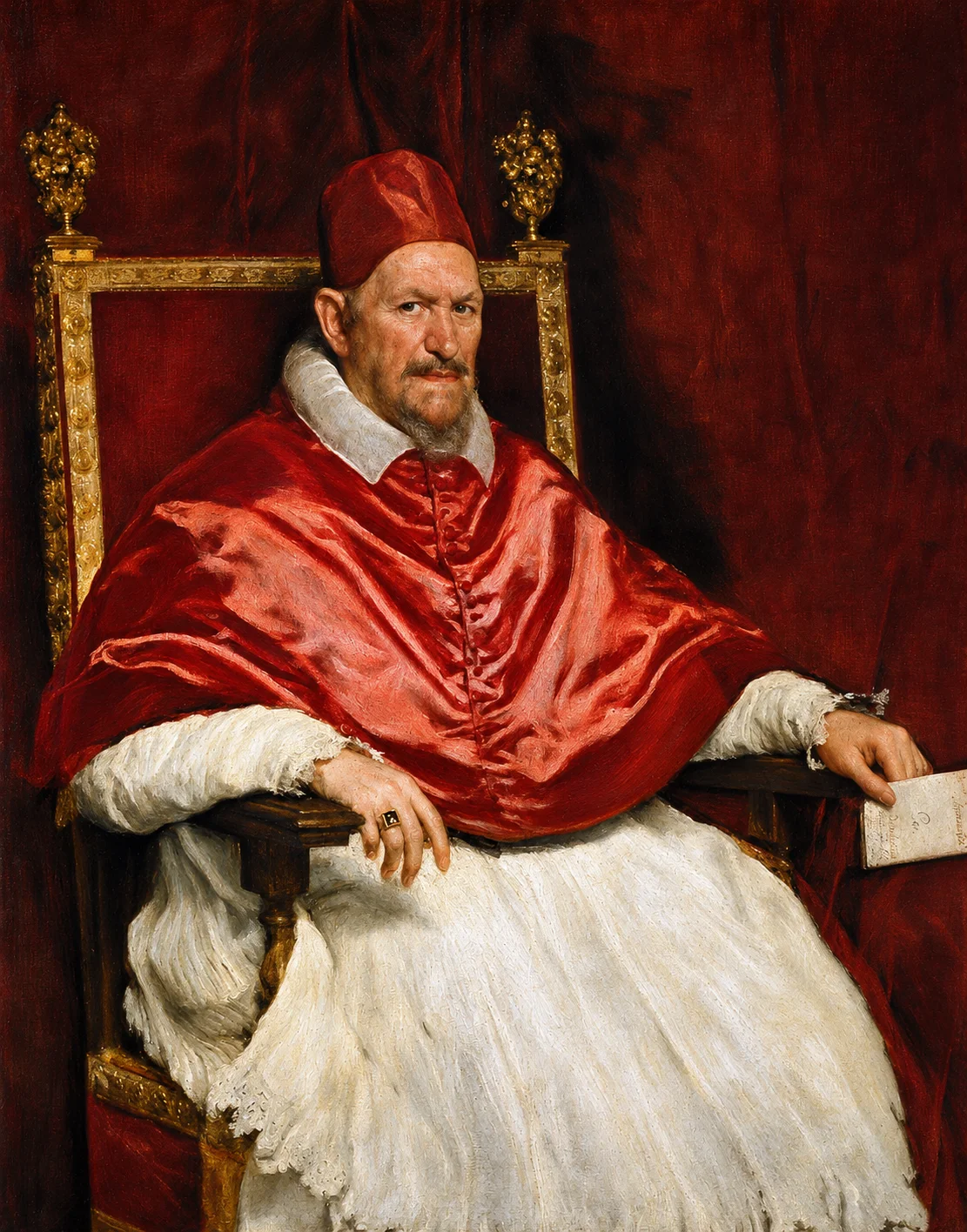
Portrait of Pope Innocent X by Diego Velázquez: Vibrant Color Edit
Free to Download & Reuse: You are welcome to use this image! If you republish or share it online, you must include a direct link back to this webpage for attribution.
Original Image Source: wikiart.org
Introduction to Portrait of Pope Innocent X by Diego Velázquez
Portrait of Pope Innocent X, painted in 1650 by the Spanish Baroque master Diego Velázquez, stands among the most extraordinary portraits in Western art history. Celebrated for its remarkable realism, psychological intensity, and masterful handling of color, the painting captures one of the most powerful religious figures of the seventeenth century with an extraordinary sense of individuality. Rather than presenting an idealized image of papal authority, Velázquez reveals a complex human personality beneath the magnificent robes and ceremonial surroundings.
The painting depicts Pope Innocent X, born Giovanni Battista Pamphilj, who served as head of the Catholic Church from 1644 until 1655. Seated upon an ornate chair and dressed in luxurious crimson and white garments, the pope commands attention through his penetrating gaze and imposing physical presence. His expression suggests intelligence, suspicion, determination, and an unmistakable awareness of his political and spiritual authority.
Today, Portrait of Pope Innocent X is preserved in the Galleria Doria Pamphilj, where it remains one of the collection’s most celebrated treasures. Its enduring reputation rests upon Velázquez’s ability to combine technical brilliance with an unusually direct examination of human character. The result is a portrait that transcends its historical circumstances and continues to fascinate viewers centuries after its creation.
Historical Context and the Creation of the Portrait
Diego Velázquez painted Portrait of Pope Innocent X during his second journey to Italy, which began in 1649. Already established as the leading painter at the Spanish court of King Philip IV, Velázquez traveled to Italy to acquire artworks and study the achievements of Italian masters. His artistic reputation provided opportunities to encounter influential figures within Rome’s religious and aristocratic circles.
Pope Innocent X occupied a position of immense authority during a period marked by political rivalries, diplomatic negotiations, and the continuing influence of the Counter-Reformation. The papacy played an important role in European affairs, and portraits of religious leaders served as powerful visual statements of institutional prestige. Velázquez approached this demanding subject with a remarkable combination of respect for papal dignity and commitment to naturalistic observation.
The portrait was completed around 1650, when Innocent X was approximately seventy-five years old. According to a longstanding anecdote, the pope reacted to the finished painting by describing it as “Troppo vero,” meaning “Too true.” Although the precise historical reliability of this reaction remains uncertain, the story reflects the extraordinary reputation the portrait acquired for its uncompromising realism.
Composition and the Representation of Papal Authority
The composition of Portrait of Pope Innocent X is deceptively straightforward, yet every element contributes to its psychological and visual impact. The pope occupies the central portion of the canvas, seated in a richly decorated chair whose gilded details emphasize the grandeur of his office. His body forms a broad, imposing silhouette, while the arrangement of his arms establishes a sense of stability and authority.
Velázquez positions the pope slightly at an angle, creating a subtle sense of depth while allowing his face to remain the painting’s principal focal point. One hand rests upon the chair’s armrest, while the other holds a document, introducing an element of administrative responsibility into the ceremonial setting. These carefully observed gestures suggest a ruler accustomed to exercising authority through both personal judgment and official decrees.
The surrounding environment remains relatively restrained, with deep red curtains and dark atmospheric passages forming a dramatic background. Rather than introducing elaborate architectural features, Velázquez concentrates attention upon the sitter’s physical presence and expression. This compositional economy strengthens the impression that the viewer has entered into a direct encounter with the pope himself.
The Extraordinary Use of Red and White
One of the most striking characteristics of Portrait of Pope Innocent X is Velázquez’s sophisticated treatment of red. The painting contains an impressive range of crimson, scarlet, burgundy, and warm reddish-brown tones, distributed across the pope’s garments, chair, and background. Despite the dominance of this single color family, the composition never appears monotonous because each variation possesses a distinct texture, temperature, and visual intensity.
The pope’s satin cape provides the most spectacular demonstration of Velázquez’s technical mastery. Broad passages of luminous pink and crimson suggest the smooth, reflective surface of expensive silk, while darker folds establish the garment’s weight and structure. These flowing areas of color create a subtle rhythm across the pope’s torso, lending movement to an otherwise stationary figure.
The white garments beneath the cape provide a brilliant contrast to the surrounding reds. Velázquez renders their delicate folds through combinations of ivory, cream, pale gray, and cool bluish shadows, giving the fabric a convincing sense of volume. This contrast between saturated red and luminous white reinforces the pope’s visual prominence while demonstrating the artist’s exceptional sensitivity to light and material.
Psychological Realism and the Pope's Expression
The psychological intensity of Portrait of Pope Innocent X distinguishes it from many conventional portraits of powerful religious figures. Velázquez presents the pope with a stern, penetrating expression that immediately establishes a relationship between the sitter and the viewer. His tightly compressed lips, slightly furrowed brow, and watchful eyes suggest a personality shaped by political experience and an acute awareness of human behavior.
Rather than softening the pope’s features to create an idealized representation, Velázquez carefully records the physical characteristics of an aging man. Subtle variations in the complexion reveal the structure of his face, while shadows around the eyes and mouth communicate the effects of age and experience. The artist’s commitment to observation gives the portrait an almost startling sense of authenticity.
Particularly remarkable is the ambiguity of the pope’s gaze. His expression can appear suspicious, thoughtful, severe, or quietly commanding depending upon the viewer’s interpretation. This psychological complexity prevents the portrait from becoming a simple celebration of ecclesiastical power and transforms it into a profound exploration of individual identity.
Brushwork, Light, and Baroque Painting Techniques
Velázquez’s handling of paint demonstrates the extraordinary freedom and confidence that characterize his mature artistic style. When examined closely, many passages consist of relatively loose, energetic brushstrokes that suggest forms without describing every detail. From a normal viewing distance, however, these apparently spontaneous marks combine to create remarkably convincing textures and volumes.
The treatment of the pope’s clothing is particularly revealing. Velázquez uses broad, fluid strokes to convey the reflective qualities of satin, while smaller touches of pigment establish the delicate highlights along folds and embroidered details. This combination of painterly freedom and precise observation gives the surface a vitality that distinguishes it from more meticulously finished portraits.
Light plays an equally important role in establishing the portrait’s dramatic atmosphere. The pope’s face and upper garments receive relatively strong illumination, while the background remains subdued and mysterious. This carefully controlled distribution of brightness directs attention toward the sitter’s expression and reinforces the sense of psychological immediacy.
Although the painting belongs to the Baroque period, Velázquez avoids excessive theatricality. Its drama emerges primarily from the interaction between light, color, texture, and human presence. This restraint contributes significantly to the portrait’s timeless quality.
Symbolism and the Meaning of Papal Power
The ceremonial garments worn by Innocent X communicate his elevated religious status and institutional authority. The crimson cape and cap immediately identify him as a figure of ecclesiastical importance, while the white clothing introduces associations with papal dignity and tradition. Together, these garments establish a powerful visual identity rooted in the ceremonial culture of the Catholic Church.
The gilded chair reinforces the pope’s position within a hierarchy of spiritual and political power. Its elaborate decoration suggests wealth, prestige, and continuity with established traditions of rulership. Nevertheless, the pope’s commanding personality remains more visually compelling than the luxurious objects surrounding him.
The document held in his hand introduces another important dimension to the painting. Its presence suggests the administrative responsibilities of the papacy and reminds viewers that Innocent X exercised authority through decisions, correspondence, and institutional governance. Velázquez therefore presents the pope as both a religious leader and an active participant in the political structures of seventeenth-century Europe.
The Influence and Legacy of Portrait of Pope Innocent X
Portrait of Pope Innocent X has exercised a profound influence upon subsequent generations of artists, particularly those interested in psychological portraiture and expressive representations of power. Its combination of technical virtuosity and uncompromising observation established a standard against which later portraits of political and religious leaders could be measured. The painting demonstrates how an artist can acknowledge institutional grandeur while simultaneously revealing the vulnerability and complexity of the individual.
One of its most famous admirers was the twentieth-century British painter Francis Bacon, who produced numerous works inspired by Velázquez’s portrait. Bacon transformed the composed and authoritative papal figure into disturbing images of isolation, anxiety, and psychological distress. His reinterpretations demonstrate the remarkable expressive potential contained within Velázquez’s original composition.
The painting also occupies an important position in the broader history of Spanish Baroque art. Velázquez’s sophisticated brushwork, restrained composition, and penetrating observation anticipate qualities that would become increasingly influential in modern painting. His ability to suggest complex visual effects through economical applications of pigment continues to inspire artists and scholars.
Conclusion: The Timeless Greatness of Velázquez's Papal Portrait
Diego Velázquez’s Portrait of Pope Innocent X remains one of the finest achievements of seventeenth-century European portraiture. Through its commanding composition, extraordinary treatment of crimson fabrics, and psychologically penetrating depiction of the sitter, the painting captures both the grandeur of papal authority and the unmistakable individuality of the man who exercised it. Every element contributes to a portrait that feels simultaneously ceremonial, intimate, and remarkably alive.
What makes the painting especially compelling is its refusal to separate power from humanity. Innocent X appears surrounded by the visual symbols of his prestigious office, yet his expression reveals an individual whose thoughts and emotions remain intriguingly inaccessible. Velázquez transforms this tension into the painting’s central source of fascination.
More than three centuries after its creation, Portrait of Pope Innocent X continues to demonstrate the extraordinary possibilities of painted portraiture. Its brilliant color harmonies, confident brushwork, and profound psychological insight secure its place among the masterpieces of Western art. Above all, the painting reveals Velázquez’s remarkable ability to capture not merely the appearance of a powerful historical figure, but the enduring mystery of human personality.