An Old Woman Cooking Eggs by Diego Velázquez: Vibrant Color Edit
Free to Download & Reuse: You are welcome to use this image! If you republish or share it online, you must include a direct link back to this webpage for attribution.
Original Image Source: wikiart.org
Introduction to “An Old Woman Cooking Eggs” by Diego Velázquez
“An Old Woman Cooking Eggs,” painted in 1618 by Diego Velázquez, is one of the most remarkable examples of early Spanish Baroque painting. Created when the artist was approximately nineteen years old, this extraordinary work demonstrates his exceptional ability to transform an ordinary domestic activity into a compelling artistic composition. Through dramatic lighting, meticulous attention to detail, and an astonishing understanding of human expression, Velázquez elevates a simple kitchen scene into a timeless exploration of everyday life.
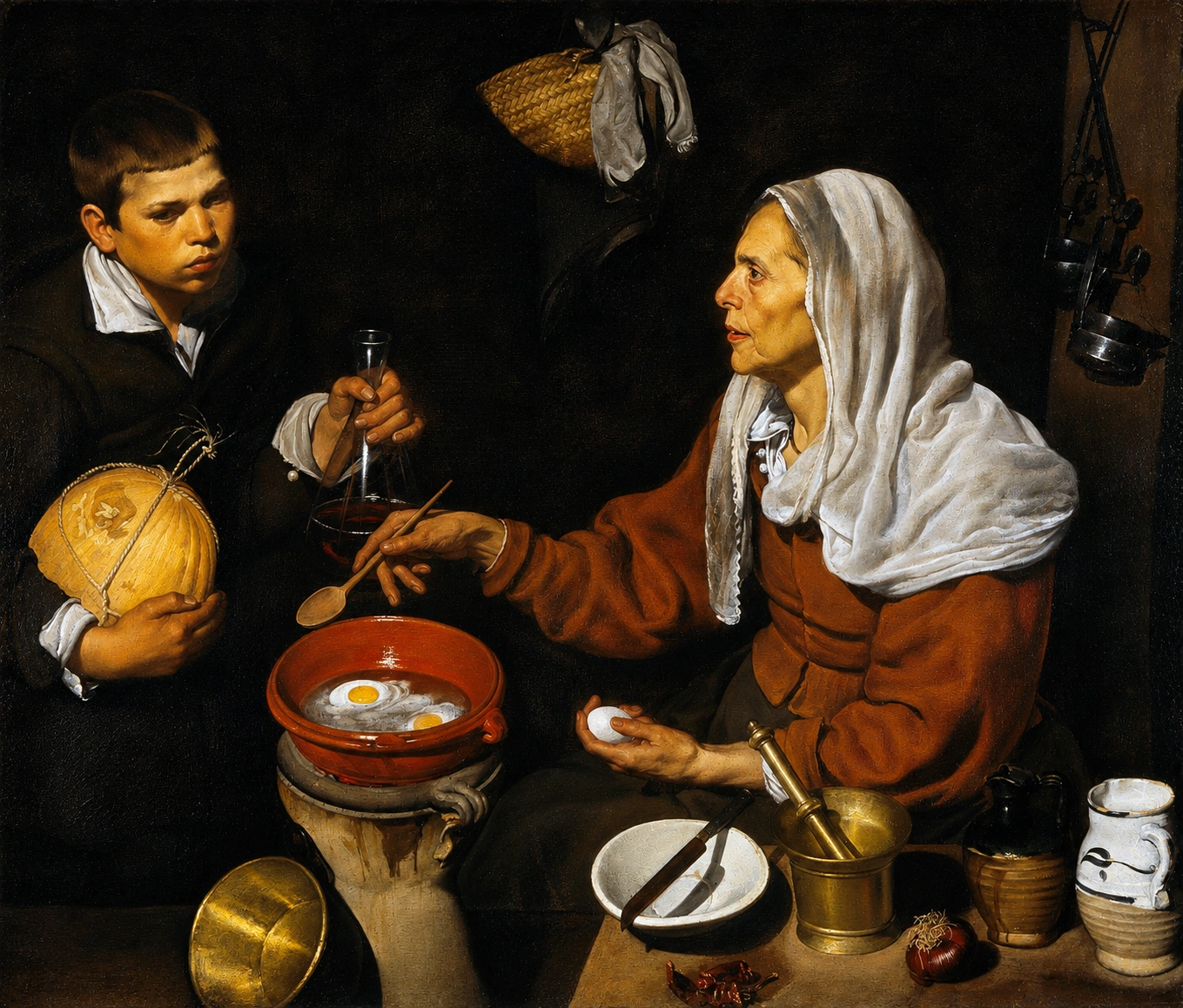
The painting depicts an elderly woman preparing eggs in a terracotta pan while a young boy stands beside her carrying a melon and a glass vessel. Their surroundings are filled with everyday kitchen utensils, humble ingredients, and carefully rendered household objects. Although the scene appears straightforward, its sophisticated composition and psychological depth reveal the extraordinary talent of an artist who would eventually become one of the greatest painters in European history.
Historical Context and Velázquez’s Early Career
Diego Velázquez painted “An Old Woman Cooking Eggs” during his formative years in Seville, Spain, a flourishing cultural and commercial center during the early seventeenth century. At the time, Seville was an important gateway to Spain’s overseas territories, creating a diverse urban environment filled with merchants, artisans, domestic workers, and ordinary citizens. This vibrant social setting provided the young artist with abundant opportunities to observe everyday life and develop his remarkable naturalistic style.
Velázquez received his artistic training under Francisco Pacheco, a respected painter and influential figure in Seville’s artistic community. Although Pacheco emphasized traditional artistic principles, Velázquez quickly demonstrated a distinctive interest in realistic observation and dramatic contrasts between light and shadow. His early paintings frequently depicted ordinary people engaged in familiar activities, reflecting his fascination with the textures, gestures, and expressions of daily existence.
“An Old Woman Cooking Eggs” belongs to a category of Spanish painting known as the bodegón, which often combines still-life elements with figures in kitchens or taverns. These compositions emphasized humble subjects and ordinary objects, challenging the traditional hierarchy that placed religious and historical painting above scenes of everyday life. Velázquez approached this genre with extraordinary seriousness, suggesting that even the simplest human activities deserved careful artistic consideration.
Composition and the Arrangement of Figures
The composition of “An Old Woman Cooking Eggs” is carefully structured around the relationship between its two principal figures. The elderly woman occupies the right side of the canvas, while the young boy stands on the left, creating a balanced arrangement connected by their gestures and the objects between them. Their contrasting ages immediately introduce a sense of generational difference, suggesting themes of experience, youth, and the passage of time.
The woman sits beside a small cooking stove, holding an egg in one hand and a wooden spoon in the other. Her head turns toward the boy, as though she is speaking to him or giving instructions concerning the preparation of the meal. The boy, meanwhile, appears thoughtful and reserved, holding a large melon against his body while grasping a glass vessel with his other hand.
Between these figures, the terracotta cooking pan becomes the visual center of the composition. The viewer’s attention naturally moves from the boy’s illuminated face toward the woman’s expressive profile before descending toward the eggs cooking in the pan. This arrangement creates a subtle visual rhythm that connects human interaction with the preparation of food.
The Extraordinary Use of Light and Shadow
One of the most striking characteristics of Diego Velázquez’s “An Old Woman Cooking Eggs” is its dramatic use of chiaroscuro, a technique involving strong contrasts between illuminated areas and deep shadows. Against the nearly black background, the figures emerge with extraordinary clarity, their faces, hands, and clothing illuminated by a concentrated source of light. This approach gives the scene an almost theatrical intensity while maintaining a convincing sense of realism.
The influence of Caravaggio and the broader European tradition of tenebrism can be recognized in the painting’s dramatic lighting. However, Velázquez develops his own distinctive interpretation by combining powerful contrasts with exceptionally delicate observations of texture and form. Rather than using darkness merely for dramatic effect, he allows the shadows to create an intimate atmosphere that emphasizes the physical presence of the figures.
The white fabric covering the woman’s head is particularly impressive, displaying subtle variations of gray, cream, and brilliant white. These tonal differences create the illusion of folded cloth catching the light at different angles. Similarly, the boy’s face is modeled through carefully controlled transitions between brightness and shadow, giving his youthful features remarkable solidity.
Realism and the Representation of Everyday Life
Velázquez’s commitment to realism is evident throughout “An Old Woman Cooking Eggs,” especially in his treatment of the elderly woman. Her face is marked by age, with visible wrinkles, prominent facial contours, and a slightly weathered complexion. Rather than idealizing her appearance, the artist presents her with dignity and individuality, emphasizing the beauty of truthful observation.
The boy receives equally careful attention, although his smooth skin and youthful features contrast strongly with the woman’s aged appearance. His expression appears contemplative, suggesting a moment of quiet concentration rather than an exaggerated emotional response. This psychological restraint gives the painting an unusual authenticity, allowing viewers to imagine the ordinary conversation or activity unfolding between the figures.
The kitchen objects also demonstrate Velázquez’s remarkable observational abilities. The terracotta pan, brass mortar, ceramic jug, glass vessel, and woven basket are rendered with an extraordinary sensitivity to their different materials. Each object reflects light in a distinctive manner, revealing the artist’s understanding of how surfaces behave under illumination.
Symbolism and the Contrast Between Youth and Age
Although “An Old Woman Cooking Eggs” primarily depicts an everyday domestic activity, its composition invites interpretations concerning the relationship between youth and old age. The elderly woman and young boy represent different stages of human existence, creating a visual contrast that may suggest the continuous passage of generations. Their shared activity provides a quiet connection between experience and innocence.
The woman’s role in preparing food can also be associated with nourishment, domestic responsibility, and the transmission of practical knowledge. Her gestures suggest familiarity with the cooking process, while the boy’s attentive presence creates the possibility of instruction or learning. Nevertheless, Velázquez leaves their precise relationship unexplained, preserving the scene’s ambiguity.
Still-Life Details and Artistic Technique
The still-life elements in “An Old Woman Cooking Eggs” are among the finest achievements of Velázquez’s early career. The eggs cooking in the reddish-brown earthenware pan are particularly remarkable, with their translucent whites and bright yellow yolks carefully distinguished from the surrounding liquid. The artist captures the delicate appearance of food undergoing transformation through heat.
The polished brass mortar in the foreground provides another demonstration of his technical sophistication. Its warm metallic surface contrasts with the matte texture of the nearby ceramic objects and the rougher appearance of the cooking stove. These variations create an almost tactile experience, encouraging viewers to imagine the weight, temperature, and texture of the objects.
The arrangement of utensils also contributes to the painting’s convincing domestic atmosphere. A knife rests across a white plate, a small onion lies nearby, and hanging implements disappear into the darkness behind the figures. Every detail strengthens the impression of a functioning kitchen while contributing to the composition’s carefully organized visual harmony.
The Importance of “An Old Woman Cooking Eggs” in Art History
“An Old Woman Cooking Eggs” occupies an important position in the development of Spanish Baroque art because it demonstrates how ordinary subjects could achieve extraordinary artistic significance. At a time when religious narratives and aristocratic portraits dominated much of European painting, Velázquez devoted exceptional attention to people engaged in humble domestic activities. His approach helped establish everyday life as a subject worthy of serious artistic exploration.
The painting also anticipates several qualities that would define Velázquez’s mature career, including psychological subtlety, technical precision, and an exceptional sensitivity to light. These characteristics would later emerge in masterpieces such as “The Surrender of Breda” and “Las Meninas,” although his painting technique would become increasingly fluid and atmospheric. The early work nevertheless reveals the foundations of his artistic genius.
Today, “An Old Woman Cooking Eggs” is preserved in the National Galleries of Scotland in Edinburgh, where it remains one of the most admired examples of Velázquez’s youthful achievements. Its remarkable preservation of ordinary seventeenth-century domestic life continues to fascinate audiences interested in both art history and the social realities of early modern Spain.
Conclusion: The Enduring Beauty of an Ordinary Moment
Diego Velázquez’s “An Old Woman Cooking Eggs” transforms a modest kitchen scene into an extraordinary meditation on observation, human presence, and the beauty of everyday existence. Through its carefully balanced composition, dramatic lighting, and remarkable attention to physical detail, the painting demonstrates how artistic greatness can emerge from seemingly insignificant subjects. The elderly woman, young boy, and ordinary household objects become participants in a scene of lasting visual and emotional power.