The Waterseller of Seville by Diego Velázquez: Vibrant Color Edit
Free to Download & Reuse: You are welcome to use this image! If you republish or share it online, you must include a direct link back to this webpage for attribution.
Original Image Source: wikiart.org
Introduction: The Extraordinary Beauty of an Ordinary Moment
“The Waterseller of Seville,” painted by Diego Velázquez around 1623, is one of the most remarkable examples of early Spanish Baroque painting. Through its extraordinary realism, dramatic lighting, and deeply human subject matter, the painting transforms an everyday encounter into a powerful meditation on dignity, experience, and the passage of time. Created during the artist’s formative years in Seville, the work demonstrates the exceptional observational skills that would eventually establish Velázquez as one of the greatest painters in European art history.
At first glance, the composition appears straightforward, depicting an elderly waterseller offering a glass of water to a young boy. However, beneath this apparently simple transaction lies an extraordinary combination of psychological depth, symbolic possibilities, and technical sophistication. Velázquez elevates an ordinary working man to the status traditionally reserved for aristocrats, religious figures, and historical heroes, revealing his remarkable ability to discover beauty and significance in everyday life.
Historical Context: Diego Velázquez and Seville in the Early Seventeenth Century
Diego Velázquez was born in Seville in 1599, when the Spanish city remained an important center of international commerce, artistic production, and cultural exchange. Its bustling streets were filled with merchants, laborers, travelers, and vendors who supplied residents with essential goods and services. Among these familiar urban figures were watersellers, whose profession was particularly important in the hot Andalusian climate.
During his early career, Velázquez developed a distinctive artistic language characterized by naturalistic figures, earthy colors, and strong contrasts between light and darkness. His training under Francisco Pacheco provided him with a foundation in artistic theory and technique, although his growing interest in direct observation soon distinguished his work from more conventional approaches. “The Waterseller of Seville” belongs to this early period and represents a particularly sophisticated example of his emerging style.
The painting is generally associated with the years immediately preceding Velázquez’s appointment as court painter to King Philip IV in 1623. Its subject reflects his fascination with ordinary people and everyday activities, an interest also evident in his early kitchen and tavern scenes. These works helped establish a new level of seriousness for subjects traditionally considered less prestigious than religious or historical painting.
Composition: Three Figures Connected Through a Simple Exchange
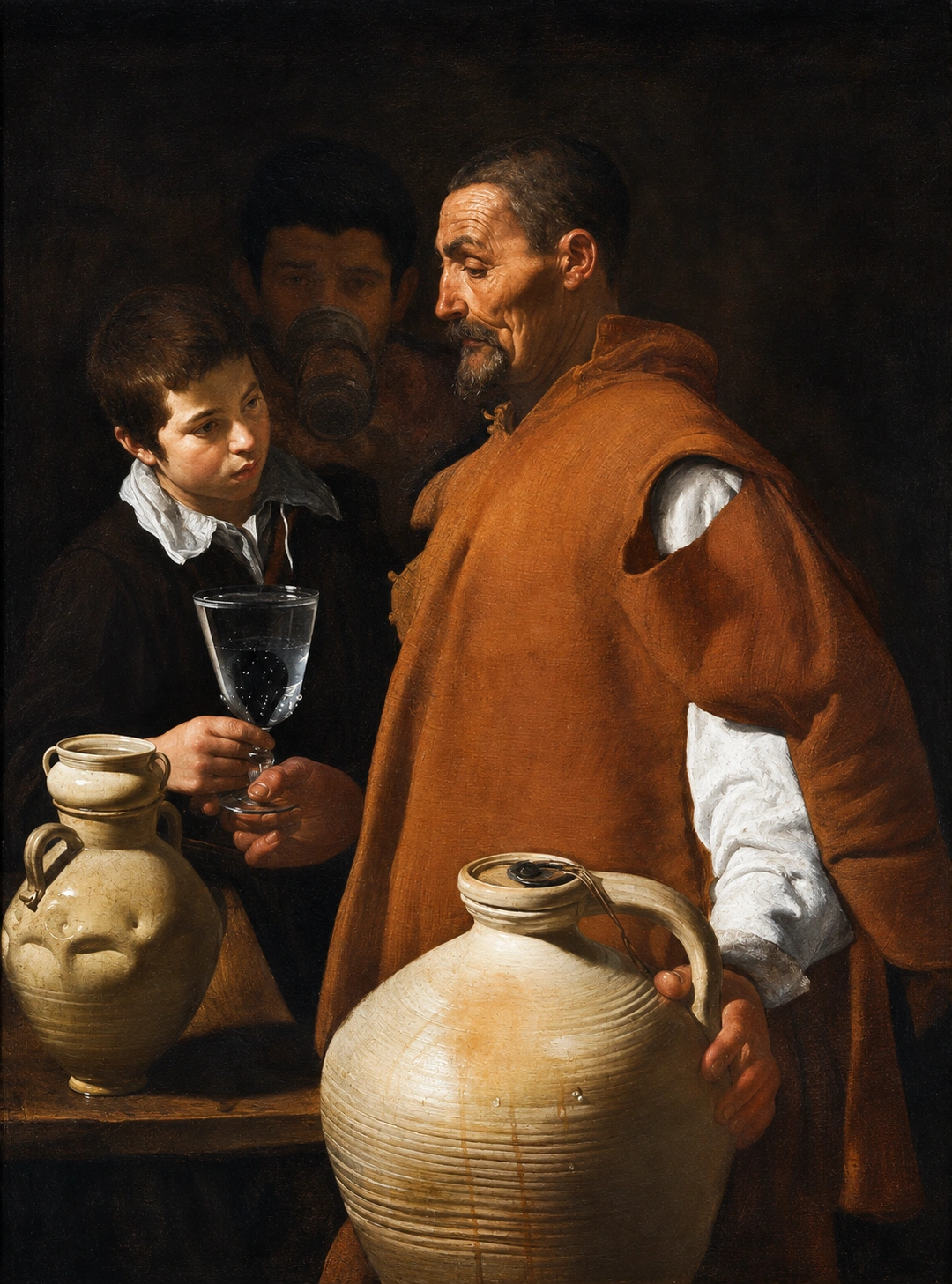
The composition of “The Waterseller of Seville” is carefully arranged around three human figures whose positions establish a subtle visual narrative. The elderly waterseller dominates the right side of the painting, while a young boy occupies the left foreground. Between them, a third figure emerges from the darkness, drinking from a vessel that partially conceals his face.
This triangular arrangement creates a sense of balance while directing attention toward the exchange of water between the elderly man and the child. Their hands meet near the center of the composition, establishing a visual connection that unites the two principal figures. Although the transaction appears ordinary, the deliberate arrangement gives it an almost ceremonial quality.
The waterseller’s imposing presence is particularly significant because his body occupies much of the available pictorial space. His broad brown garment, strongly illuminated face, and weathered hands establish him as the central character. Velázquez presents him with a quiet monumentality that encourages viewers to recognize the dignity of his labor.
The Waterseller: A Portrait of Age, Labor, and Human Dignity
The elderly waterseller is among the most compelling figures in Velázquez’s early paintings. His deeply lined face, thinning hair, and solemn expression suggest a lifetime of physical work and accumulated experience. Rather than exaggerating these characteristics for dramatic effect, Velázquez records them with extraordinary sensitivity and restraint.
The man’s downward gaze conveys concentration as he completes the task of offering water to his young customer. His expression seems thoughtful, perhaps even melancholic, although the painting leaves his inner feelings deliberately ambiguous. This psychological uncertainty gives the figure a sense of individuality that extends beyond his occupation.
His clothing further reinforces the painting’s commitment to realism. The heavy brown fabric appears coarse and practical, while the white sleeve emerging beneath it introduces a striking contrast of light and texture. Through these carefully observed details, Velázquez transforms a humble street vendor into a figure possessing remarkable authority and presence.
The Young Boy and the Symbolism of Generations
The young boy provides an important visual and emotional contrast to the elderly waterseller. His smooth complexion, dark clothing, and attentive expression emphasize his youth, while the older man’s weathered features communicate maturity and experience. Their physical differences suggest the passage of time and the relationship between successive generations.
The glass of water connecting their hands becomes the central object in this interaction. Beyond its practical function, it can be interpreted as a symbol of nourishment, knowledge, or the transmission of experience from old age to youth. Such interpretations remain possibilities rather than definitive meanings, but they enrich the painting’s emotional significance.
The boy’s restrained expression contributes to the atmosphere of seriousness. He appears absorbed in the encounter, and his quiet concentration mirrors the waterseller’s careful movements. Their shared attention transforms a simple commercial exchange into an intimate moment of human connection.
Light and Shadow: The Influence of Caravaggio
One of the defining characteristics of “The Waterseller of Seville” is its dramatic use of chiaroscuro, the technique of creating strong contrasts between illuminated and shadowed areas. Velázquez employs a concentrated light source that reveals the waterseller’s face, the boy’s features, and the surfaces of the vessels while allowing much of the surrounding space to disappear into darkness. This approach recalls the naturalistic lighting associated with Caravaggio and the broader European Baroque tradition.
The dark background removes unnecessary distractions and intensifies the physical presence of the figures. Light becomes an instrument of visual storytelling, directing attention toward expressions, gestures, and objects essential to understanding the scene. The resulting atmosphere feels intimate, solemn, and almost theatrical.
Particularly impressive is the treatment of the waterseller’s white sleeve, which catches the light with remarkable intensity. Its brightness contrasts with the warm brown garment and the surrounding shadows, creating a convincing impression of fabric stretched over a human arm. These contrasts demonstrate Velázquez’s growing mastery of light as both a descriptive and expressive element.
Still Life Details: The Extraordinary Realism of Water and Clay
The painting’s large ceramic vessels reveal Velázquez’s exceptional talent for representing different materials. The enormous pale earthenware jug in the foreground occupies a substantial portion of the composition, its rounded form carefully modeled through subtle variations of light and shadow. Its textured surface communicates the weight, roughness, and physical substance of fired clay.
Small droplets of moisture appear on the vessel, suggesting the coolness of the water contained within. This detail is particularly evocative because it appeals to the viewer’s sense of touch as well as sight. The ceramic surface becomes so convincingly rendered that its temperature and texture seem almost perceptible.
The transparent drinking glass provides a striking contrast to the opaque earthenware containers. Velázquez carefully depicts its reflective surface and the delicate interplay between glass, water, and light. This attention to ordinary objects demonstrates how closely the artist studied the physical world, transforming practical household items into extraordinary demonstrations of painterly skill.
Symbolism and Deeper Meaning
Although “The Waterseller of Seville” depicts a recognizable occupation, its unusually solemn atmosphere has encouraged interpretations extending beyond everyday realism. The relationship between the elderly man and the young boy may suggest the movement from youth to old age, while the exchange of water introduces associations with life, renewal, and spiritual nourishment. These symbolic possibilities are strengthened by the painting’s restrained gestures and almost ceremonial stillness.
Water carries particularly rich associations within Christian traditions, where it frequently represents purification, renewal, and spiritual life. Nevertheless, Velázquez does not provide an unmistakable religious narrative, and the work remains open to multiple interpretations. Its power emerges partly from this balance between physical reality and potential allegorical meaning.
The presence of the shadowed third figure adds another dimension to the scene. His partially concealed appearance introduces depth and suggests that the central exchange belongs to a larger world of human activity. At the same time, the three figures can invite reflection on different stages of life, although this interpretation cannot be established with certainty.
Artistic Legacy and the Importance of the Painting
“The Waterseller of Seville” occupies an important position in the development of Diego Velázquez’s artistic career. Its combination of naturalism, psychological sensitivity, and technical precision anticipates many qualities that would distinguish his later portraits and historical compositions. Even before entering the Spanish royal court, Velázquez demonstrated an exceptional capacity to represent human beings with both realism and dignity.
The painting also illustrates the growing importance of everyday subjects within seventeenth-century European art. By treating a working-class figure with such seriousness, Velázquez challenged traditional assumptions about which individuals deserved artistic attention. The result is a composition that celebrates ordinary human experience without idealizing or sentimentalizing its subject.
Today, the painting is housed at Apsley House in London, where it remains one of the most celebrated surviving works from Velázquez’s early Seville period. Its enduring appeal lies in the remarkable balance between technical mastery and emotional restraint. Through the simplest exchange of water, Velázquez created an image that continues to resonate across centuries.
Conclusion: The Timeless Humanity of "The Waterseller of Seville"
Diego Velázquez’s “The Waterseller of Seville” demonstrates how an ordinary moment can become extraordinary through careful observation and artistic sensitivity. Its dramatic lighting, convincing textures, balanced composition, and psychologically compelling figures reveal a young painter already possessing exceptional technical and imaginative abilities. Every element contributes to an atmosphere of quiet dignity that encourages viewers to contemplate the significance of seemingly insignificant encounters.
Ultimately, the painting’s greatness lies in its ability to communicate profound humanity without relying on elaborate action or overt symbolism. The elderly vendor, the attentive child, and the humble vessels are sufficient to create a scene of remarkable emotional and visual richness. More than four centuries after its creation, “The Waterseller of Seville” remains a powerful testament to Velázquez’s belief in the artistic importance of everyday life.