The Clothed Maja by Francisco Goya: Vibrant Color Edit
Free to Download & Reuse: You are welcome to use this image! If you republish or share it online, you must include a direct link back to this webpage for attribution.
Original Image Source: wikiart.org
Introduction to The Clothed Maja by Francisco Goya
The Clothed Maja, painted around 1800 by the celebrated Spanish artist Francisco Goya, is one of the most captivating portraits in the history of Spanish art. Combining elegance, sensuality, and psychological depth, the painting presents a reclining woman dressed in fashionable clothing, gazing directly at the viewer with remarkable confidence. Her relaxed posture, luxurious garments, and mysterious expression create an atmosphere of intimacy that continues to fascinate audiences more than two centuries after its creation.
The painting belongs to a remarkable period in Goya’s artistic career, when he was exploring the relationship between beauty, individuality, and social conventions. Although the composition appears relatively simple, its carefully arranged colors, expressive brushwork, and unusual presentation reveal an artist challenging traditional expectations of female portraiture. Through this extraordinary work, Goya transforms an apparently casual scene into a compelling exploration of femininity, personal freedom, and the power of the human gaze.
Historical Context and the Artistic World of Francisco Goya
At the beginning of the nineteenth century, Spain was experiencing significant political, cultural, and social transformations. The Spanish aristocracy maintained elaborate traditions of fashion and etiquette, while Enlightenment ideas encouraged new discussions about individuality, morality, and personal expression. Within this changing environment, Francisco Goya established himself as an influential painter whose portraits frequently revealed the personalities and social identities of his subjects.
By 1800, Goya had achieved considerable success as a court painter, producing portraits of prominent aristocrats and members of the Spanish royal family. However, his artistic interests extended beyond conventional representations of wealth and authority. He increasingly explored human emotions, private behavior, and the contradictions between public appearances and personal desires.
The Clothed Maja reflects this fascination with the complexities of human identity. Unlike formal aristocratic portraits, which often emphasized status through rigid poses and ceremonial surroundings, Goya depicts his subject reclining comfortably in an intimate setting. The painting therefore occupies an intriguing position between traditional portraiture and a more personal, unconventional representation of feminine beauty.
Composition and the Reclining Female Figure
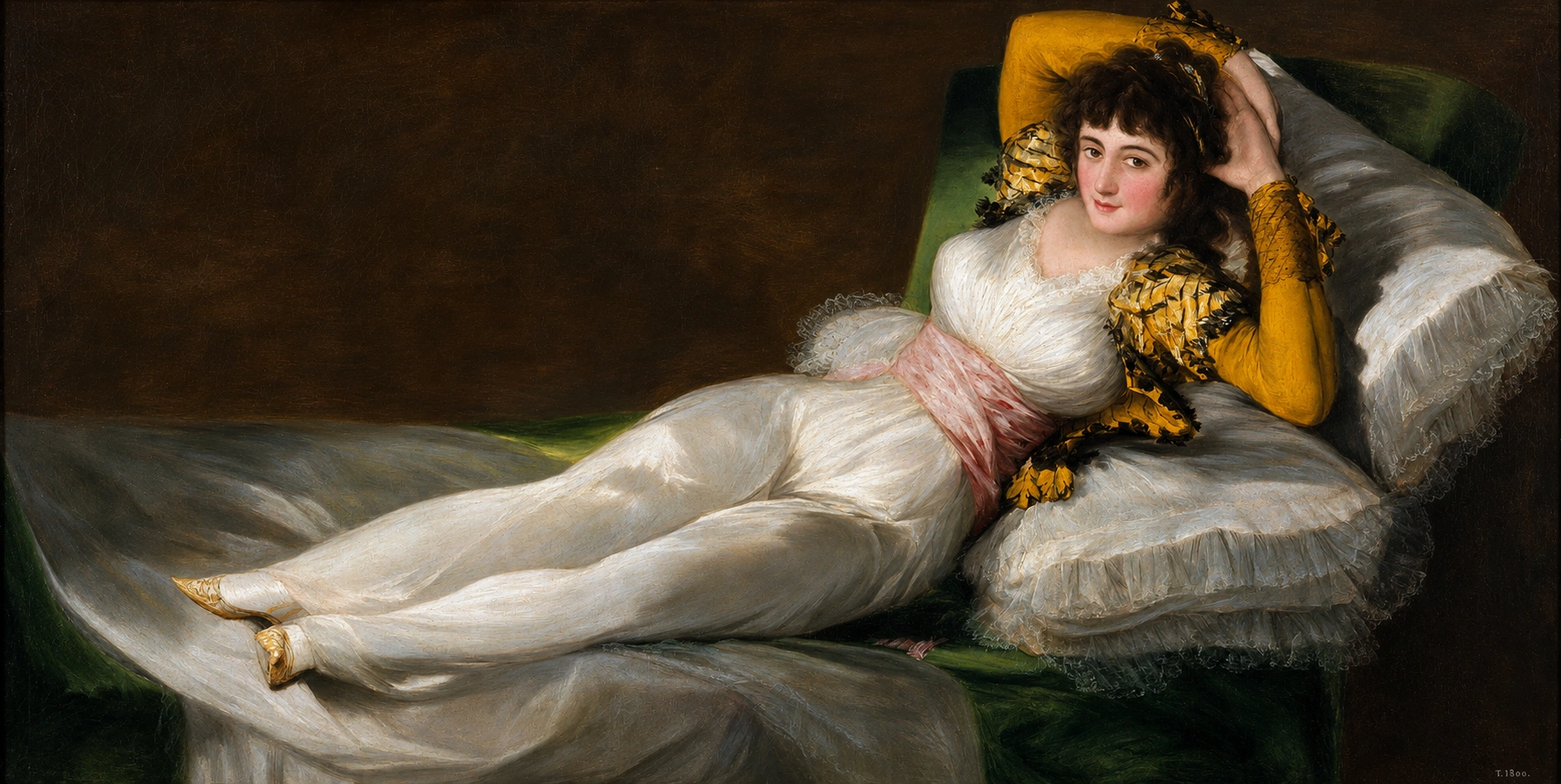
The composition of The Clothed Maja is dominated by the elegant horizontal arrangement of the woman’s body. Reclining across a luxurious couch, she stretches diagonally from the lower left corner toward the upper right portion of the canvas. This carefully constructed positioning creates a gentle visual movement that guides the viewer’s attention from her delicate shoes and flowing garments toward her expressive face.
Her arms are raised behind her head, forming an open and relaxed posture that suggests confidence rather than vulnerability. The arrangement also introduces a subtle sense of theatricality, as though the woman is consciously presenting herself to an unseen audience. Goya carefully balances this deliberate pose with natural details that make the figure appear comfortable and spontaneous.
The surrounding cushions reinforce the composition’s atmosphere of luxury and intimacy. Their rounded forms contrast with the elongated silhouette of the woman’s body, introducing visual variety without disturbing the painting’s overall harmony. Meanwhile, the dark, relatively empty background concentrates attention on the subject, allowing her luminous clothing and expressive features to dominate the scene.
Color Palette and the Beauty of Goya's Contrasts
One of the most striking features of The Clothed Maja is its sophisticated color palette, which combines luminous whites, golden yellows, delicate pinks, and deep earthy browns. These colors work together to create an atmosphere of warmth and refinement while emphasizing the richness of the woman’s fashionable attire. Goya demonstrates an exceptional understanding of how contrasting tones can establish visual depth and direct attention.
The woman’s white garments occupy much of the composition, creating a brilliant contrast against the subdued background. Rather than using a uniform white, Goya introduces subtle variations of ivory, silver, gray, and cream to suggest the movement of light across delicate fabric. These tonal changes give the clothing a convincing sense of texture and volume.
Golden-yellow sleeves provide an energetic contrast to the predominantly white costume. Their darker decorative patterns introduce visual complexity while connecting the upper body to the warm tones surrounding the woman’s head. The soft pink sash around her waist adds another layer of color, creating a gentle transition between the brilliant clothing and the warmer complexion of her face.
Clothing, Fashion, and Social Identity
The elaborate clothing worn by the woman is essential to understanding the painting’s cultural significance. Her outfit reflects the fashionable Spanish maja aesthetic, associated with stylish urban women who embraced distinctive elements of traditional Spanish dress. During Goya’s lifetime, this fashion became particularly interesting because members of the aristocracy sometimes adopted styles associated with popular culture.
The woman’s white garments, fitted bodice, ornate yellow sleeves, and decorative sash establish an appearance that is simultaneously elegant and playful. Her clothing follows the contours of her reclining body, allowing Goya to suggest physical presence through fabric rather than exposed skin. This approach contributes to the painting’s sensual atmosphere while maintaining an outward appearance of fashionable refinement.
The luxurious materials also communicate sophistication and personal confidence. Rather than functioning as a conventional display of aristocratic rank, the costume becomes an expression of individuality and fashionable self-presentation. Goya’s treatment of clothing therefore reveals his interest in the complicated relationship between social identity, personal taste, and visual appearance.
The Woman's Expression and Direct Gaze
Perhaps the most psychologically compelling element of The Clothed Maja is the woman’s direct gaze. Her dark eyes meet the viewer with an expression that appears calm, confident, and slightly playful. Unlike subjects who look away modestly or adopt a distant expression, she acknowledges the viewer’s presence without appearing uncomfortable.
Her gently flushed cheeks and softly defined lips contribute to the portrait’s warmth and humanity. Goya avoids an excessively idealized face, instead giving the woman an individuality that suggests a living personality. The result is an expression that invites interpretation without revealing precisely what she might be thinking.
This psychological ambiguity is central to the painting’s enduring fascination. The woman appears aware of being observed, yet she does not seem entirely passive under the viewer’s gaze. Her confident expression creates a subtle reversal of traditional relationships between the observer and the subject, giving her a powerful sense of personal agency.
Light, Texture, and Goya's Painting Technique
Goya’s technical mastery becomes especially apparent in his treatment of light and fabric. Soft illumination falls across the woman’s face, bodice, and reclining figure, creating gentle transitions between highlighted surfaces and darker folds. The resulting interplay of brightness and shadow gives the painting a convincing three-dimensional quality.
The artist’s brushwork varies considerably across the composition. Around the woman’s face, the handling appears comparatively controlled, allowing her features to remain delicate and recognizable. In the cushions, sleeves, and flowing white garments, broader and more energetic strokes create the impression of textured materials.
This contrast between precise observation and expressive brushwork contributes to the painting’s vitality. Goya allows certain details to dissolve into painterly suggestions while preserving the essential structure of the figure. His approach anticipates aspects of nineteenth-century painting in which atmosphere, light, and the visible activity of the brush would become increasingly important.
The Relationship Between The Clothed Maja and The Nude Maja
The Clothed Maja is inseparable from its famous companion painting, The Nude Maja. Both works portray a reclining woman in nearly identical positions, establishing a remarkable visual relationship between two different interpretations of the same subject. While the clothed version emphasizes fashionable elegance, the nude version presents the female body without the traditional mythological justification commonly associated with European nude painting.
The precise identity of the model remains uncertain, although various theories have connected her with prominent women from Goya’s social environment. The relationship between the two paintings has also generated considerable debate concerning their original purpose and intended audience. What remains clear is that their shared composition encourages viewers to consider how clothing changes the interpretation of identity, sensuality, and social respectability.
Interestingly, the clothed figure does not necessarily appear less provocative than her nude counterpart. Her luxurious costume, relaxed posture, and unwavering gaze create their own form of sensuality, demonstrating Goya’s ability to communicate intimacy through subtle visual suggestions. Together, the paintings challenge conventional distinctions between modesty and desire.
Symbolism, Sensuality, and Feminine Independence
Although The Clothed Maja does not depend on elaborate symbolic objects, its composition carries important cultural and psychological meanings. The reclining posture traditionally appeared in representations of mythological figures, particularly Venus, the Roman goddess of love and beauty. Goya adapts this artistic tradition while presenting a woman whose clothing and appearance connect her to contemporary Spanish society.
Her confident gaze may be interpreted as an expression of independence, particularly within a historical environment where women were frequently represented according to ideals of modesty and restraint. The painting’s sensuality emerges through the subject’s self-assured presence rather than through dramatic gestures or overt symbolism. Her personality becomes as important as her physical beauty.
The luxurious setting also introduces questions about privacy and public observation. Although the woman occupies an intimate environment, her direct engagement with the viewer transforms that private space into a scene of deliberate presentation. This tension between intimacy and display gives the work much of its psychological richness.
The Lasting Legacy of The Clothed Maja
Today, The Clothed Maja is among Francisco Goya’s most recognizable paintings and forms an important part of the collection of the Museo del Prado. Its enduring reputation reflects both its exceptional artistic qualities and its connection to changing attitudes toward feminine representation in European painting. The work continues to attract attention because its apparent simplicity conceals sophisticated questions about identity, beauty, and the relationship between artist, subject, and viewer.
Goya’s innovative approach helped expand the possibilities of portraiture beyond the formal conventions of his era. His emphasis on psychological presence, expressive brushwork, and unconventional subject matter anticipated developments that would become increasingly important in modern European art. The painting therefore represents an important moment in the evolution of the reclining female portrait.
Conclusion: The Timeless Appeal of Francisco Goya's The Clothed Maja
The Clothed Maja remains an extraordinary achievement because it combines visual elegance with a compelling sense of human individuality. Through its graceful composition, luminous garments, warm colors, and confident subject, Francisco Goya creates a painting that feels both intimate and remarkably modern. The woman’s direct gaze and relaxed posture establish a relationship with the viewer that continues to generate curiosity and admiration.
Beyond its immediate beauty, the painting offers a fascinating glimpse into the social attitudes, artistic traditions, and fashionable culture of Spain around 1800. Goya transforms a reclining portrait into a sophisticated meditation on appearance, confidence, and feminine identity. More than two centuries later, The Clothed Maja continues to demonstrate the artist’s exceptional ability to capture the complex relationship between outward elegance and inner personality.