The Dog by Francisco Goya: Vibrant Color Edit
Free to Download & Reuse: You are welcome to use this image! If you republish or share it online, you must include a direct link back to this webpage for attribution.
Original Image Source: wikiart.org
Introduction to The Dog by Francisco Goya
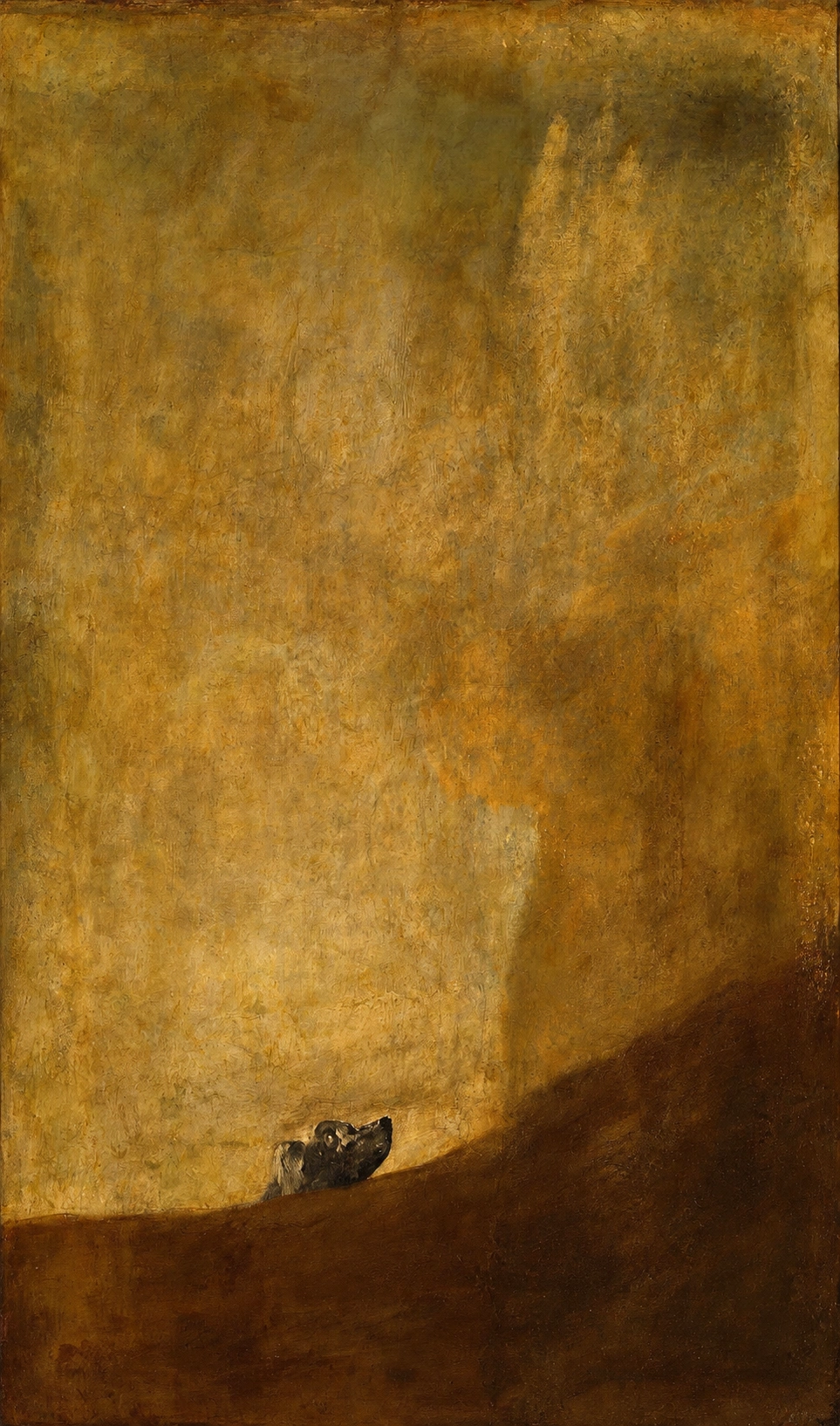
The Dog, painted by Francisco Goya around 1819 to 1823, is one of the most mysterious and emotionally powerful works in the history of Spanish art. Despite its extraordinary simplicity, the painting communicates profound feelings of loneliness, vulnerability, uncertainty, and existential despair. Featuring a small dog’s head emerging from behind a dark, sloping foreground beneath an immense expanse of empty space, the composition challenges traditional expectations of what a painting should represent.
Created during the final decades of Goya’s life, The Dog belongs to his celebrated series known as the Black Paintings. These deeply personal works reflect the artist’s increasingly troubled relationship with society, human nature, mortality, and the unknown. Unlike his earlier royal portraits and historical compositions, The Dog abandons elaborate storytelling in favor of an unsettling visual experience that invites viewers to confront their own emotions.
What makes The Dog particularly remarkable is its ability to communicate so much through so little. The animal’s ambiguous situation, combined with the painting’s vast emptiness, creates an atmosphere that feels simultaneously intimate and overwhelming. More than two centuries after its creation, Goya’s haunting image continues to inspire interpretations concerning suffering, hope, abandonment, and the fragile nature of existence.
Historical Context and Goya's Black Paintings
Francisco Goya painted The Dog during a period marked by personal hardship, political instability, and profound disillusionment. Born in 1746, Goya had enjoyed considerable success as a court painter before experiencing serious illness, deafness, and the devastating consequences of war. His experiences during the Napoleonic invasion of Spain and the subsequent political repression profoundly influenced his artistic vision.
Around 1819, Goya acquired a country house near Madrid known as the Quinta del Sordo, meaning “House of the Deaf Man.” There, he created fourteen paintings directly on the interior walls, including Saturn Devouring His Son, Witches’ Sabbath, and The Dog. These works were never intended for public exhibition, allowing Goya an unusual degree of artistic freedom.
The Black Paintings differ dramatically from the elegant portraits and decorative compositions that had established Goya’s reputation. Their dark palettes, unsettling imagery, and psychological intensity suggest an artist increasingly interested in humanity’s deepest fears. Within this series, The Dog stands apart because it expresses emotional uncertainty without depicting violence, supernatural creatures, or recognizable human drama.
Although traditionally associated with 1819, the painting is generally dated to the period between 1819 and 1823. Its original meaning remains unknown, partly because Goya left no definitive explanation of the image. This absence of certainty has become central to the painting’s enduring fascination.
Composition and the Power of Empty Space
The composition of The Dog is extraordinary for its radical simplicity. Most of the canvas consists of an expansive, almost featureless surface of muted yellow, ochre, and brown. Near the bottom, a dark diagonal slope rises toward the right, partially concealing the small animal whose head emerges into view.
The dog occupies only a tiny portion of the overall composition, making its apparent vulnerability immediately striking. Its head is positioned near the lower center, while the surrounding emptiness dominates nearly everything else. This dramatic imbalance creates an impression of insignificance, as though the animal exists within a world too vast to understand or control.
Goya’s use of negative space is particularly important to the painting’s psychological effect. Rather than filling the background with identifiable objects, landscapes, or architectural details, he allows emptiness itself to become the dominant visual presence. The result is an atmosphere of uncertainty in which the viewer struggles to establish the animal’s surroundings.
The diagonal foreground introduces a subtle sense of movement and instability. Its upward slope could suggest a hillside, a mound of earth, or an undefined barrier, although none of these interpretations can be confirmed. Because the dog’s body remains hidden, the viewer cannot determine whether it is standing safely behind the slope, struggling to emerge, or gradually disappearing.
This compositional ambiguity transforms an apparently ordinary animal into a powerful symbol of existential uncertainty.
The Dog as a Symbol of Loneliness and Despair
The emotional center of the painting is undoubtedly the dog’s small, expressive head. Its upward gaze suggests attention directed toward something beyond the visible composition. Whether the animal is searching for assistance, observing an approaching presence, or simply looking into the distance remains impossible to determine.
One interpretation presents the dog as a symbol of abandonment and helplessness. Surrounded by an immense and indifferent environment, the animal appears isolated from companionship or protection. Its diminutive scale reinforces the impression that it possesses little control over its circumstances.
Another interpretation connects the image to the universal experience of confronting an uncertain future. The dog looks upward, yet the painting offers no indication of what it sees. This unanswered question creates a psychological tension that resembles the human search for meaning in a world that rarely provides clear explanations.
The animal may also represent perseverance rather than defeat. Despite its apparent vulnerability, its head remains raised, suggesting awareness, curiosity, or even determination. This possibility introduces a fragile sense of hope into an otherwise melancholy scene.
The remarkable quality of The Dog lies in its refusal to establish which interpretation is correct. Goya presents a situation that can evoke despair and resilience simultaneously, allowing viewers to discover different meanings through their own experiences.
Color Palette and Atmospheric Expression
Goya’s restrained color palette contributes enormously to the painting’s haunting atmosphere. The composition is dominated by earthy yellows, muted ochres, dusty browns, and subtle variations of gray. These colors create an impression of dryness, stillness, and emotional exhaustion.
The upper portion contains delicate tonal variations that prevent the background from appearing completely uniform. Weathered textures and irregular patches of color suggest an aged surface, giving the composition an almost geological quality. Rather than describing a recognizable sky or landscape, these variations establish a mysterious environment without clear boundaries.
The dark foreground provides the painting’s strongest tonal contrast. Its reddish-brown surface forms a visual barrier between the dog and the lower edge of the composition. Against this darker area, the animal’s head becomes the focal point despite its extremely small size.
Goya’s loose brushwork further intensifies the emotional atmosphere. The painting avoids the polished precision associated with traditional academic art, favoring expressive textures and simplified forms. This approach gives the image an immediacy that feels strikingly modern.
The surviving surface has also been affected by the painting’s complicated history, including its transfer from a wall to canvas during the nineteenth century. Consequently, its present appearance should not be understood as an entirely unchanged reflection of Goya’s original execution.
Existentialism and the Human Condition
Although The Dog depicts an animal rather than a human figure, its emotional implications extend far beyond the immediate subject. The painting can be understood as a meditation on humanity’s relationship with an indifferent universe. Its enormous empty background suggests the overwhelming scale of existence, while the small dog becomes a visual metaphor for individual vulnerability.
This interpretation resonates with themes later associated with existentialist philosophy. Human beings frequently confront uncertainty, isolation, mortality, and the absence of definitive answers. Goya’s composition appears to anticipate these concerns through an image that communicates emotional experience without requiring an elaborate narrative.
The dog’s upward gaze is particularly significant within this interpretation. It suggests a desire to understand something outside its immediate circumstances, echoing humanity’s persistent search for meaning. Yet the surrounding space offers no visible response, reinforcing the tension between curiosity and uncertainty.
The painting’s silence is equally important. There is no dramatic action, no identifiable destination, and no clear resolution. Instead, Goya captures a suspended moment in which expectation becomes more powerful than any observable event.
Through this extraordinary simplicity, The Dog transforms a modest subject into a reflection on the mysteries of existence.
The Influence of The Dog on Modern Art
One of the most remarkable aspects of The Dog is how contemporary its composition appears. Created decades before the emergence of modern abstraction, the painting relies on broad fields of color, minimal detail, and psychological suggestion. These characteristics establish unexpected connections with artistic developments of the twentieth century.
Its enormous empty background anticipates the expressive possibilities of abstraction, particularly the use of simplified compositions to evoke emotional responses. The relationship between the tiny animal and its surrounding environment also resembles later explorations of scale, emptiness, and alienation.
Artists associated with Expressionism and modern psychological painting would explore similarly intense emotional subjects. Although direct influence should not be assumed in every case, Goya’s willingness to abandon conventional representation helped establish an important precedent for artistic experimentation.
The painting also demonstrates that visual complexity is not necessary for emotional depth. By reducing the composition to a handful of essential elements, Goya creates an image that remains unforgettable. Its influence lies partly in showing how absence, ambiguity, and restraint can become powerful artistic tools.
Today, The Dog is preserved in the Museo del Prado in Madrid, where it remains one of the most recognizable works from Goya’s final creative period.
Conclusion: The Enduring Mystery of The Dog
Francisco Goya’s The Dog remains one of the most compelling examples of emotional expression through visual simplicity. Its small animal, immense empty background, and mysterious diagonal foreground combine to create a composition that resists any single explanation. The painting communicates loneliness, uncertainty, vulnerability, and perhaps even hope without relying on recognizable narrative details.
Its historical connection to the Black Paintings adds another dimension to its emotional power. Created during Goya’s later years, the work reflects an artistic vision increasingly concerned with psychological experience and the darker possibilities of existence. Yet its meaning remains open enough to speak to viewers across different cultures and generations.
Ultimately, the greatness of The Dog lies in the questions it leaves unanswered. Is the animal sinking, waiting, searching, or simply observing something beyond our sight? Goya offers no definitive response, transforming the viewer’s uncertainty into the painting’s central experience.
More than two centuries after its creation, The Dog continues to demonstrate how a single fragile figure surrounded by emptiness can express some of the deepest emotions associated with being alive.