The Artist’s Garden at Giverny by Claude Monet: Vibrant Color Edit
Free to Download & Reuse: You are welcome to use this image! If you republish or share it online, you must include a direct link back to this webpage for attribution.
Original Image Source: wikiart.org
The Artist’s Garden at Giverny by Claude Monet
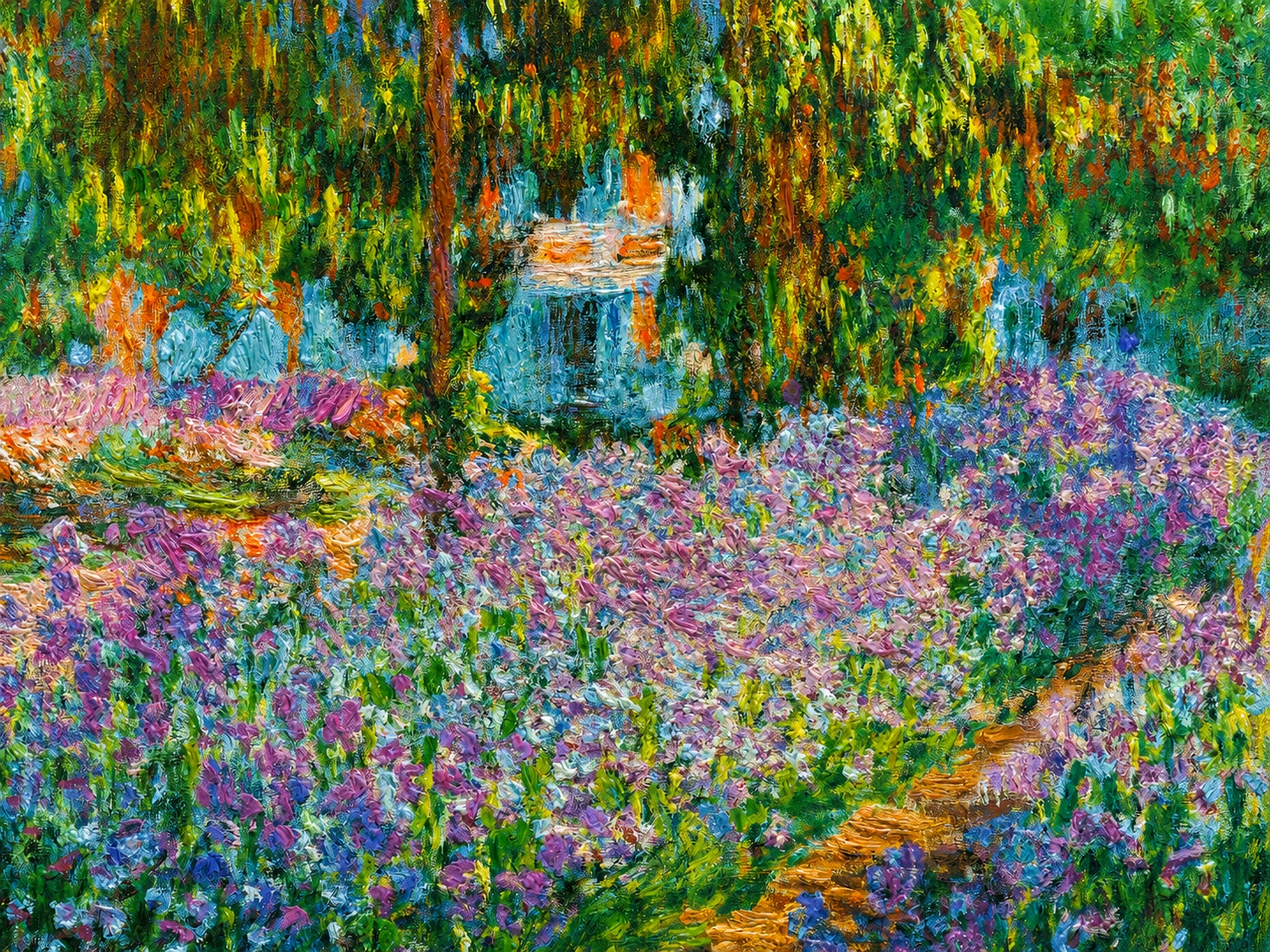
Claude Monet’s “The Artist’s Garden at Giverny” from 1900 is a radiant vision of the painter’s private world transformed into color, texture, and light. Rather than presenting the garden as a carefully mapped physical place, Monet turns it into an immersive field of sensation. The viewer is not simply looking at flowers, trees, and a path. The viewer is surrounded by growth, fragrance, shade, sunlight, and movement. Every part of the canvas seems alive, from the dense purple flowers in the foreground to the hanging greens and deep shadows at the back of the garden.
The painting belongs to Monet’s mature period at Giverny, the home and garden that became one of the great subjects of his later career. By 1900, Monet was no longer just painting landscapes observed during travel. He was painting a world he had shaped himself. His garden was both a natural environment and an artistic creation, designed with the eye of a painter. In this work, that dual identity is essential. The garden is real, but it also feels like a living canvas.
A Garden Built From Color
The first thing that strikes the viewer is the abundance of color. Purple, lavender, blue, green, yellow, orange, and soft pink are layered across the scene in thick, flickering brushstrokes. The flowerbed dominates the lower half of the painting, spreading like a sea of blossoms. Monet does not describe each individual flower with botanical precision. Instead, he captures the overall impression of blooming life.
The purples and violets are especially important. They create a cool, dreamlike atmosphere while also giving the painting its rich decorative rhythm. These colors are balanced by warmer touches of orange, rust, and golden brown, especially in the path that cuts diagonally through the lower right side. This path is one of the few clear structural elements in the composition. It guides the eye inward, but it does not fully organize the scene. Nature remains dominant.
The greens in the background are darker and more complex. They are not simple areas of foliage, but interwoven strokes of emerald, olive, teal, brown, and yellow. Monet uses these layered colors to suggest depth without relying on sharp outlines. The garden appears dense and slightly mysterious, as if the plants are constantly shifting in light.
Light, Shadow, and Atmosphere
Monet’s great subject was not just nature, but nature transformed by light. In “The Artist’s Garden at Giverny,” the light is filtered and broken. It does not fall evenly across the scene. Instead, it glimmers through leaves, catches on petals, and disappears into shaded areas. The result is a painting that feels atmospheric rather than fixed.
The upper part of the canvas is filled with hanging foliage and dark vertical accents. These create a curtain-like effect, enclosing the garden and making it feel private. Behind the flowers, small patches of pale blue and white suggest openings, reflections, or garden structures glimpsed through the vegetation. Monet leaves these details ambiguous, which gives the painting much of its poetic power. The viewer senses space without needing every object explained.
This softness is not a lack of control. It is one of Monet’s most deliberate achievements. By allowing forms to dissolve into each other, he shows how the eye actually experiences a garden in changing light. Flowers blur together. Leaves overlap. Shadows absorb detail. Color becomes more important than contour. The painting captures perception as an event, not as a frozen record.
Brushwork and Texture
The surface of the painting is full of energy. Monet’s brushstrokes vary from short dabs to longer dragging marks, from thick touches of pigment to softer blended areas. In the foreground, the paint suggests clusters of blossoms, stems, and grasses. In the background, the strokes become more vertical and tangled, echoing the hanging branches and dense foliage.
This active brushwork gives the garden a tactile quality. The flowers do not merely appear colorful. They seem to have weight, texture, and movement. The viewer can almost feel the roughness of petals, the uneven ground, and the humid density of the garden air. Monet’s technique makes the scene both visual and physical.
The lack of hard outlines is central to the painting’s effect. Instead of drawing the garden first and filling it with color, Monet builds the image directly through color. The forms emerge from relationships between tones. A flower exists because violet meets green. A path appears because orange and brown contrast against cooler surrounding colors. A shaded tree becomes visible through darker strokes pressed into lighter ones.
Composition and Movement
Although the painting may appear spontaneous, its composition is carefully controlled. The lower portion is packed with flowers, creating a lush visual field. The path on the right introduces movement and depth. It bends into the garden, inviting the viewer to enter the scene. Yet the path is partly swallowed by plants, which makes the garden feel abundant and slightly untamed.
The central background contains a pale, luminous area that draws the eye. It acts almost like a distant window of light within the dense foliage. Around it, darker greens and browns create a framing effect. This contrast between openness and enclosure gives the painting emotional depth. The garden is welcoming, but also secluded. It feels like a retreat from the outside world.
Monet avoids a single dominant focal point. Instead, the eye wanders across the surface, moving from flower to flower, from light to shadow, from foreground to background. This wandering is part of the experience. The painting does not ask to be read quickly. It rewards slow looking.
The Meaning of Giverny
Giverny was more than Monet’s home. It was the environment in which his late style fully developed. He cultivated his gardens with great care, choosing flowers and arrangements that would provide changing harmonies of color throughout the year. In “The Artist’s Garden at Giverny,” the garden becomes a reflection of Monet’s artistic identity. It is nature shaped by vision, then painted through sensation.
The painting also suggests a deeper meditation on time. Gardens are temporary by nature. Flowers bloom, fade, and return with the seasons. Light changes from moment to moment. Monet’s loose, vibrant handling captures this instability. The scene feels immediate, as if it could change seconds after we look away. That sense of passing beauty is one of the emotional strengths of the work.
Rather than presenting the garden as a possession, Monet presents it as an experience. The painting does not feel like a formal portrait of a property. It feels like a memory of being there, surrounded by flowers and shade. This is why the work remains so powerful. It turns a specific place into a universal image of immersion in nature.
A Mature Impressionist Vision
“The Artist’s Garden at Giverny” shows Monet at the height of his mature Impressionist language. The painting has the freshness of direct observation, but also the depth of long familiarity. Monet knew this garden intimately. He had watched it in different seasons, under different skies, and at different hours of the day. That intimacy allows him to paint not just what the garden looked like, but how it felt.
The result is a work of extraordinary richness. Its beauty does not depend on precise detail. It depends on harmony, movement, and atmosphere. The viewer is invited into a world where color replaces outline, light replaces description, and the garden becomes a living extension of the artist’s eye.