The Promenade, Woman with a Parasol by Claude Monet: Vibrant Color Edit
Free to Download & Reuse: You are welcome to use this image! If you republish or share it online, you must include a direct link back to this webpage for attribution.
Original Image Source: wikiart.org
An Introduction to Monet’s Open-Air Vision
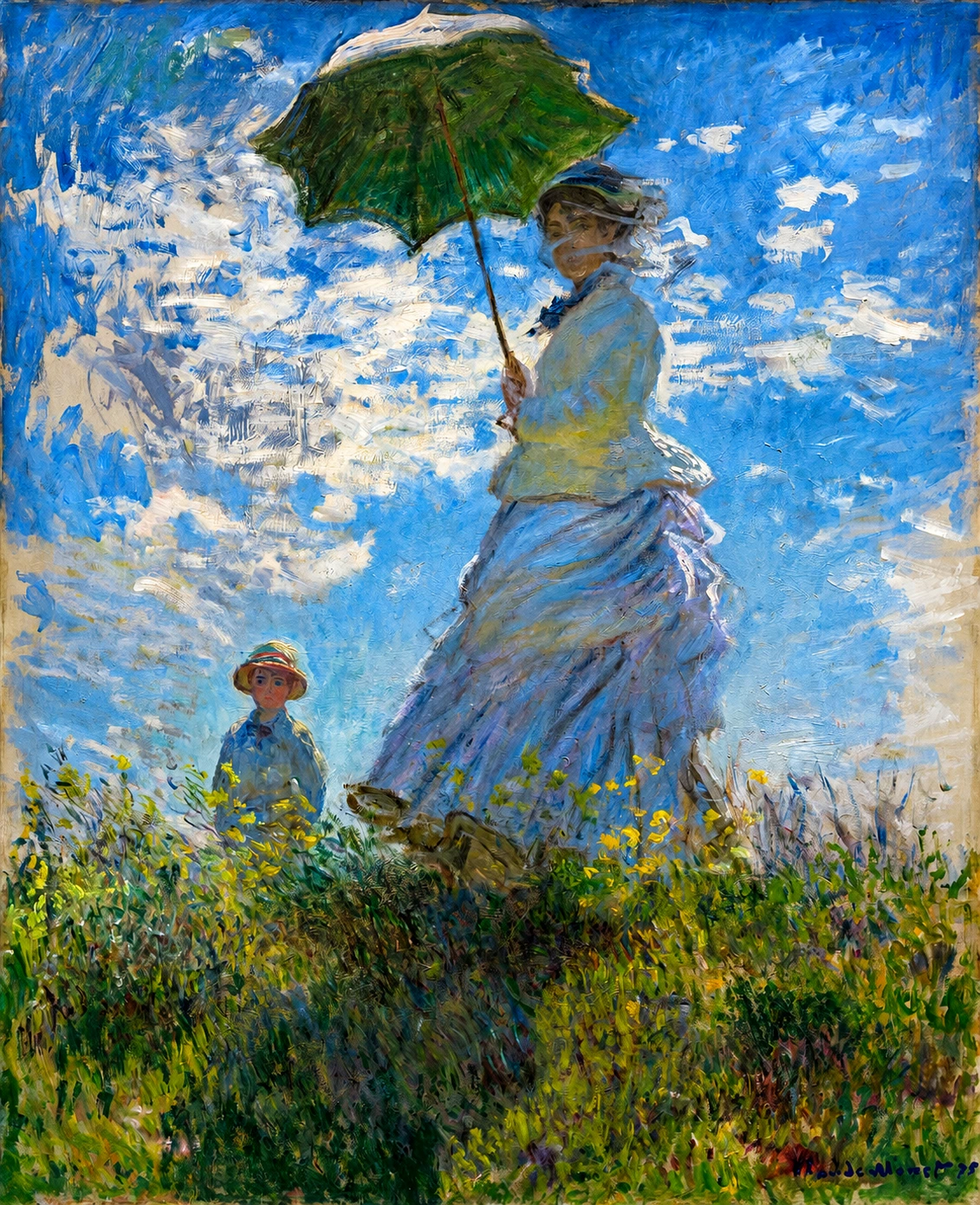
Claude Monet’s “The Promenade, Woman with a Parasol” from 1875 is one of the most radiant images of Impressionism, a painting that seems less constructed than caught in a passing instant. The scene shows a woman standing on a grassy rise beneath a green parasol, while a young boy appears lower in the meadow behind her. The figures are usually understood as Camille Monet, the artist’s wife, and their son Jean. Rather than presenting them as formal portrait subjects, Monet places them inside a living atmosphere of wind, sunlight, cloud, grass, and movement.
The painting belongs to Monet’s years at Argenteuil, a period when he was deeply engaged with outdoor painting and the changing effects of natural light. Everything in the work feels temporary. The clouds are moving, the dress is shifting in the breeze, the grasses are alive with flickering color, and the woman turns as though she has just noticed the viewer. Monet transforms a simple family walk into a study of perception itself.
Composition and the Feeling of Movement
The composition is striking because Monet places Camille high against the sky, giving her figure an almost monumental presence while still keeping the scene informal. She is not posed in a studio or surrounded by symbolic objects. She stands outdoors, seen from below, as if the viewer has looked up from the grass and caught her mid-walk. This low viewpoint makes the sky feel vast and immediate, while the meadow becomes a textured foreground that rises toward the figures.
The parasol anchors the upper part of the painting. Its green canopy spreads across the sky like a second patch of landscape, echoing the grasses below. Its tilted angle suggests wind, shelter, and motion all at once. Camille’s body leans slightly, her veil and skirt lifted by the breeze. Even Jean, though smaller and more still, contributes to the sense of a passing moment. He appears half-hidden among the flowers and grasses, as though the scene has been discovered rather than arranged.
Monet’s arrangement avoids rigid symmetry. Camille is placed slightly to the right, Jean to the left, and the parasol rises near the center. This balance feels natural rather than calculated. The viewer’s eye moves upward from the wild vegetation, across Camille’s pale dress, toward the parasol and the brilliant sky. The whole composition has the upward lift of wind.
Light, Color, and Atmosphere
The true subject of “The Promenade, Woman with a Parasol” is light. Monet uses color not simply to describe objects, but to show how sunlight changes them. Camille’s white dress is not painted as pure white. It contains blues, lavenders, grays, soft yellows, and cool shadows. These tones suggest fabric glowing in daylight, receiving reflections from the sky and surrounding meadow.
The sky is built from broad, energetic strokes of blue and white. The clouds do not sit calmly in the background. They seem to race behind the figure, matching the movement of the parasol, veil, and grass. Monet’s brushwork allows the sky to feel airy and physical at the same time. It is not a flat backdrop, but an active presence.
The meadow is equally alive. Green, yellow, purple, and darker blue-green strokes create the sensation of tall grass and wildflowers stirred by wind. Monet does not define every plant. Instead, he uses broken color to create a visual vibration. The field feels full of sun, shadow, and movement. This is one of the great achievements of the painting: it does not freeze nature into detail, but gives the impression of seeing nature while it is changing.
Camille Monet as Figure and Atmosphere
Camille is central to the painting, yet she is not described with the hard clarity of traditional portraiture. Her face is partly veiled, softened by shadow, and dissolved into surrounding light. This does not make her less important. Instead, it makes her part of the atmosphere. She is a figure made of air, fabric, sunlight, and movement.
Her pale dress occupies much of the composition, but Monet treats it with loose, sweeping strokes rather than precise contour. The skirt seems to billow outward, catching the wind and reflecting the sky. The figure is both present and fleeting. She looks substantial enough to command the scene, yet delicate enough to disappear into the brightness around her.
This treatment reflects Monet’s Impressionist priorities. He is not trying to record every feature of Camille’s appearance. He is trying to capture how she appeared in a specific instant, outdoors, under shifting light. The parasol shades her face, while the sun illuminates the edges of her body and dress. She becomes a meeting point between human presence and natural sensation.
Jean Monet and the Intimacy of the Scene
Jean’s small figure adds tenderness and depth to the painting. He stands lower in the meadow, looking outward from beneath a hat. His placement makes the scene feel personal without becoming sentimental. He is not the main focus, yet his presence changes the emotional character of the work. The painting becomes not just a study of light, but a glimpse of family life.
The distance between Camille and Jean creates a subtle rhythm. She rises against the sky, while he remains closer to the earth. She is swept into the brightness above, while he is partly absorbed by the grasses. Together, they suggest a shared walk, a summer day, and a private moment seen with affection.
Monet’s decision to include Jean in this way also deepens the sense of spontaneity. The painting does not feel like a planned family portrait. It feels like a moment from ordinary life that suddenly became visually extraordinary.
Impressionist Brushwork and Modern Vision
“The Promenade, Woman with a Parasol” is a powerful example of Impressionist brushwork. Monet’s strokes remain visible, energetic, and varied. In the sky, they are broad and sweeping. In the dress, they become layered and directional. In the grass, they are short, tangled, and flickering. The brushwork does not hide the process of painting. It invites the viewer to experience the act of seeing as something active and unstable.
This visible handling was central to the modernity of Impressionism. Monet moved away from polished surfaces and carefully blended academic finish. He wanted the painting to retain the freshness of direct observation. The result is a work that feels immediate even today. It has the vividness of a memory and the quickness of a glance.
The Lasting Appeal of the Painting
The enduring appeal of “The Promenade, Woman with a Parasol” lies in its combination of simplicity and brilliance. The subject is easy to understand: a woman and child outdoors on a windy day. Yet Monet transforms that simple subject into a dazzling study of light, air, and movement. The painting feels joyful, but not decorative in a shallow way. Its beauty comes from the sensitivity with which Monet observes the world.
The work also captures something central to Impressionism: the belief that modern painting could find greatness in ordinary moments. Monet does not need mythology, drama, or historical grandeur. He finds visual poetry in a parasol, a summer sky, a white dress, a child in the grass, and the wind passing through a meadow.
In this painting, time seems to pause and move at once. Camille turns, the clouds drift, the grass trembles, and the sunlight changes. Monet gives us not a fixed scene, but an experience of being there. “The Promenade, Woman with a Parasol” remains one of his most beloved works because it captures the fragile beauty of a moment before it vanishes.