Impression, Sunrise by Claude Monet: Vibrant Color Edit
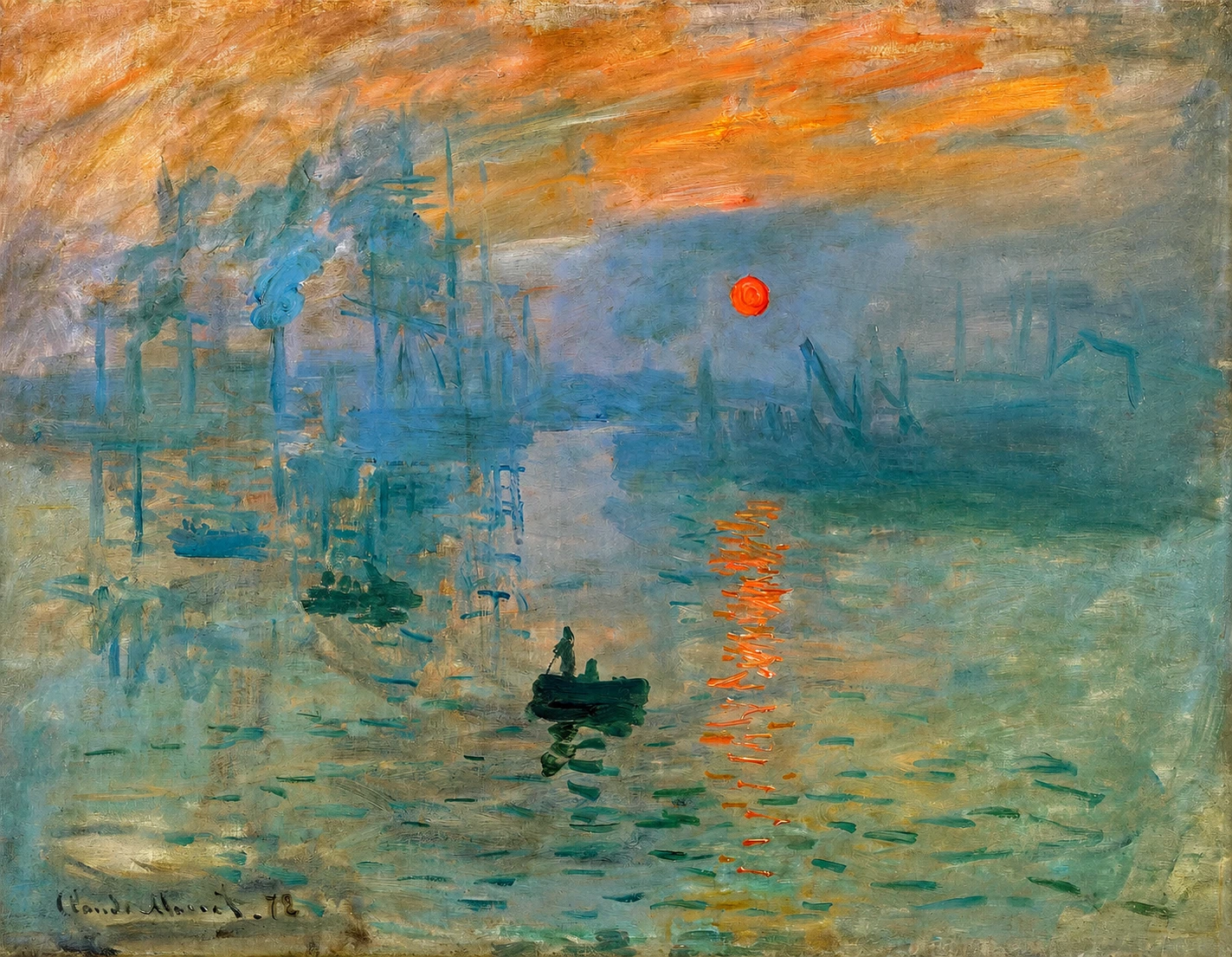
Free to Download & Reuse: You are welcome to use this image! If you republish or share it online, you must include a direct link back to this webpage for attribution.
Original Image Source: wikiart.org
Introduction
Claude Monet’s “Impression, Sunrise” from 1872 is one of the most important paintings in the history of modern art. The work shows the harbor of Le Havre at dawn, with a small orange sun rising through mist, smoke, and cool blue-gray atmosphere. At first glance, the painting may appear simple: a few boats, a glowing reflection, vague industrial forms, and a hazy sky. Yet this apparent simplicity is exactly what made the painting so radical. Monet was not trying to describe the port with polished detail. He was trying to capture the instant sensation of seeing it, before the eye organizes everything into firm outlines and fixed objects.
The painting’s title became historically important because the word “Impression” helped give the Impressionist movement its name. What had first seemed unfinished or sketchlike to critics later became recognized as a new way of painting. Monet’s work shifted attention away from precise academic finish and toward light, color, movement, and perception.
The Harbor of Le Havre
“Impression, Sunrise” is rooted in Monet’s personal connection to Le Havre, the port city where he spent much of his youth. The painting presents the harbor not as a grand urban panorama, but as a fleeting visual experience. Ships, cranes, chimneys, and masts appear in the background, but they are softened by fog and atmosphere. Instead of carefully separating each structure, Monet lets them dissolve into the morning haze.
This setting is important because Le Havre was both a natural and industrial landscape. The water, sky, and sunrise suggest beauty and calm, while the dark silhouettes of ships and the smoke-filled atmosphere point to modern commerce. Monet does not treat industry as an intrusion that must be hidden. He absorbs it into the visual rhythm of the scene. The harbor becomes a place where nature and modern life meet, blurred together by light.
Color and Atmosphere
The most striking feature of the painting is its color harmony. Monet builds most of the image from muted blues, greens, grays, and soft browns. These colors create a cool, damp atmosphere, suggesting early morning air heavy with mist. Against this subdued palette, the small orange sun becomes intensely powerful. It is not large, but it controls the entire painting.
The sun’s reflection stretches downward in broken orange strokes across the water. These marks are loose and almost abstract, yet they immediately communicate shimmering light. Monet does not paint a smooth reflection. He paints the sensation of light scattered across moving water. The contrast between the orange sun and the blue-green surroundings gives the painting its emotional charge. The scene feels quiet, chilly, and atmospheric, but also alive with the first warmth of day.
Brushwork and Modern Vision
Monet’s brushwork in “Impression, Sunrise” is central to its meaning. The paint is applied in quick, visible strokes that do not hide the artist’s hand. The boats are reduced to dark shapes. The figures inside them are barely indicated. The distant ships and harbor equipment are suggested with vertical and horizontal marks rather than fully described forms.
This loose handling was shocking to viewers accustomed to smooth academic painting. In traditional salon art, brushstrokes were often blended until the surface looked polished and complete. Monet did the opposite. He allowed the marks to remain visible, making the painting feel immediate and fresh. The viewer can sense the speed of observation, as if Monet had to work quickly before the light changed.
This technique supports the painting’s theme. “Impression, Sunrise” is not about permanent form. It is about temporary effects. The fog will lift, the sun will rise higher, the boats will move, and the colors of the harbor will change. Monet’s brushwork expresses that instability.
Composition and Visual Balance
The composition of “Impression, Sunrise” is carefully balanced despite its loose appearance. The sun sits slightly right of center, becoming the visual anchor of the painting. Below it, the orange reflection creates a vertical path that draws the eye from the sky down into the water. This glowing line connects the upper and lower halves of the scene.
The dark boat in the foreground provides contrast and depth. Its strong silhouette gives the viewer a point of entry into the hazy space. Other boats and harbor shapes recede into the mist, creating a sense of distance without relying on sharp perspective. Monet uses atmosphere rather than architecture to build space.
The left side of the painting contains heavier industrial forms, while the right side opens into softer, more ambiguous shapes. This balance between density and openness keeps the composition from feeling static. Everything seems suspended between visibility and disappearance.
Why the Painting Was Revolutionary
“Impression, Sunrise” was revolutionary because it challenged what a finished painting could be. Monet did not present the harbor as a detailed record. He presented it as an optical event. The painting asks the viewer to accept sensation as a valid subject in itself.
This was a major break from the expectations of nineteenth-century French art. Academic painting often valued historical themes, mythological subjects, clear drawing, and refined surfaces. Monet focused instead on everyday modern life, natural light, and the changing conditions of vision. The painting’s meaning lies not in a story, but in the act of seeing.
Its apparent incompleteness was part of its innovation. Monet trusted the viewer’s eye to complete the scene. A few strokes become rippling water. A dark patch becomes a boat. A soft vertical mark becomes a mast or chimney. This active relationship between painting and viewer became one of the defining features of Impressionism.
The Emotional Mood of the Work
Although “Impression, Sunrise” is often discussed for its technical importance, it also has a powerful emotional atmosphere. The painting feels quiet, uncertain, and dreamlike. The harbor is waking, but not yet fully awake. Human activity is present, but subdued. The small figures in the boat seem absorbed into the larger rhythm of water, fog, and light.
The mood is neither purely peaceful nor purely industrial. It is somewhere between beauty and obscurity. The sun suggests renewal, but the haze keeps the scene mysterious. This emotional ambiguity gives the painting lasting appeal. Monet captures not only what dawn looks like, but how dawn can feel: brief, fragile, and half-formed.
Legacy of “Impression, Sunrise”
The legacy of “Impression, Sunrise” is enormous. The painting helped define Impressionism, one of the most influential movements in Western art. Its title became attached to a style that valued direct observation, broken color, visible brushwork, and the study of light. Monet would continue exploring these ideas throughout his career, especially in his series paintings of haystacks, poplars, Rouen Cathedral, and water lilies.
Yet “Impression, Sunrise” remains unique because it captures the beginning of something larger. It is both a harbor scene and a statement about modern painting. Monet showed that a work of art did not need to describe every detail to be truthful. It could be truthful to perception, atmosphere, and time.
The painting endures because it still feels immediate. Even today, the viewer can sense the damp air, the dim morning light, and the glowing sun breaking through the mist. “Impression, Sunrise” is not only a landmark of Impressionism. It is a painting about the beauty of a moment before it disappears.