Water Lilies by Claude Monet: Vibrant Color Edit
Free to Download & Reuse: You are welcome to use this image! If you republish or share it online, you must include a direct link back to this webpage for attribution.
Original Image Source: wikiart.org
Water Lilies by Claude Monet: A Late Vision of Giverny
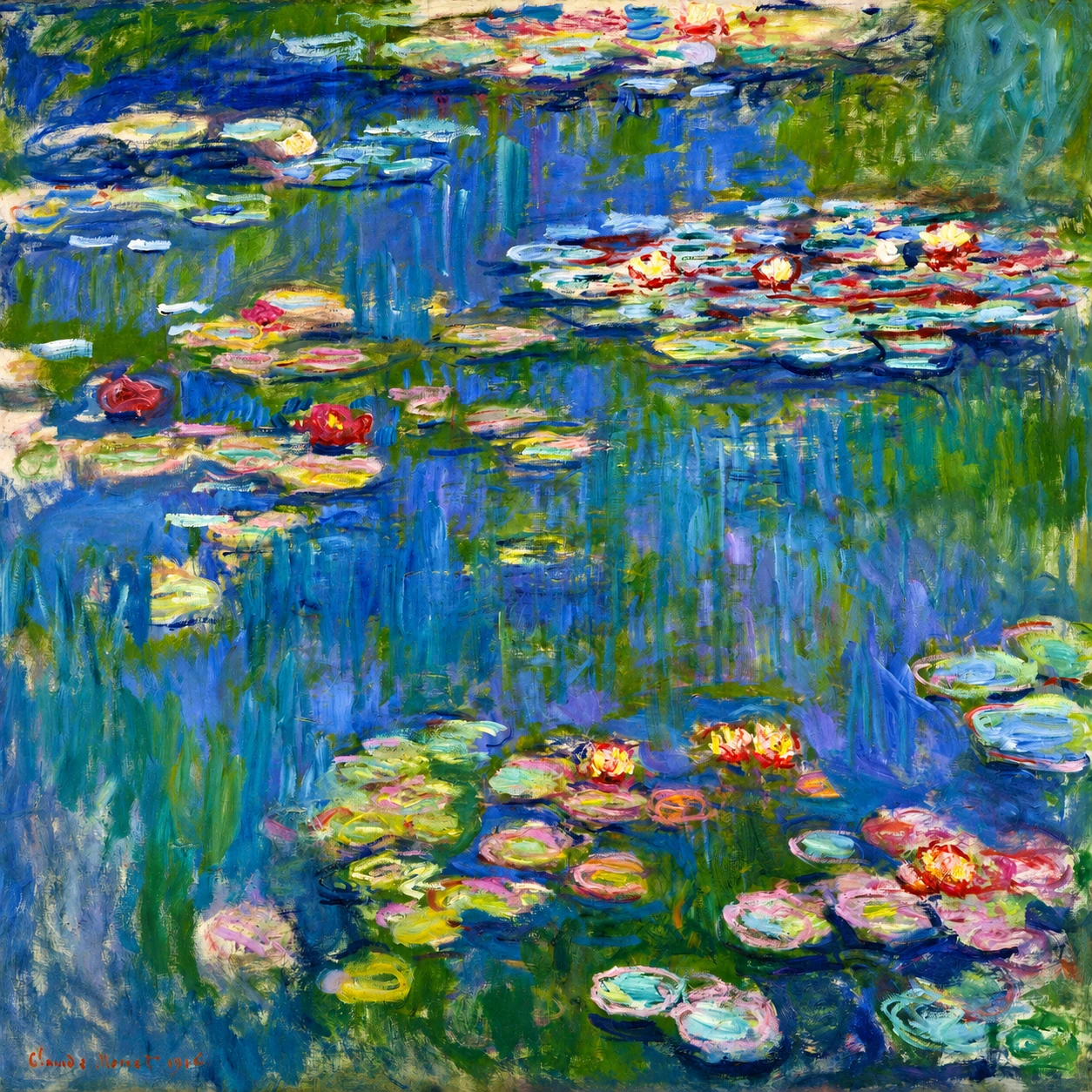
Claude Monet’s Water Lilies from 1916 belongs to one of the most important and recognizable series in modern art. Painted during the later years of his life, this work shows Monet’s garden pond at Giverny, but it does not present the scene as a simple landscape. Instead, it becomes a floating world of color, reflection, movement, and atmosphere. The painting captures the surface of water covered with lily pads and blossoms, yet it also suggests sky, trees, depth, and shifting light. In Water Lilies, Monet turns a familiar garden subject into a nearly immersive visual experience.
By 1916, Monet had spent decades studying the effects of light and color. His garden at Giverny became his great artistic laboratory. Rather than travel widely in search of subjects, he found endless variety in the same pond, returning to it again and again as the weather, seasons, and hours changed. This painting reflects that mature concentration. It is not about describing every detail accurately. It is about recording the sensation of looking, the way the eye moves across water, catches a flower, loses itself in reflection, and returns to the trembling surface.
Composition and the Absence of a Horizon
One of the most striking qualities of this painting is its lack of a traditional horizon. Monet does not give the viewer a clear shoreline, sky, or fixed point of entry. The entire canvas is filled with water, lilies, reflections, and painterly movement. This makes the image feel open and continuous, as though it could extend beyond the edges of the frame.
The composition is balanced through clusters of lily pads and flowers. Some gather near the upper right, others float across the lower half, while smaller patches appear throughout the center and left side. These areas guide the eye without creating a rigid structure. The viewer drifts from one group to another, much like the water itself might carry light, leaves, and reflections across the pond.
This floating composition is central to the power of Water Lilies. Instead of standing outside the scene, the viewer seems to hover above it. There is no firm ground. The painting becomes an environment rather than a window. Monet invites us not simply to look at the pond, but to feel surrounded by its colors and rhythms.
Color, Light, and Reflection
The color palette is rich but delicate. Blues and violets dominate the water, creating a cool, atmospheric foundation. These tones are interrupted by greens, pinks, yellows, reds, and pale whites. The lily pads appear in soft greens and light blues, while the blossoms glow with warmer accents. The contrast between cool water and warm flowers gives the painting much of its visual energy.
Monet’s color is not used only to describe objects. It also describes light. The blue and purple areas suggest reflections of sky, while the vertical green strokes evoke trees and reeds mirrored on the water’s surface. At the same time, the viewer is never entirely sure where reflection ends and surface begins. This ambiguity is part of the painting’s beauty. The pond becomes a place where sky, plant life, and water dissolve into one another.
The red and pink blossoms provide small but important points of intensity. They draw attention without dominating the composition. Their brightness makes the surrounding water feel deeper and more luminous. The flowers seem to flicker, as though they are catching sunlight for only a moment before the light changes again.
Brushwork and Surface Movement
The brushwork in Water Lilies is loose, layered, and expressive. Monet does not hide the act of painting. The strokes are visible everywhere, from the quick marks that form lily pads to the vertical streaks that suggest reflected plants. This visible brushwork gives the painting a living surface. Nothing feels still. The water appears to ripple, shimmer, and breathe.
Some strokes are broad and soft, blending into the surrounding color. Others are sharper and more energetic, especially around the flowers and lily pads. This variation creates a feeling of movement across the canvas. The eye senses water even when Monet does not draw waves in a conventional way. He suggests motion through color relationships, broken forms, and repeated touches of paint.
The painting’s surface also shows Monet’s move toward abstraction. The subject is still recognizable, but many areas are made of marks that do not fully resolve into objects. A patch of blue may be water, sky, shadow, or all three at once. A green stroke may be a reflection or a plant. This openness allows the image to remain active. The viewer participates in completing the scene.
Monet’s Late Style
Painted in 1916, Water Lilies comes from Monet’s late period, when his work became larger, freer, and more immersive. His late water lily paintings are often seen as a bridge between Impressionism and later forms of abstraction. The Impressionist interest in light remains, but the structure of traditional landscape painting becomes less important. What matters most is sensation.
In this period, Monet was not simply repeating an earlier success. He was pushing his art into new territory. The garden pond became a subject through which he could explore time, perception, and the instability of vision. The more he painted the water lilies, the less the paintings depended on fixed outlines or conventional space. Instead, they became meditations on how the world appears through light and color.
This painting shows that transformation clearly. The lilies are beautiful, but they are not arranged like flowers in a decorative pattern. They are part of a larger visual field. The reflections, shadows, and water are just as important as the blossoms. Monet treats the entire surface as a living fabric of perception.
The Emotional Atmosphere of the Painting
Although Water Lilies is based on a garden scene, its mood is more complex than simple peacefulness. There is calm in the floating flowers and cool water, but there is also intensity in the restless brushwork and deep colors. The painting feels contemplative, yet alive with movement. It suggests quiet observation, but not stillness.
The absence of figures adds to this atmosphere. No person appears in the scene, and there is no narrative event. The painting asks the viewer to slow down and look closely. Its drama comes from light, color, and the act of perception itself. In this way, Monet transforms the pond into a private world of reflection and feeling.
The water also carries a sense of depth and mystery. Because the viewer cannot always tell what is above, below, or reflected, the scene feels almost dreamlike. The surface of the pond becomes a boundary between the visible and the intangible. Monet paints not only what he sees, but the experience of seeing something that is always changing.
Why Water Lilies Remains Important
Water Lilies by Claude Monet remains important because it shows the full maturity of one of art history’s greatest investigations into light. Monet takes a modest subject from his own garden and turns it into a profound study of vision. The painting is both natural and abstract, intimate and expansive, decorative and deeply serious.
Its lasting appeal comes from this balance. Viewers can enjoy it immediately as a beautiful image of flowers on water, but they can also return to it again and again and find new complexities. The colors shift. The reflections become more mysterious. The brushwork grows more expressive. The painting does not reveal itself all at once.
In Water Lilies, Monet creates a world where nature is seen through movement, memory, and light. The painting is not a frozen view of a pond in 1916. It is an experience of perception itself, captured in paint. That is why Monet’s water lilies continue to feel modern, intimate, and alive more than a century later.