Water Lilies by Claude Monet: Vibrant Color Edit
Free to Download & Reuse: You are welcome to use this image! If you republish or share it online, you must include a direct link back to this webpage for attribution.
Original Image Source: wikiart.org
Introduction
Claude Monet’s “Water Lilies” from 1919 belongs to one of the most recognizable and deeply personal series in modern art. By this point in his career, Monet had spent decades observing the pond at his home in Giverny, returning again and again to the same floating lilies, mirrored trees, shifting sky, and trembling surface of water. Yet this painting is not simply a decorative view of a garden. It is a meditation on perception, time, aging, and the dissolving boundary between nature and abstraction.
The scene appears simple at first: a pond filled with lily pads, flowers, reflections, and moving light. But Monet transforms this familiar subject into a visual experience that feels almost limitless. There is no traditional horizon, no fixed viewpoint, and no clear separation between solid forms and reflected images. Instead, the viewer is invited to enter a world of color, rhythm, and atmosphere, where the surface of the water becomes both a mirror and a living field of paint.
The Floating Composition
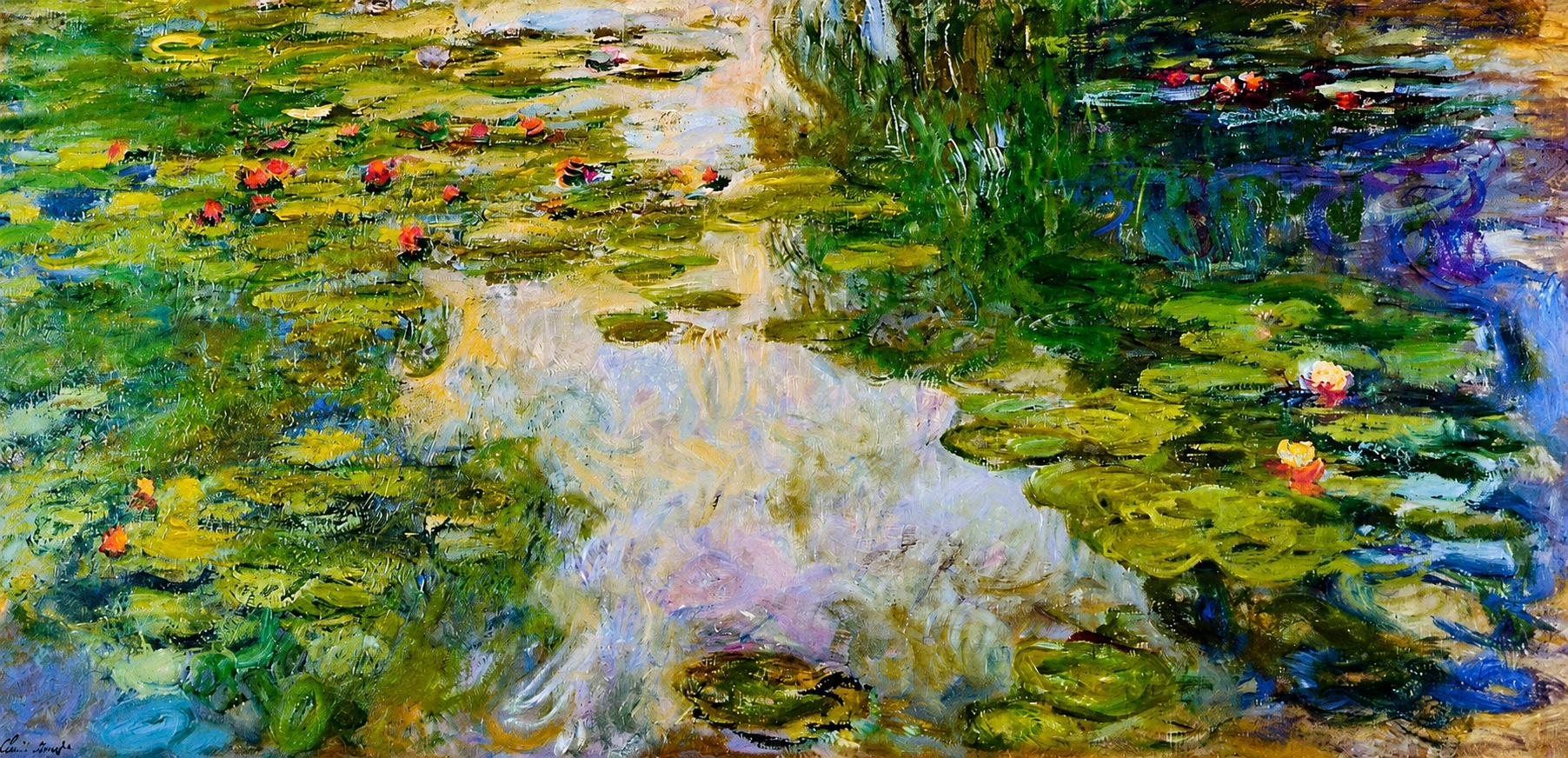
One of the most striking qualities of “Water Lilies” is its open, floating composition. Monet does not frame the pond from a distance. He places the viewer directly over the water, as though we are standing at the edge of the pond and looking into a surface that continues beyond the canvas. The horizontal format strengthens this sensation, allowing the eye to drift across the painting rather than settle on a single focal point.
The lily pads are scattered across the water in clusters, creating a loose rhythm from left to right. Some pads are sharply visible, while others dissolve into soft green strokes. The flowers appear as small accents of red, pink, yellow, and white, punctuating the green and blue surface like brief flashes of life. Their placement feels natural rather than arranged, yet Monet carefully balances them across the canvas so that the composition never feels empty or crowded.
The central area of pale reflection gives the painting a luminous opening. It interrupts the darker greens and blues around it, suggesting sky reflected in the pond. This bright passage pulls the viewer inward, but it does not become a conventional center. Instead, it functions like a breathing space, a place where light expands and forms become uncertain.
Color, Light, and Reflection
Monet’s color palette is rich but controlled. Greens dominate the image, ranging from deep mossy tones to yellowish highlights and cool blue greens. These greens give the painting its organic life, suggesting both the lily pads floating on the water and the vegetation reflected from the banks of the pond. The blues and violets, especially on the right side, add depth and coolness, making the water feel shadowed and alive.
What makes the painting especially powerful is Monet’s treatment of reflection. The water does not simply reflect the sky and trees in a realistic way. It breaks them apart into strokes, patches, and wavering bands of color. The pale reflection near the center seems to contain sky, cloud, and light, but none of these elements is fully defined. The darker vertical strokes near the upper center suggest trees or reeds reflected in the water, yet they also read as abstract marks.
This ambiguity is essential to the painting. Monet is not trying to tell us exactly what is above the pond or around it. He is showing how vision changes when light, water, and movement interfere with certainty. The painting captures not objects alone, but the experience of looking.
Brushwork and Surface
The brushwork in “Water Lilies” is energetic, layered, and expressive. Monet uses short, broken strokes to describe the lily pads, while longer, looser marks create the motion of reflections. In some areas, the paint feels dense and textured, especially where the greens overlap. In other areas, the strokes are thinner and more transparent, allowing the light of the canvas and neighboring colors to create a shimmering effect.
This brushwork gives the pond a living surface. Nothing appears still. Even the lily pads, which are physically floating objects, seem to pulse with the movement of the water and the motion of Monet’s hand. The viewer becomes aware of the painting as both image and material object. We see a pond, but we also see paint behaving like water, light, vegetation, and air.
By 1919, Monet’s late style had become freer and more immersive than his earlier Impressionist paintings. The forms are less clearly outlined, the brushwork is broader, and the distinction between representation and abstraction is less stable. This does not mean the painting abandons nature. Rather, nature becomes the starting point for a more intense visual language.
The Garden at Giverny as a World Apart
Monet’s water lily pond at Giverny was not just a subject he found by chance. It was a space he designed, cultivated, and studied over many years. The pond became an artistic world of its own, a place where he could observe the same motif under changing conditions of light, season, weather, and time of day. In “Water Lilies,” the garden is not presented as a picturesque landscape with paths, architecture, or figures. It becomes a self contained universe of water and reflection.
This focus gives the painting an intimate feeling. Monet is not offering a grand historical scene or a dramatic narrative. He is concentrating on something quiet and ordinary, yet through sustained attention, he reveals its complexity. The pond becomes a site of endless transformation. A patch of water can contain sky, shadow, flower, leaf, and reflected tree all at once.
The absence of people also matters. There is no figure to guide our interpretation. The viewer’s own gaze becomes the human presence in the painting. We are not watching someone experience the garden. We are placed inside the act of perception ourselves.
A Late Impressionist Vision
“Water Lilies” reflects the legacy of Impressionism, but it also moves beyond it. Early Impressionism often emphasized modern life, outdoor painting, fleeting light, and everyday subjects. Monet remains faithful to the Impressionist desire to capture the changing effects of light, but his late water lily paintings are more contemplative and expansive. They are less about a momentary glimpse of the world and more about total immersion in vision.
The painting’s lack of traditional depth is especially important. Instead of leading us into a landscape through foreground, middle ground, and background, Monet flattens the view across the surface of the canvas. The water is both deep and flat, both illusion and surface. This quality helped make his late work feel important to later modern artists, especially those interested in abstraction. The painting still represents a pond, but it also invites us to experience color and form for their own sake.
Mood and Meaning
The mood of this painting is peaceful, but not static. It has a quiet emotional intensity. The water lilies suggest beauty and calm, while the reflections introduce mystery and instability. The viewer senses the passage of time in the broken light and shifting surface. Nothing is permanent. The flowers bloom briefly, the light changes, the water moves, and the reflection disappears as soon as conditions change.
This gives “Water Lilies” a poetic quality. Monet turns the pond into an image of perception itself. To look at the painting is to feel how uncertain and beautiful seeing can be. The world is not fixed into hard outlines. It is made of relationships between color, light, memory, and sensation.
Conclusion
Claude Monet’s “Water Lilies” from 1919 is more than a garden scene. It is a mature statement by an artist who had spent his life studying light and color. Through floating composition, luminous reflections, and expressive brushwork, Monet transforms a pond into an immersive field of visual sensation. The painting captures the quiet beauty of water lilies, but it also reaches toward something larger: the mystery of how the visible world changes before our eyes.
Its power lies in this balance between simplicity and depth. The subject is familiar, yet the experience is almost dreamlike. Monet asks us to slow down, to look carefully, and to accept the shifting nature of perception. In doing so, “Water Lilies” becomes one of the great examples of late Impressionist vision, a painting where nature, memory, and abstraction meet on the surface of water.