Water Lilies by Claude Monet: Vibrant Color Edit
Free to Download & Reuse: You are welcome to use this image! If you republish or share it online, you must include a direct link back to this webpage for attribution.
Original Image Source: wikiart.org
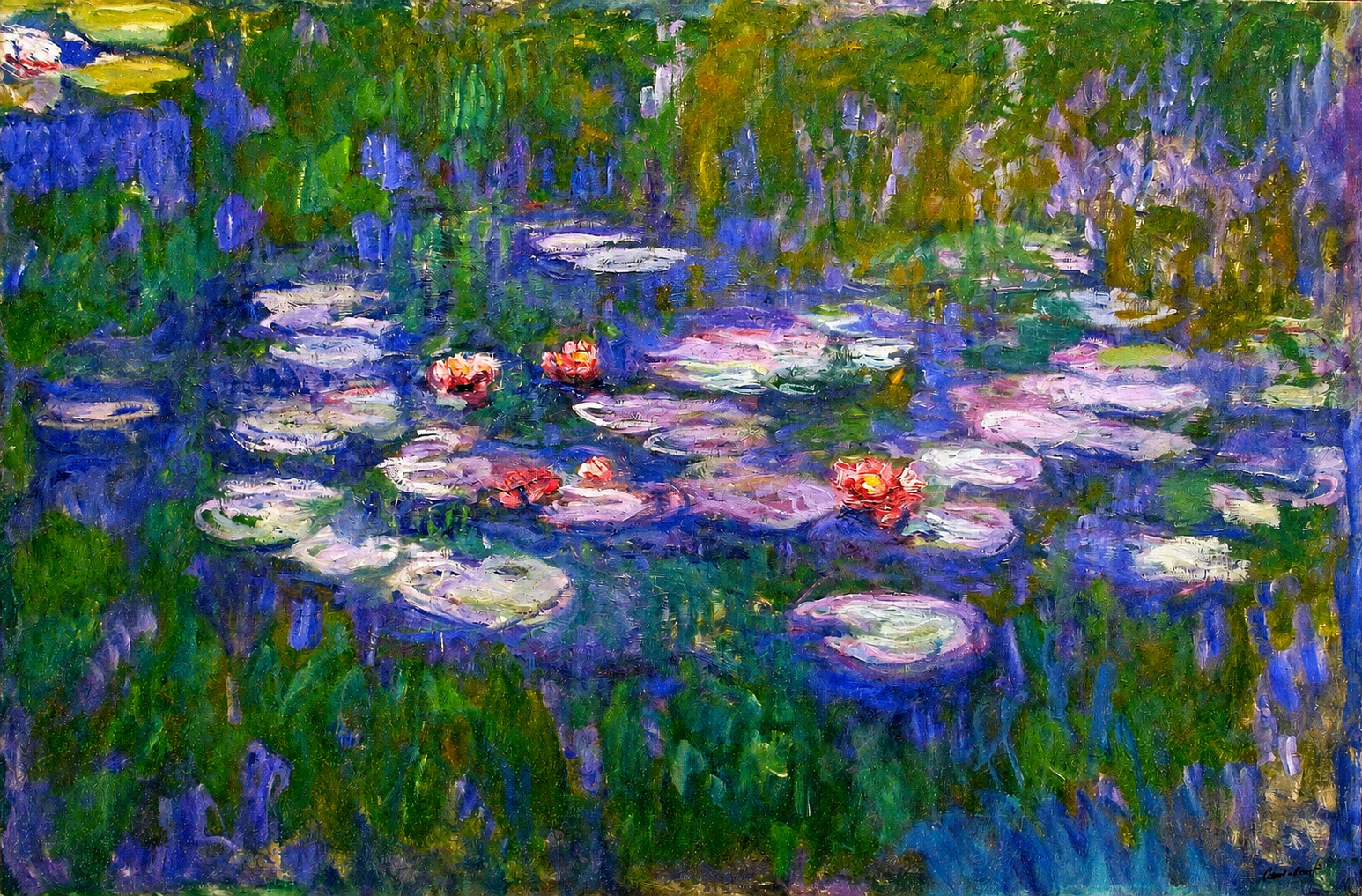
Claude Monet’s “Water Lilies” from 1919
Claude Monet’s “Water Lilies” from 1919 belongs to the great late period of the artist’s career, when his garden at Giverny became the center of his artistic universe. Instead of painting wide landscapes, bustling streets, or recognizable architecture, Monet turned repeatedly toward the pond he had designed and cultivated himself. In this work, the subject is simple: floating lily pads, blooming water lilies, reflected greenery, and the shimmering surface of water. Yet the painting feels far larger than a garden scene. It becomes a meditation on light, color, perception, and the unstable beauty of nature.
The composition removes nearly every traditional point of orientation. There is no horizon line, no sky shown directly, and no solid bank to tell the viewer where the pond ends. Monet places us above the water, looking down into a world of reflections and floating forms. The result is immersive. The eye does not travel into depth in the usual way. Instead, it wanders across the surface, moving from pale lily pads to violet shadows, from deep green passages to bright orange blossoms. The painting feels less like a window onto a scene and more like an atmosphere surrounding the viewer.
The Floating Composition
One of the most striking qualities of “Water Lilies” is the way Monet builds the composition without relying on firm outlines. The lily pads appear as pale, irregular ovals scattered across the pond. Some are clearly visible, while others dissolve into the surrounding reflections. This creates a rhythm across the canvas. The flowers act as small sparks of warmth within a cooler field of greens, blues, purples, and silvery whites.
The arrangement feels natural rather than staged, but it is carefully balanced. The brightest blossoms are placed near the center and right side, drawing attention into the middle of the image. The pale pads spread outward, creating a loose horizontal movement. Around them, vertical strokes of green and violet suggest reflected plants, reeds, and trees. These reflections give the painting a sense of depth, even though the surface remains dominant. Monet allows the pond to become both mirror and field, both real water and abstract color.
This floating structure is one reason the painting feels modern. Monet is not interested in describing every botanical detail. He is interested in how water, plants, and reflected light merge in vision. The forms are recognizable, but they constantly shift toward abstraction. The viewer knows this is a lily pond, yet the experience of looking is more important than the exact identity of each shape.
Color, Light, and Reflection
The color palette is one of the painting’s greatest strengths. Monet uses cool blues, violets, greens, and soft lavenders to create the watery atmosphere. These colors do not simply describe the pond. They suggest the way light changes when it is reflected, absorbed, and broken apart by water. The purple and blue tones give the scene a dreamlike quality, while the greens anchor it in the living garden.
The orange and red water lilies provide a powerful contrast. They are small compared with the overall canvas, but their warmth gives the painting energy. These blossoms glow like brief flashes of sunlight, standing out against the cooler surroundings. Monet often used complementary relationships to make color vibrate, and here the warm flowers intensify the blues and greens around them.
The white and pale pink lily pads are equally important. They catch the light and create resting places for the eye. Some appear almost solid, while others look thin and transparent. This variation gives the surface a flickering quality. Nothing in the painting feels fixed. Every form seems to be changing with the movement of light across the pond.
Brushwork and Late Monet
By 1919, Monet’s brushwork had become looser, broader, and more expressive than in much of his earlier work. In this painting, the strokes are visible and active. They do not hide behind illusion. Instead, they create the sensation of water through layered touches of paint. Short, quick marks describe lily pads and blossoms, while longer vertical strokes suggest reflections. The brushwork lets the painting breathe.
This late style gives “Water Lilies” a powerful emotional presence. Monet was still connected to Impressionism, but these works move beyond the quick outdoor impression associated with his earlier career. The surface feels denser and more inward. The garden is not only observed, it is remembered, felt, and transformed through paint.
The looseness of the handling also helps explain why Monet’s late water lily paintings were so influential for modern art. They anticipate abstraction without abandoning nature. The pond remains visible, but it is also a field of color and movement. Monet shows that a painting can be based on direct observation while also becoming a nearly abstract arrangement of tones, textures, and sensations.
The Giverny Garden as Artistic World
Monet’s Giverny garden was not just a subject he found by chance. It was a world he created. The pond, water lilies, Japanese bridge, and surrounding plantings became an artistic laboratory where he could study changing light over many years. In “Water Lilies” from 1919, that long familiarity is clear. Monet does not paint the pond like a visitor discovering it for the first time. He paints it like someone who has watched it through countless hours, seasons, and weather conditions.
This intimacy gives the work its quiet intensity. The painting does not need dramatic action. Its drama comes from perception itself. The surface of the water contains reflections of trees, sky, flowers, and shadow, but none of these elements remains separate for long. Everything blends into a single visual experience. The pond becomes a place where the boundaries between object and reflection, depth and surface, nature and art begin to disappear.
Meaning and Mood
“Water Lilies” has a peaceful mood, but it is not empty or decorative. Its beauty comes from concentration. Monet asks the viewer to slow down and notice subtle relationships: the way violet deepens beside green, the way a pale pad seems to hover, the way a bright flower changes the emotional temperature of the entire scene. The painting rewards patient looking.
There is also a sense of silence in the work. Because there are no figures, buildings, or narrative details, the viewer is left alone with the pond. This absence makes the painting feel timeless. It is not tied to a specific event. Instead, it captures a moment of vision that feels continuous, as though the water could keep shifting forever.
The late date of 1919 adds another layer of meaning. Monet was painting after the devastation of the First World War, and his water lily paintings can be seen as acts of retreat, resilience, and renewal. They do not show conflict directly, but they offer an alternative world of reflection, growth, and fragile harmony. The garden becomes a sanctuary, and painting becomes a way to preserve beauty in a changing world.
Why “Water Lilies” Still Matters
Claude Monet’s “Water Lilies” from 1919 remains compelling because it joins natural observation with visual freedom. It is clearly a painting of a pond, yet it also feels like a study of color, rhythm, and light for their own sake. The work invites viewers to experience nature not as a fixed scene, but as something fluid, layered, and constantly transforming.
The painting’s power lies in its balance between recognition and mystery. We see lilies, water, reflections, and flowers, but we also see paint moving across canvas with extraordinary freedom. Monet turns a quiet garden motif into a vast visual experience. In doing so, he shows why the “Water Lilies” series stands among the most important achievements of modern painting.