Water Lilies by Claude Monet: Vibrant Color Edit
Free to Download & Reuse: You are welcome to use this image! If you republish or share it online, you must include a direct link back to this webpage for attribution.
Original Image Source: wikiart.org
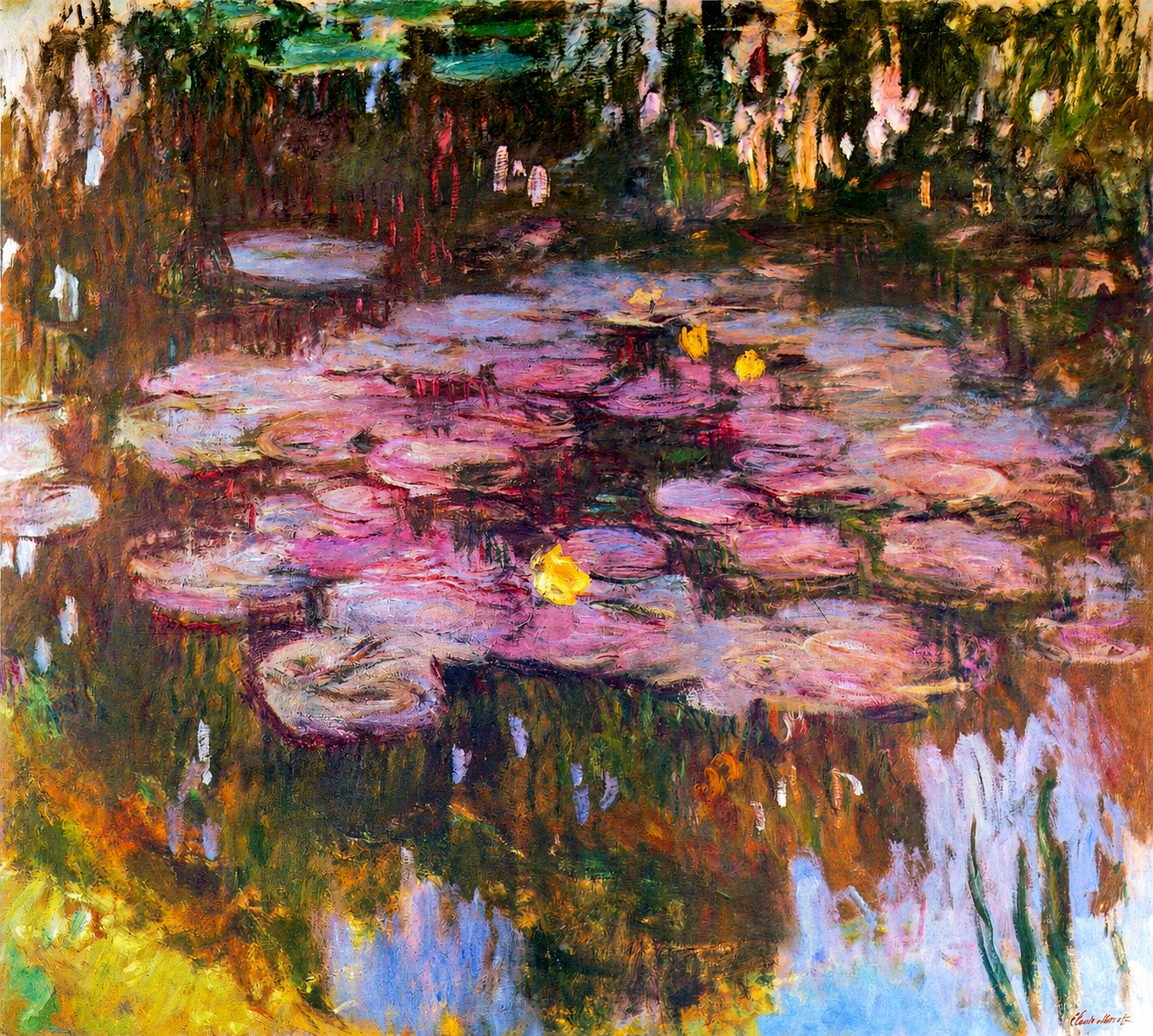
Claude Monet’s “Water Lilies” from 1917
Claude Monet’s “Water Lilies” from 1917 belongs to one of the most famous and deeply personal projects in the history of modern painting. Rather than presenting a traditional landscape with a clear horizon, solid ground, and recognizable distance, Monet turns the surface of the pond into the entire world of the image. The viewer is not placed on a path looking across a garden. Instead, the viewer seems to hover above water, surrounded by reflections, floating lily pads, shifting colors, and dissolving forms. This makes the painting feel both intimate and expansive, as though a small corner of Monet’s garden at Giverny has opened into a vast meditation on light, nature, and perception.
By 1917, Monet had spent decades studying the visual effects of atmosphere, weather, and changing daylight. His water lily paintings were not simply decorative garden scenes. They were the result of a lifelong search for a new way of seeing. In this work, the pond becomes a living mirror. It reflects trees, sky, and surrounding vegetation, but those reflections are unstable. They tremble across the surface, broken by lily pads and touches of bright flower color. The painting captures nature not as a fixed object, but as a continuous movement of light and sensation.
Composition and Spatial Ambiguity
One of the most striking qualities of “Water Lilies” is its lack of conventional perspective. There is no clear foreground, middle ground, or background. The lily pads spread across the image in loose clusters, while the water pulls the eye downward into reflected color. The composition feels almost all-over, with no single central subject dominating the scene. Even the yellow blossoms, though bright and eye-catching, are only temporary accents within a much larger field of movement.
This creates a sense of spatial ambiguity. The viewer is looking at the surface of the pond, but also into the pond, and also at the sky and trees reflected in it. Monet collapses these layers into one visual experience. The pinks, purples, greens, blues, browns, and yellows all appear to exist on the same shimmering plane. The result is a painting that resists ordinary depth. It is not organized like a window onto nature. It is closer to an enveloping atmosphere, a field of color in which water, reflection, plant life, and light become inseparable.
The cropping also gives the painting a modern feeling. The scene appears to continue beyond the edges of the canvas. Monet does not frame the pond neatly or provide a complete view of the garden. Instead, he selects a fragment and allows it to feel endless. This sense of continuation is essential to the emotional effect of the work. The painting seems less like a single view and more like a moment inside a larger, flowing visual world.
Color, Light, and Reflection
Color is the true subject of Monet’s “Water Lilies.” The pond is not painted as a flat blue or green surface. It is alive with mauve, rose, violet, turquoise, ochre, orange, and dark earthy tones. These colors do not merely describe objects. They describe the experience of light passing through air, touching water, bouncing off foliage, and changing from one instant to the next.
The pink and lavender lily pads give the surface a soft, luminous quality, while the darker vertical strokes suggest reflected trees and hanging vegetation. In the lower area, pale blue passages evoke the sky reflected in the pond, but Monet keeps them loose and fluid. The viewer understands them as sky, yet they remain paint, brushwork, and color. This balance between recognition and abstraction is one of the great strengths of the painting.
The yellow water lilies serve as small bursts of warmth. Their brightness contrasts with the cooler purples and blues around them, creating visual rhythm. They guide the eye through the composition without turning into a traditional focal point. These flowers feel like flashes of sunlight, brief and delicate, emerging from the surrounding haze. Monet’s color is vibrant, but it is not harsh. The tones seem to breathe into each other, producing a soft radiance that is central to the painting’s beauty.
Brushwork and Impressionist Technique
The brushwork in “Water Lilies” is energetic, layered, and highly expressive. Monet does not smooth the surface or hide the painter’s hand. Instead, he builds the image through visible strokes, dabs, smears, and sweeping touches of pigment. Some areas are thin and atmospheric, while others are denser and more textured. This variety gives the painting its sense of life.
The lily pads are not carefully outlined botanical forms. They are suggested through rounded strokes and shifting patches of pink, green, and violet. The reflections are even freer, made from vertical marks that seem to drip and ripple across the water. This looseness is not accidental. Monet is painting the sensation of seeing, not the exact inventory of a garden pond. He wants the viewer to feel how vision works when light is unstable and forms are constantly changing.
In this sense, the painting pushes Impressionism toward abstraction. The subject remains recognizable, but the surface becomes increasingly independent. The eye moves between the illusion of water and the physical presence of paint. This tension gives the work its modern power. Monet shows that a painting can be both an image of nature and a self-contained arrangement of color and movement.
Meaning and Late Monet
The year 1917 places this painting within Monet’s late period, when his art became more immersive and introspective. His garden at Giverny was not simply a subject he found. It was a world he created, cultivated, and returned to obsessively. The water lily pond became a place where he could study nature with extraordinary patience, but also a refuge from the pressures of the outside world.
There is a quiet emotional depth in this work. The painting does not tell a story, and it contains no human figures, yet it feels intensely personal. The pond becomes a space of contemplation. Its reflections suggest time passing, memory shifting, and the fragile beauty of perception. Nothing is fixed. The water changes, the light changes, and the forms dissolve as soon as they appear. Monet turns this instability into beauty.
“Water Lilies” also reveals how radical Monet remained near the end of his career. Instead of repeating the formulas of earlier Impressionism, he expanded them. He removed the horizon, loosened the composition, intensified the color, and allowed the painting to become almost immersive. Later artists would see in these works a path toward abstraction, color field painting, and modern ideas of pictorial space.
The Lasting Appeal of “Water Lilies”
The appeal of Claude Monet’s “Water Lilies” lies in its ability to feel both peaceful and visually adventurous. At first glance, it is a beautiful garden painting filled with floating lilies and reflected light. On closer viewing, it becomes something more complex: a study of perception, color, surface, and time. The viewer is invited to slow down and let the image unfold gradually.
The painting captures the essence of Monet’s genius. He transforms a familiar natural subject into an experience of pure visual sensation. The pond is not still. It glows, trembles, deepens, and dissolves. Every part of the canvas participates in this movement. The result is a work that feels alive, not because it describes nature in precise detail, but because it recreates the feeling of nature as it is seen in a fleeting moment.
“Water Lilies” from 1917 stands as one of Monet’s great late achievements. It shows an artist who had moved beyond simple observation into a more profound exploration of vision itself. Through color, reflection, and touch, Monet turns the surface of a pond into a world of shimmering beauty.