Field of Poppies by Claude Monet: Vibrant Color Edit
Free to Download & Reuse: You are welcome to use this image! If you republish or share it online, you must include a direct link back to this webpage for attribution.
Original Image Source: wikiart.org
A Complete Analysis of “Field of Poppies” by Claude Monet
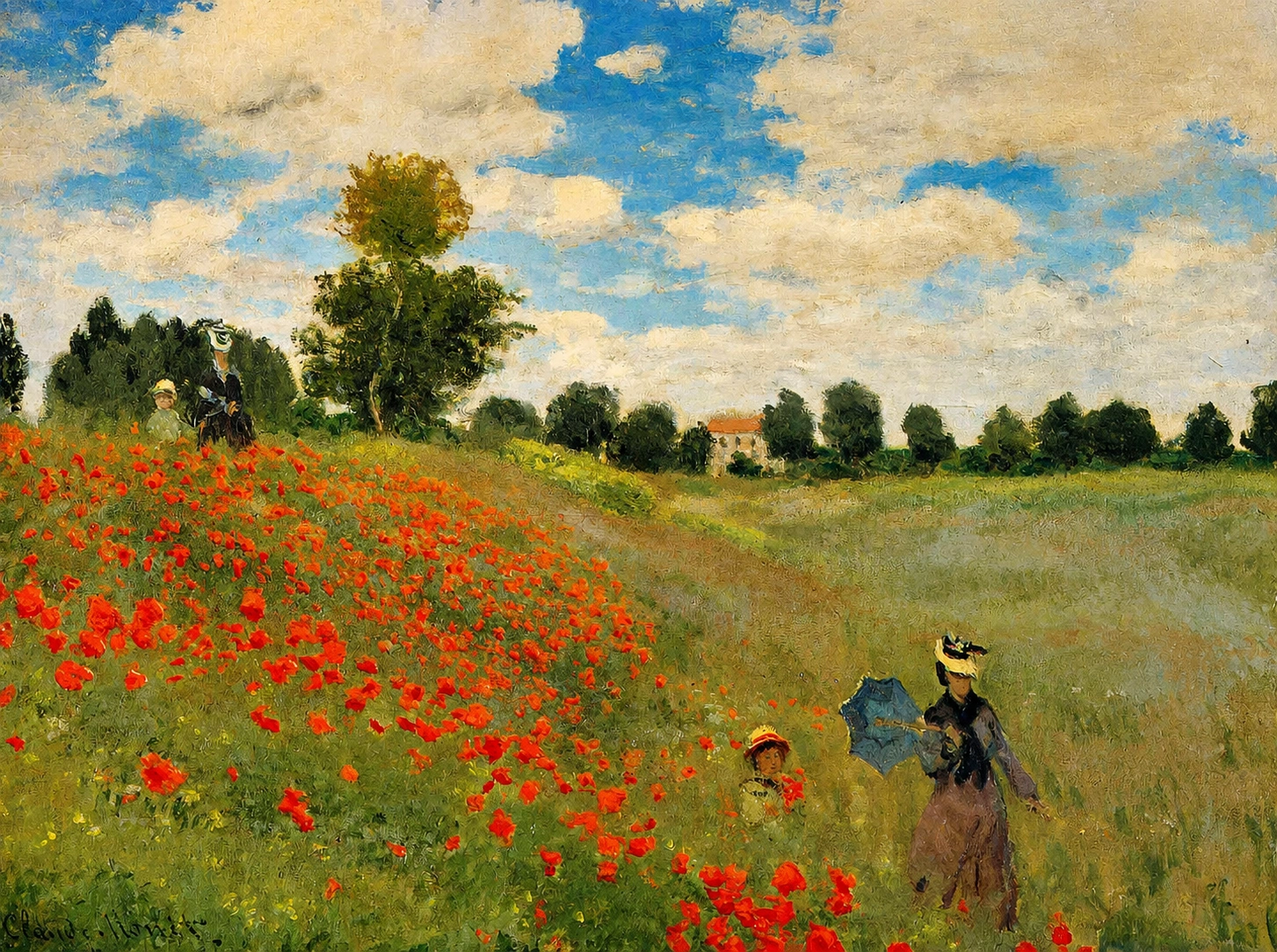
Claude Monet’s “Field of Poppies,” painted in 1873, is one of the most memorable images of early Impressionism. The painting captures a summer walk through the countryside near Argenteuil, where Monet lived during a highly productive period of his career. At first glance, the scene seems simple: a sloping meadow, scattered red poppies, a wide sky, trees in the distance, and two pairs of figures moving through the field. Yet the power of the painting lies in the way Monet turns this ordinary outdoor moment into a vivid study of light, color, atmosphere, and modern leisure.
The composition is built around a gentle diagonal movement. The poppy field rises from the lower left toward the center, while the figures descend through the grass on the right. This creates a natural rhythm, as if the viewer’s eye is walking through the landscape. The large expanse of sky gives the scene openness and breath, while the darker line of trees anchors the horizon. Monet does not arrange the landscape as a carefully staged academic view. Instead, he presents it as a moment glimpsed in passing, fresh, immediate, and full of sensory life.
The Landscape as a Living Experience
“Field of Poppies” is not only a painting of flowers. It is a painting of being outdoors. Monet makes the viewer feel the warmth of the day, the movement of air, and the softness of the grass. The meadow is not described through sharp botanical detail. Instead, it is created through loose touches of green, yellow, brown, and red. The poppies appear as quick flashes of color, scattered across the slope like sparks of sunlight caught in the grass.
This loose handling is central to the painting’s Impressionist character. Monet was less interested in recording every petal and leaf than in capturing the visual sensation of the field as it appeared at a particular moment. The red poppies are especially important because they break through the muted greens with striking energy. Their brightness guides the eye across the canvas and gives the landscape a feeling of movement. The flowers seem to flicker rather than sit still, suggesting the instability of vision under changing outdoor light.
The sky plays an equally important role. Its blue patches and soft clouds create a luminous canopy over the scene. Monet’s clouds are broad and airy, painted with a freedom that matches the looseness of the field below. The sky is not a background decoration. It sets the mood of the entire painting, creating a sense of calm brightness that softens the forms beneath it.
Figures Within the Field
The figures in “Field of Poppies” are small but essential. On the right, a woman holding a parasol walks with a child through the tall grass. Farther to the left, another pair appears near the trees, almost like an echo of the first. This repetition creates depth and rhythm. It also gives the painting a quiet narrative, suggesting a leisurely family walk through the countryside.
The figures are not portrayed with detailed facial features. They are part of the landscape, absorbed into the same atmosphere of light and color. The woman’s dark dress and parasol contrast with the pale grass and sky, giving the lower right side of the painting visual weight. The child’s small form adds tenderness and scale. Together, they make the field feel large, open, and immersive.
The repetition of the two figure groups is one of the painting’s most interesting compositional choices. It may suggest movement through time, as if we are seeing the same pair at two moments during their walk. It also creates a visual pathway from the distant left side of the painting to the foreground right side. This makes the viewer feel drawn into the scene rather than simply placed in front of it.
Color, Light, and Impressionist Technique
Color is the emotional center of “Field of Poppies.” Monet uses a relatively soft palette of greens, creams, blues, and browns, then animates it with intense red accents. The poppies are not modeled carefully with shadow and outline. They are placed in quick, confident marks that rely on the eye to complete the effect. This technique gives the painting its freshness. The flowers feel alive because they are not overdefined.
The painting also shows Monet’s growing interest in how light dissolves solid form. The trees on the horizon are dark masses, but their edges are softened by the surrounding air. The house in the distance is small and understated, partly hidden by the landscape. The grass is not a fixed surface but a woven texture of color. Everything seems touched by the same light.
This approach challenged the expectations of traditional painting in the 1870s. Academic art often valued polished surfaces, clear outlines, and carefully finished detail. Monet’s method was different. He allowed brushstrokes to remain visible and forms to stay open. The result was not unfinished in a careless sense. Rather, it was finished according to a new goal: to preserve the living impression of a moment before it disappeared.
The Meaning of Modern Leisure
“Field of Poppies” also reflects a broader change in nineteenth-century French life. The countryside near Paris became a place of escape for middle-class families, artists, and city dwellers. Argenteuil, where Monet lived, was close enough to Paris to represent both rural retreat and modern accessibility. In this painting, the field is not wild or dramatic. It is peaceful, approachable, and domestic.
The woman and child walking through the flowers suggest leisure, comfort, and intimacy. There is no grand historical event, no mythological subject, and no moral drama. Monet finds beauty in a private everyday experience. This was one of Impressionism’s great innovations. It made modern life, ordinary places, and passing sensations worthy of serious artistic attention.
The painting’s calmness should not be mistaken for simplicity. Monet carefully balances freedom and structure. The diagonal field, repeated figures, dark tree line, and bright poppies all work together to create harmony. The viewer may feel that the scene is spontaneous, but its effect depends on subtle organization.
Why “Field of Poppies” Still Feels Fresh
The lasting appeal of “Field of Poppies” comes from its ability to feel immediate even many years after it was painted. Monet does not ask the viewer to decode a complex story. He invites us to enter a moment of light, color, and quiet movement. The painting preserves the feeling of a summer afternoon with remarkable directness.
Its beauty lies in what it leaves slightly unfinished. The faces are indistinct, the flowers are dabs of red, and the grass is a shifting fabric of brushwork. These choices allow the viewer’s own perception to participate in the image. We do not just look at the field. We sense it.
“Field of Poppies” remains one of Monet’s most beloved paintings because it captures the essence of Impressionism with unusual clarity. It transforms a simple walk through a meadow into a radiant experience of modern vision. Through loose brushwork, luminous color, and a deeply natural composition, Monet shows that beauty can be found in the fleeting, the familiar, and the ordinary world touched by sunlight.