House of Parliament Sun by Claude Monet: Vibrant Color Edit
Free to Download & Reuse: You are welcome to use this image! If you republish or share it online, you must include a direct link back to this webpage for attribution.
Original Image Source: wikiart.org
A Complete Analysis of “House of Parliament Sun” by Claude Monet
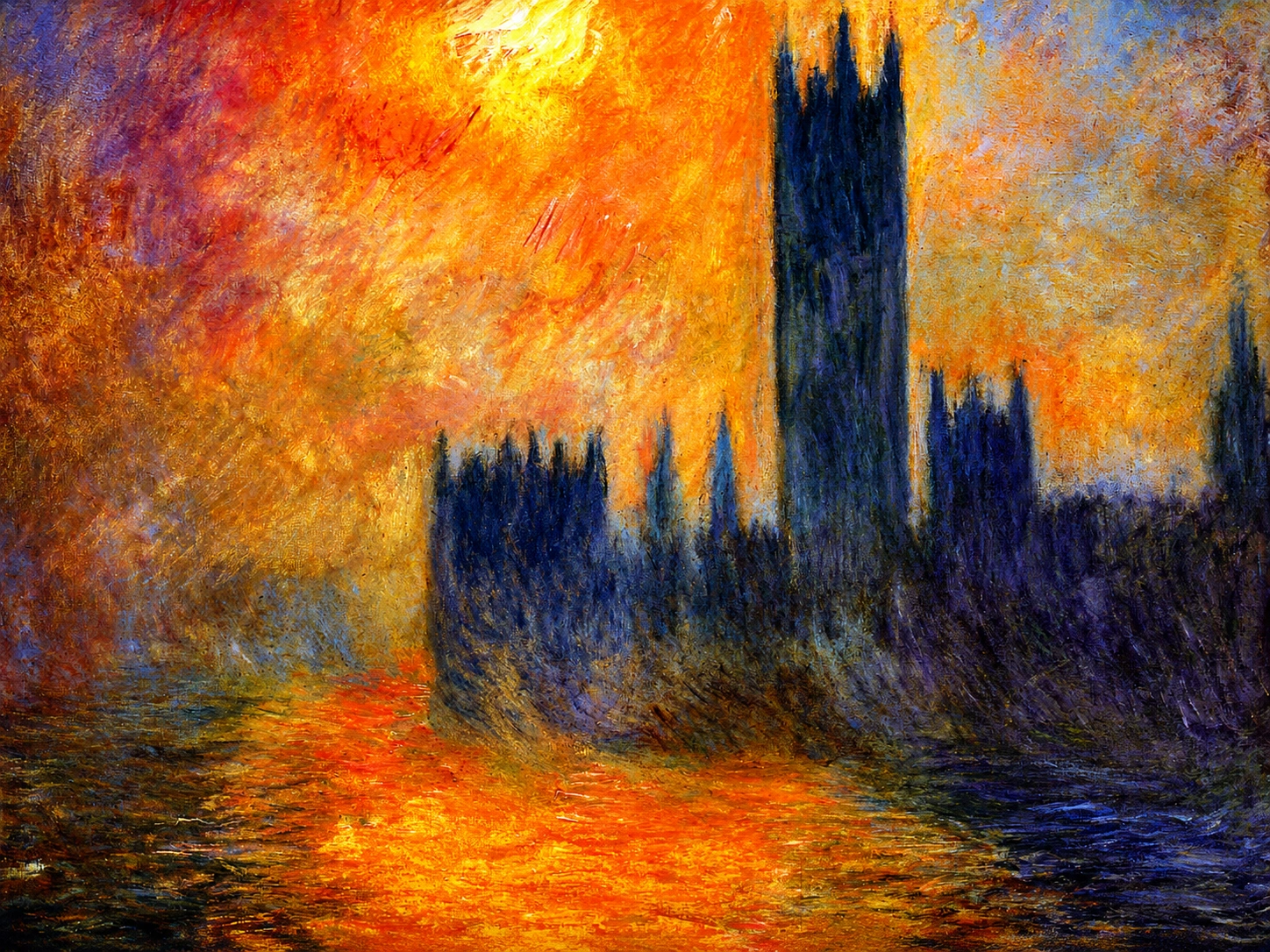
Claude Monet’s “House of Parliament Sun,” painted in 1903, belongs to one of the most atmospheric and visually daring phases of the artist’s career. The painting presents the Houses of Parliament in London as a dark, almost spectral silhouette rising from the River Thames, while the sky and water burn with orange, gold, red, violet, and blue. Rather than offering a precise architectural record, Monet transforms the scene into an experience of light. The building is present, but it is not the true subject. The real subject is the way sunlight, fog, reflection, and color dissolve the solid world into sensation.
At first glance, the composition seems simple. The Palace of Westminster stands on the right, with the tall tower cutting upward into the glowing sky. The river occupies the lower portion of the canvas, catching the warm radiance of the sun and turning it into a shimmering field of broken color. Yet the simplicity of the view hides the complexity of Monet’s vision. Everything in the painting is unstable. The sky appears to move, the water seems to flicker, and the buildings hover between visibility and disappearance. Monet captures not a place as it permanently exists, but a passing instant when nature, weather, and perception briefly come together.
Light as the Main Subject
The most powerful element in “House of Parliament Sun” is the blazing light that fills the upper left portion of the composition. Monet does not paint the sun as a small, clearly defined circle. Instead, he suggests it through a radiant explosion of yellow, orange, and red. This choice makes the sun feel less like an object and more like a force. It spreads across the sky, stains the mist, and pours into the water below.
The light also changes the identity of the architecture. The Houses of Parliament, one of the most recognizable symbols of British political power, are reduced to a dark shape against the atmosphere. This is a bold artistic decision. A traditional painter might have emphasized the Gothic details, windows, towers, and stonework of the building. Monet does the opposite. He allows the sun and haze to swallow detail, making the monument secondary to the visual drama of the moment.
This approach reflects Monet’s Impressionist belief that perception is shaped by changing conditions. A building is not seen the same way at noon, at dusk, in fog, or in clear weather. In this painting, the Houses of Parliament become almost weightless, as though the intense light has loosened them from the physical world.
Color, Atmosphere, and Contrast
The color palette is one of the painting’s most striking features. Monet places fiery oranges and yellows beside deep blues, violets, and blacks. This contrast gives the work its emotional intensity. The warm colors suggest heat, sunset, and glowing air, while the cool blues and purples give the buildings and shadows a mysterious depth.
The sky is not painted as a smooth background. It is built from visible strokes and layered tones that shift from gold to crimson to lavender. This creates a sense of turbulent atmosphere. The air seems thick with fog, smoke, and reflected light. London’s industrial atmosphere fascinated Monet because it softened the outlines of the city and turned familiar structures into luminous shapes. In “House of Parliament Sun,” that haze becomes almost magical.
The water repeats and transforms the colors of the sky. The orange reflection near the center and lower left is especially important because it links the sun above to the Thames below. Monet does not create a mirror reflection in a realistic sense. Instead, he breaks the light into short strokes and rippling patches. The river becomes a vibrating surface, alive with color and movement.
The Houses of Parliament as Silhouette
The dark outline of the Houses of Parliament gives the painting structure. Without this architectural mass, the image might dissolve completely into color. The tower on the right anchors the composition and creates a strong vertical counterpoint to the horizontal flow of the river. Its sharp upward thrust gives the scene drama, while the surrounding buildings form a lower, uneven rhythm across the middle of the canvas.
Yet even this silhouette is not fully solid. The edges are blurred, softened, and absorbed into the surrounding atmosphere. The tower seems to emerge from the fog rather than stand firmly behind it. Monet’s brushwork makes the building feel both monumental and fragile. It is recognizable, but it is also temporary, as though it might vanish when the light changes.
This tension between permanence and impermanence is central to the painting. Parliament represents history, empire, law, and authority. Monet presents it as a shadow shaped by weather and light. In doing so, he quietly shifts attention away from human institutions and toward the natural forces that alter how everything is seen.
Brushwork and Impressionist Technique
Monet’s brushwork in “House of Parliament Sun” is loose, layered, and energetic. The strokes do not hide themselves. They remain visible, reminding the viewer that the painting is not a window onto reality but a constructed surface of color. This is especially clear in the sky, where the strokes swirl and overlap, giving the impression of dense, glowing air.
In the water, the brushwork becomes shorter and more horizontal. These strokes suggest ripples, reflections, and the constant movement of the Thames. Monet does not need precise detail to create the feeling of water. Through rhythm and color alone, he makes the surface seem fluid.
The architecture is painted with darker, more vertical strokes, but even there, the handling is soft and atmospheric. The building is not outlined with academic precision. Instead, Monet lets the brushstrokes blur into one another. This technique creates the sensation of looking through mist, where distance and form become uncertain.
The London Series and Monet’s Late Vision
“House of Parliament Sun” is part of Monet’s broader London series, in which he repeatedly painted the same subjects under different conditions of light and weather. The Houses of Parliament, Waterloo Bridge, and Charing Cross Bridge all became vehicles for his study of atmosphere. This serial method allowed Monet to show that a single motif could produce endless visual variations.
By 1903, Monet had moved far beyond the early Impressionist goal of capturing everyday modern life. His work had become increasingly focused on the instability of vision itself. The London paintings anticipate the near abstraction of his later Water Lilies. In both cases, recognizable subjects remain, but they are transformed by color, reflection, and atmosphere.
“House of Parliament Sun” is especially powerful because it balances representation and abstraction. We can still identify the river, sky, and Parliament, but the emotional force of the painting comes from color and sensation. The scene is almost dreamlike. It feels observed, remembered, and imagined at the same time.
Meaning and Emotional Effect
The mood of the painting is dramatic, mysterious, and deeply atmospheric. The glowing sun suggests beauty, but also intensity. The dark buildings suggest grandeur, but also distance and uncertainty. The painting does not simply celebrate London as a modern city. It presents the city as something transformed by nature, almost overwhelmed by light.
There is also a sense of time passing. The sun appears low, the reflections shimmer, and the forms are beginning to fade. Monet captures a moment that cannot last. This fleeting quality gives the painting its poetic power. It reminds the viewer that vision is temporary and that even the most solid structures are changed by the conditions surrounding them.
Conclusion
“House of Parliament Sun” by Claude Monet is a masterful study of light, color, and atmosphere. Rather than focusing on architectural detail, Monet uses the Houses of Parliament as a dark silhouette against a fiery sky and shimmering river. The painting turns London into a place of glowing mist and visual uncertainty, where buildings dissolve into color and reflections become as important as solid forms.
Its power lies in the way Monet makes the viewer feel the instability of sight. Nothing is fixed. The sun spreads through the fog, the river breaks the light into fragments, and the great tower rises like a shadow from the haze. Through this transformation, Monet shows that the world is not only made of objects, but also of the changing light through which we see them.