Houses of Parliament by Claude Monet: Vibrant Color Edit
Free to Download & Reuse: You are welcome to use this image! If you republish or share it online, you must include a direct link back to this webpage for attribution.
Original Image Source: wikiart.org
A Vision of London Through Light
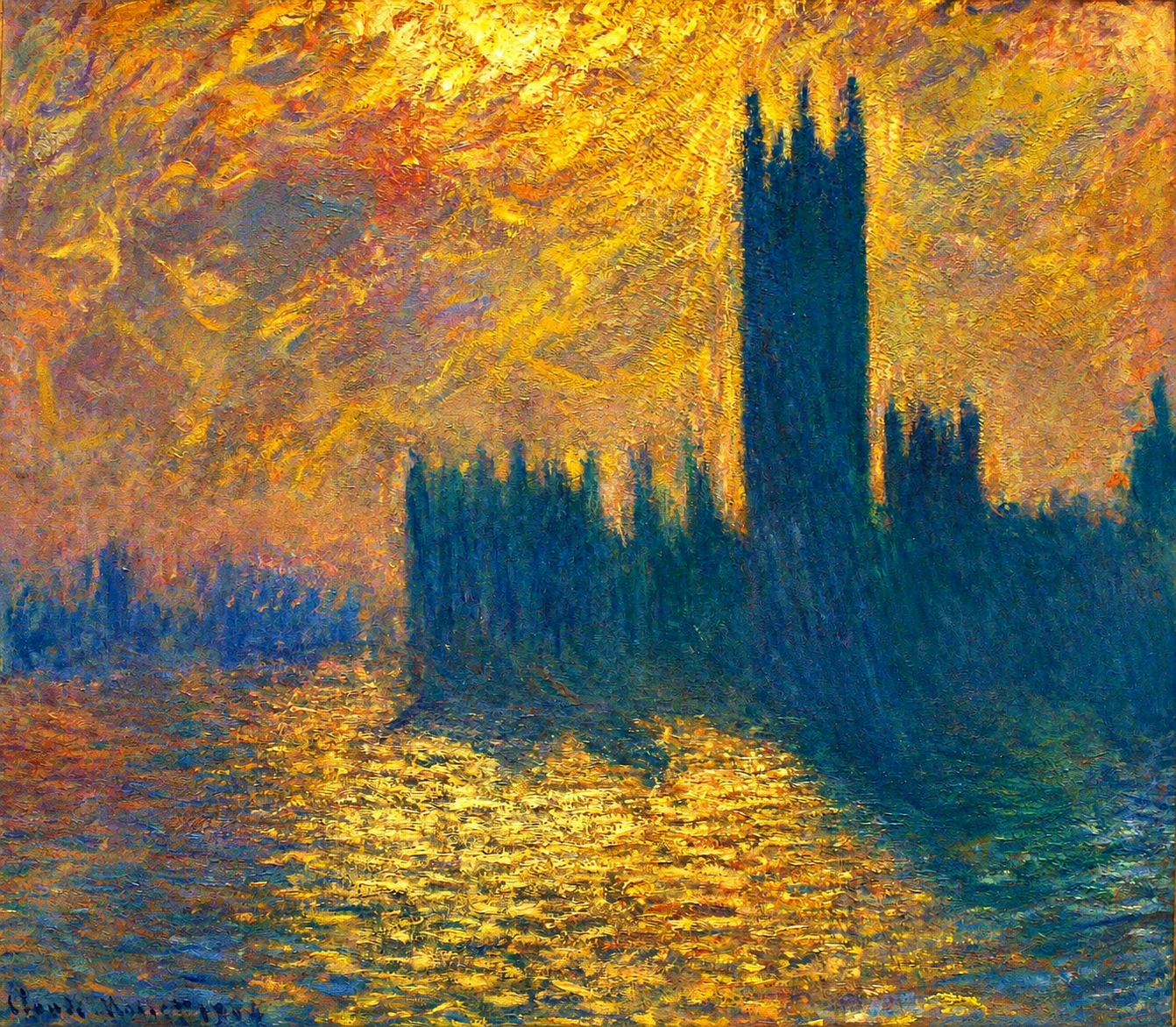
Claude Monet’s “Houses of Parliament” from 1904 is a powerful example of how Impressionism could transform a recognizable landmark into an almost dreamlike study of atmosphere, color, and perception. Rather than presenting the Palace of Westminster as a sharply detailed architectural subject, Monet turns it into a dark, wavering silhouette suspended between river, fog, and glowing sky. The painting is not mainly about the political building itself. It is about the way London’s mist, sunlight, and water reshape the building until it becomes part of a larger visual experience.
The composition is immediately striking because of its contrast between solidity and dissolution. The Houses of Parliament rise on the right side of the painting, with the tall Victoria Tower standing above the lower horizontal mass of the building. Yet this structure, usually associated with stone, power, and permanence, appears unstable and mysterious. Its edges are softened by haze. Its towers do not feel carved from architecture as much as painted out of vapor. Monet suggests the building’s Gothic outline, but he refuses to define every window, arch, or ornament. The result is a landmark that feels both familiar and unreachable.
Color, Fog, and the Thames
The color palette is one of the painting’s most expressive features. Monet uses golden yellows, warm oranges, smoky violets, muted greens, and deep blue-greens to create the impression of sunlight spreading through dense London fog. The sky glows with a molten brightness, especially near the upper center of the canvas, where the light seems to press through the atmosphere. This glow is not clean or transparent. It is thick, textured, and turbulent, as though the light itself has become material.
Against this luminous sky, the Parliament buildings appear in cool shadow. The deep teal and blue-green tones of the architecture create a dramatic opposition with the gold and ochre around them. This contrast gives the scene its emotional force. The city seems to be caught between warmth and coldness, visibility and obscurity, day and dusk. Monet does not simply record a weather effect. He makes weather the subject of the painting.
The Thames plays an equally important role. In the lower half of the image, the river reflects the golden sky in broken strokes of yellow, orange, and pale green. The water is not smooth. It is alive with small, shifting marks that suggest ripples, reflections, and movement. These strokes keep the painting from becoming static. Even though the building stands still, the scene feels constantly changing because the light on the river appears to flicker from moment to moment.
Impressionism and the Modern City
“Houses of Parliament” belongs to Monet’s larger fascination with repeated subjects. Throughout his career, he painted series of haystacks, poplars, Rouen Cathedral, water lilies, and views of London. In each series, the subject remains relatively stable, while light and atmosphere change everything. The Houses of Parliament series is especially important because it brings this method into the heart of the modern city. London was not a rural field or a garden pond. It was an industrial capital, filled with smoke, fog, traffic, and political symbolism.
Monet turns that modern atmosphere into beauty. The famous London fog, partly natural and partly intensified by urban smoke, becomes a veil of color. Instead of treating pollution and haze only as obstacles to vision, he treats them as conditions that create new visual possibilities. The fog softens form, blends tones, and allows the sun to scatter across the scene in unexpected ways. The city becomes less like a map of buildings and more like a field of sensations.
This approach is deeply Impressionist. Monet does not paint the building as the mind knows it, with clear outlines and stable facts. He paints it as the eye experiences it at a particular instant, under particular conditions. The viewer is invited to feel the uncertainty of looking. We do not receive a complete description. We receive an impression, one that depends on distance, weather, reflection, and changing light.
The Power of the Silhouette
The silhouette of the Houses of Parliament gives the painting its central drama. The building is dark enough to anchor the composition, but not so dark that it becomes flat. Within the shadowed mass, Monet allows subtle variations of blue, green, and violet to appear. These variations prevent the architecture from becoming a simple black shape. It remains alive, vibrating against the sky.
The vertical tower is especially important. It rises like a dark column through the golden haze, creating a strong counterpoint to the horizontal shimmer of the river below. The tower’s height gives the painting a sense of grandeur, but Monet undercuts that grandeur by blurring its edges. Power is present, but it is softened by atmosphere. The monumental building is absorbed into the same changing world as the clouds and water.
This treatment gives the painting a poetic ambiguity. The Houses of Parliament can be read as a symbol of empire, government, and historical continuity. Yet in Monet’s hands, that symbol becomes fragile and transient. The building may be massive, but the viewer sees it only through light. This suggests that even the most permanent human structures are dependent on perception. What we see is never fixed. It is always shaped by time, weather, and the act of looking.
Surface and Brushwork
The painting’s surface is rich with visible brushwork. Monet’s marks do not disappear into illusion. They remain present, reminding us that this is a painted construction of vision. In the sky, the strokes swirl and layer over one another, creating a dense atmospheric texture. In the river, the brushwork becomes shorter and more broken, imitating the sparkle of light on moving water. In the architecture, the marks are heavier and darker, but still porous enough to let the surrounding colors influence the form.
This handling of paint is central to the painting’s effect. Monet does not separate object, air, and reflection with hard boundaries. Instead, he lets them interact across the canvas. The same golden light that fills the sky reappears in the river. The same cool blues and greens that define the building also seep into the water and haze. Everything is connected through color. The result is a unified atmosphere rather than a collection of separate objects.
The Emotional Atmosphere
Although “Houses of Parliament” is based on observation, it also has a strong emotional presence. The painting feels quiet, majestic, and slightly mysterious. The glowing sky gives it warmth, while the shadowed building introduces solemnity. The river’s reflections add movement, but the overall mood remains contemplative. It is a painting of a city seen at a moment when ordinary visibility has been transformed into something almost spiritual.
The sunlit fog makes the scene feel suspended in time. There is no clear narrative, no crowd, no event, and no dramatic action. Yet the painting is full of tension because light is constantly changing. The viewer senses that this exact arrangement of color and shadow will not last. In this way, Monet captures one of the central ideas of Impressionism: beauty often exists in passing conditions.
Why “Houses of Parliament” Still Matters
Claude Monet’s “Houses of Parliament” remains compelling because it shows how a famous landmark can be reinvented through vision. Monet does not give us a documentary view of London. He gives us a meditation on perception itself. The painting asks us to consider how light can dissolve architecture, how fog can create color, and how water can turn a city into reflection.
Its greatness lies in this balance between recognition and abstraction. We know we are looking at the Houses of Parliament, yet the painting also approaches pure color and atmosphere. The subject is specific, but the experience is universal. Anyone who has seen light break through mist, or watched a reflection tremble on water, can understand the sensation Monet is pursuing.
In “Houses of Parliament,” the real subject is not only London, nor only the Palace of Westminster. The true subject is the instability of sight. Monet shows that the world is never seen once and for all. It changes with every shift of light, every movement of air, and every moment of attention. That is why this painting continues to feel alive more than a century later.