Houses of Parliament at Sunset by Claude Monet: Vibrant Color Edit
Free to Download & Reuse: You are welcome to use this image! If you republish or share it online, you must include a direct link back to this webpage for attribution.
Original Image Source: wikiart.org
Introduction
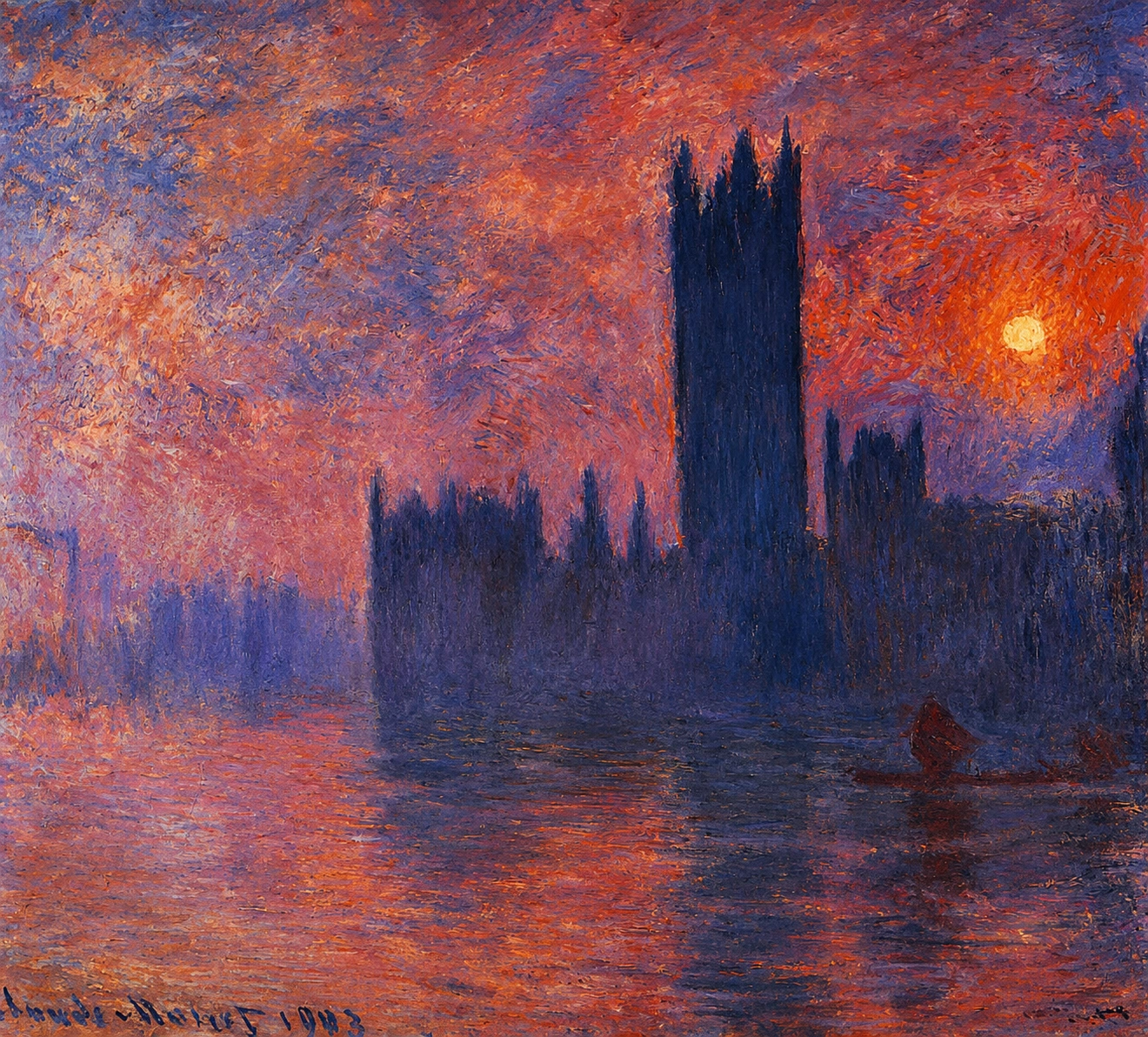
Claude Monet’s “Houses of Parliament at Sunset,” painted in 1903, is one of the most atmospheric works from his celebrated London series. Rather than presenting the Houses of Parliament as a sharply described architectural subject, Monet transforms the building into a dark, almost dreamlike silhouette suspended between mist, water, and fading light. The painting is not simply a view of Westminster. It is an exploration of how a familiar landmark changes under the pressure of sunset, fog, reflection, and perception. Monet was less interested in the permanent identity of the monument than in the unstable effects surrounding it. The result is a canvas where London becomes a field of violet haze, red-orange illumination, and soft dissolving forms.
Monet’s London Vision
Monet visited London several times and became fascinated by the city’s unique atmosphere. The combination of river mist, coal smoke, and low English light gave him exactly the kind of shifting visual conditions he loved to paint. In “Houses of Parliament at Sunset,” the famous Gothic Revival building is visible, yet it is almost swallowed by the environment. The towers rise like shadowy apparitions, their outlines softened by the thickness of the air. The scene feels both real and unreal, as though the viewer is seeing the city through memory rather than direct observation.
This approach reflects Monet’s mature Impressionist method. He was not painting architecture in the traditional sense. He was painting the sensation of architecture at a specific moment. The building matters because it interrupts the sunset and gives structure to the haze, but the true subject is light itself. The Houses of Parliament become a dark screen against which color, atmosphere, and reflection can perform.
Composition and Structure
The composition is simple but deeply effective. The Parliament buildings stretch horizontally across the middle of the canvas, anchoring the image in a broad band of shadow. The Victoria Tower rises near the center-right, creating the strongest vertical accent. Smaller towers and spires cluster around it, giving the silhouette a jagged rhythm. These vertical shapes contrast with the softer horizontal movement of the Thames below and the glowing sky above.
The sun appears as a small orange disk on the right side of the painting. It is not large, but it dominates the mood of the scene. Its glow radiates through the surrounding sky, tinting the clouds and mist with reddish warmth. Because the sun is placed off-center, the composition feels natural rather than staged. The viewer’s eye moves from the dark tower to the glowing orb, then down into the water where the colors become muted reflections.
The river occupies the lower portion of the image, but it does not behave like a clear mirror. Instead, it absorbs and fragments the colors of the sky. The reflection is blurred, smoky, and unstable, reinforcing the sense that the whole scene is in motion. Even the small boat at the lower right feels like a shadow passing through vapor.
Color and Atmosphere
The color palette is one of the painting’s greatest strengths. Monet builds the scene from purples, mauves, blue-grays, smoky reds, and muted oranges. The effect is vibrant without being harsh. The sky is not a simple sunset sky. It is layered with cool violet and warm ember-like tones, suggesting a dense atmosphere through which sunlight must struggle to pass.
The orange sun creates a powerful contrast against the surrounding purples. This contrast is not decorative. It gives the painting its emotional charge. The warmth of the sun seems temporary and fragile, while the dark architecture appears heavy and immovable. Yet even the Parliament building is not truly solid. Its edges blur into the fog, and its darkness is softened by surrounding color. Monet makes the whole world feel temporary.
The dark blue and purple silhouette of the buildings gives the image a solemn grandeur. At the same time, the reddish light prevents the scene from becoming cold or lifeless. The painting exists between melancholy and radiance. It captures the final intensity of the day just before the city disappears into evening.
Brushwork and Surface
Monet’s brushwork is loose, layered, and atmospheric. The sky is built from restless strokes that move in different directions, creating a sense of vibrating air. The surface does not aim for smooth finish. Instead, the visible texture of the paint becomes part of the experience. The viewer can feel the fog, smoke, and light through the broken handling of color.
The Parliament silhouette is also painted with softened edges rather than precise lines. Monet gives enough information for the viewer to recognize the subject, but he withholds architectural detail. This restraint is essential. Too much detail would fix the image too firmly in place. By reducing the building to a shadow, Monet allows it to become part of the atmosphere.
The water is handled with horizontal strokes that suggest both movement and reflection. The river seems heavy and quiet, yet alive with subtle color. It does not merely sit below the scene. It participates in the same visual instability as the sky.
Light as the True Subject
In “Houses of Parliament at Sunset,” light is not just illumination. It is the organizing force of the painting. The sun changes everything it touches. It turns the sky into a veil of red and violet. It pushes the building into silhouette. It flickers faintly on the river. The entire image depends on the relationship between light and obscurity.
Monet’s genius lies in making the viewer feel that this moment could vanish at any second. The sunset is brief. The fog is shifting. The reflections are unstable. The painting holds together a moment that nature itself would not hold still. This is why the work feels so modern. It does not treat the world as fixed and permanent. It treats vision as fleeting, subjective, and sensitive to time.
The Houses of Parliament as Symbol
Although Monet was not a symbolic painter in a literary sense, the subject carries unavoidable associations. The Houses of Parliament represent political power, national identity, and historical continuity. Yet Monet does not emphasize these meanings directly. Instead, he shows the building as a silhouette softened by nature and atmosphere. The seat of government becomes a dark shape within a larger world of light, air, and water.
This treatment subtly changes the meaning of the landmark. It is no longer simply a monument to power. It becomes part of a visual experience. Human architecture is made vulnerable to weather, time, and perception. The painting suggests that even the most imposing structures are transformed by the conditions through which they are seen.
Mood and Emotional Effect
The mood of the painting is contemplative and mysterious. The darkness of the building gives the scene a solemn quality, while the glowing sunset adds warmth and intensity. There is a quiet drama in the contrast between the heavy silhouette and the dissolving sky. The painting feels still, but not empty. It is filled with suspended energy.
The small boat near the lower right adds a human note without disturbing the larger atmosphere. It reminds the viewer of scale and movement, but it remains subdued. Like the building, it is absorbed into the foggy environment. Everything in the painting belongs to the same twilight world.
Place in Monet’s Career
By 1903, Monet had moved far beyond the early Impressionist interest in outdoor leisure and modern life. His later work became increasingly focused on serial observation. He painted the same subjects repeatedly under different conditions, not because he lacked variety, but because he understood that no subject ever appears the same twice. The London series belongs to this mature phase, alongside his haystacks, poplars, Rouen Cathedral, and water lilies.
“Houses of Parliament at Sunset” shows Monet at the height of this serial vision. The painting is both specific and universal. It is a view of London in 1903, but it is also a meditation on perception itself. The viewer does not simply see Parliament. The viewer sees seeing.
Conclusion
“Houses of Parliament at Sunset” by Claude Monet is a masterful study of atmosphere, light, and visual transformation. Its power comes from restraint. Monet does not describe every window, stone, or architectural detail. Instead, he gives us the sensation of a city dissolving into sunset. The dark towers, glowing sun, misty sky, and reflective river all work together to create an image that feels fleeting yet unforgettable.
The painting captures a moment when the solid world becomes uncertain. Parliament, one of London’s most recognizable monuments, is turned into a shadow within a luminous haze. Through this transformation, Monet reveals the beauty of impermanence. The scene is not important because it lasts, but because it passes. That passing quality is exactly what makes the painting so haunting.