Rouen Cathedral by Claude Monet: Vibrant Color Edit
Free to Download & Reuse: You are welcome to use this image! If you republish or share it online, you must include a direct link back to this webpage for attribution.
Original Image Source: wikiart.org
Rouen Cathedral by Claude Monet: An Analysis
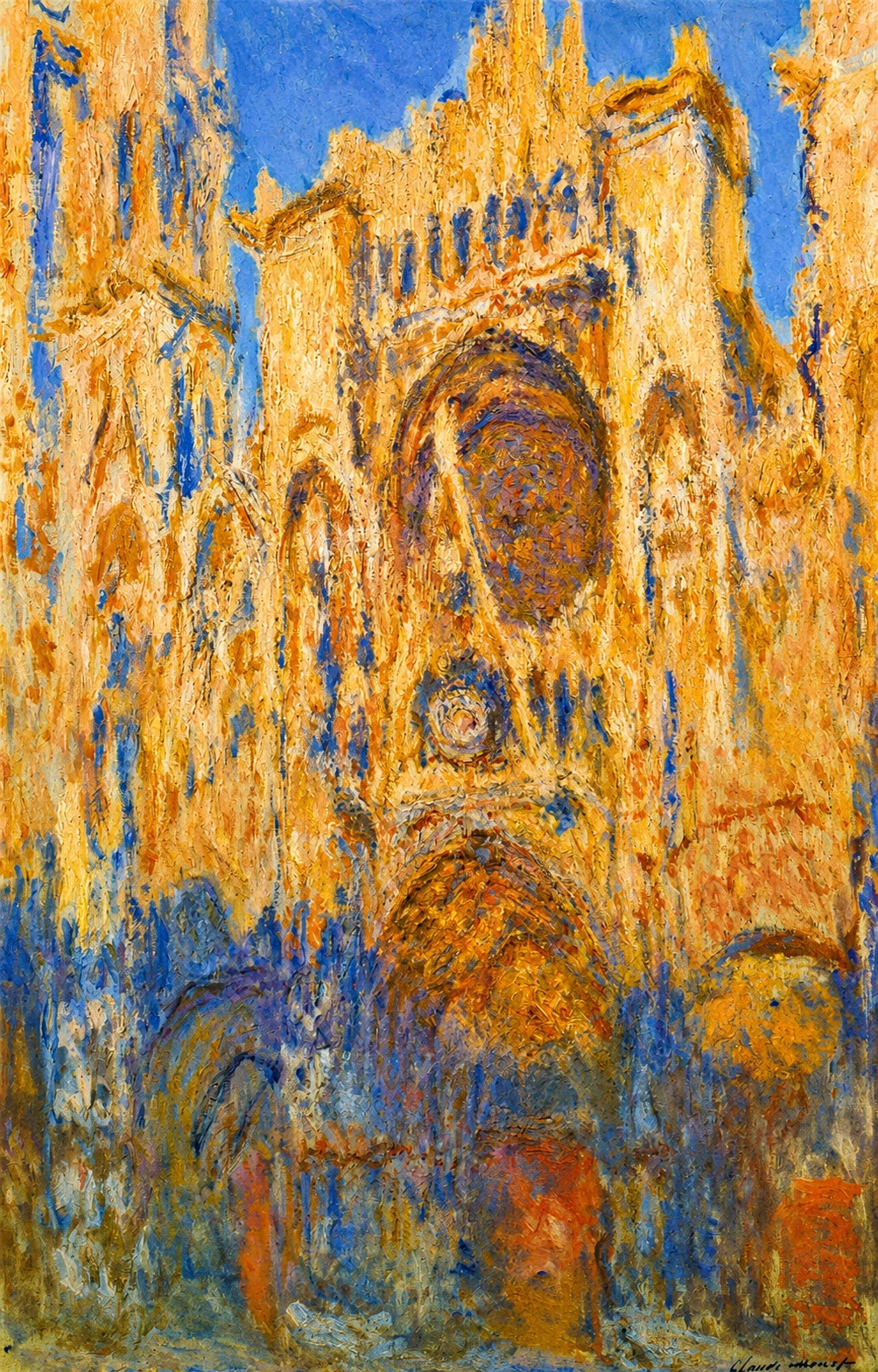
Claude Monet’s “Rouen Cathedral” from 1893 belongs to one of the most important painting series of the Impressionist movement. Rather than treating the cathedral as a fixed architectural monument, Monet transforms it into a living surface of light, atmosphere, color, and sensation. The subject is the western façade of Rouen Cathedral, one of the great Gothic buildings of France, but the painting is not primarily about stone, structure, or historical grandeur. It is about the way vision changes from moment to moment. In this work, Monet turns a massive medieval cathedral into something almost weightless, shimmering, and unstable, as if the building were being dissolved by sunlight.
The composition is vertical and tightly framed, emphasizing the upward thrust of the cathedral façade. The viewer is placed close to the building, looking directly at its towering entrance, sculptural recesses, and lace-like Gothic details. Yet Monet does not describe these details with precise architectural clarity. Instead, he suggests them through vibrating strokes of orange, gold, blue, violet, cream, and green. The cathedral seems to rise like a flame, its surface animated by the flicker of daylight. The stone does not appear cold or static. It appears warm, breathing, and responsive to the changing air.
Light as the True Subject
Although the painting is called “Rouen Cathedral”, the true subject is light. Monet was fascinated by the idea that a single motif could look entirely different depending on the time of day, the weather, and the quality of the atmosphere. In this version, the cathedral is flooded with warm illumination. The dominant tones of yellow, ochre, peach, and orange suggest sunlight striking the façade and turning the stone into a glowing field of color. These warm tones are balanced by cooler blues and violets, especially in the shadows and lower areas of the painting.
The contrast between warm light and cool shadow gives the image its visual energy. Monet does not use shadow simply to darken forms. He makes shadow colorful, alive, and essential to the atmosphere of the work. The blue areas are not empty spaces or neutral backgrounds. They participate in the rhythm of the painting, pushing against the golden façade and intensifying the sensation of brightness. The result is a cathedral that seems to pulse between material presence and optical illusion.
The Dissolving Gothic Façade
Rouen Cathedral was an ideal subject for Monet because its Gothic façade offered countless carvings, arches, recesses, towers, and ornamental surfaces. A more traditional painter might have emphasized the precision of these forms, presenting the building as a masterpiece of medieval craftsmanship. Monet takes a different approach. He allows the architectural details to blur into one another, creating an image that is both recognizable and dreamlike.
The central arch is still visible, as are the vertical towers and decorative openings, but their edges are softened. The façade appears to melt into patches of color. This gives the painting a remarkable tension. On one hand, the viewer knows this is a stone cathedral, huge, ancient, and immovable. On the other hand, Monet’s brushwork makes it seem fragile and temporary, as though it might vanish when the light changes. This tension is at the heart of the painting’s power.
The Gothic building becomes less a monument than a screen on which light performs. The heavy stone architecture is translated into a fabric of broken brushstrokes. Monet’s method suggests that what we see is never just the object itself. We see the object through weather, light, distance, time, and our own perception.
Color and Brushwork
The color palette of this painting is rich, warm, and expressive. Golden yellows and pale oranges dominate the upper and central façade, creating the impression of sunlight striking aged stone. Deeper oranges and reddish browns appear around the arches and lower sections, adding warmth and depth. Cool blues and blue-greens appear throughout the composition, especially along the sides and in the shadowed passages. These cooler tones prevent the painting from becoming flat or overly decorative. They create depth, contrast, and atmospheric vibration.
Monet’s brushwork is loose but controlled. The paint is applied in short, broken touches that allow colors to sit beside one another rather than blend smoothly. This technique gives the surface a shimmering quality. The eye mixes the colors from a distance, creating the effect of light flickering across the cathedral. Up close, the painting may appear almost abstract, with strokes and patches of color taking priority over clear lines. From farther away, the cathedral emerges as a luminous vision.
This balance between abstraction and recognition is one of the most modern aspects of the work. Monet does not abandon the subject, but he pushes it toward pure visual experience. The cathedral remains present, yet it is constantly being transformed by paint.
Atmosphere, Time, and Perception
The “Rouen Cathedral” series is one of Monet’s greatest investigations into time. By painting the same building again and again under different conditions, he showed that no single image could fully capture reality. Each painting records a different encounter between the cathedral and the atmosphere surrounding it. This 1893 work feels especially concerned with warmth, glare, and radiance. The building seems caught in a particular instant, when sunlight turns the façade into a glowing, almost immaterial presence.
The painting invites the viewer to think about perception itself. Monet suggests that seeing is not passive. It is active, shifting, and dependent on circumstance. The cathedral may be centuries old, but the visual impression it creates is always new. Morning light, afternoon light, mist, sun, shadow, and seasonal changes all produce different versions of the same subject. In this way, Monet challenges the idea of a stable, final image. Reality becomes a sequence of impressions.
Historical Importance
“Rouen Cathedral” is central to Monet’s mature achievement. By the 1890s, he had already explored series painting through subjects such as haystacks and poplars. With the cathedral series, he brought this method to one of France’s most historically and spiritually charged architectural subjects. The result is not a religious image in the traditional sense, but it still carries a sense of awe. The awe comes not from narrative or symbolism, but from the mysterious power of light to transform matter.
The painting also points toward later developments in modern art. Its emphasis on surface, color, and perception helped open the way for more abstract approaches to painting. Monet remains attached to the visible world, but he shows that the visible world can be unstable, fragmented, and intensely subjective. The cathedral becomes a bridge between Impressionism and the more radical experiments of the twentieth century.
Conclusion
Claude Monet’s “Rouen Cathedral” from 1893 is a masterpiece of visual transformation. It presents a famous Gothic monument not as a fixed structure, but as a radiant event shaped by light and atmosphere. Through warm color, cool shadow, broken brushwork, and dissolving form, Monet turns stone into sensation. The painting captures the cathedral at one fleeting moment, yet it also suggests the endless changeability of vision itself.
What makes the work so compelling is its combination of grandeur and delicacy. The cathedral is monumental, but Monet makes it tremble with light. It is ancient, but it appears newly born in the moment of perception. In this painting, architecture becomes atmosphere, history becomes color, and the act of seeing becomes the central drama.