Rouen Cathedral by Claude Monet: Vibrant Color Edit
Free to Download & Reuse: You are welcome to use this image! If you republish or share it online, you must include a direct link back to this webpage for attribution.
Original Image Source: wikiart.org
Rouen Cathedral by Claude Monet
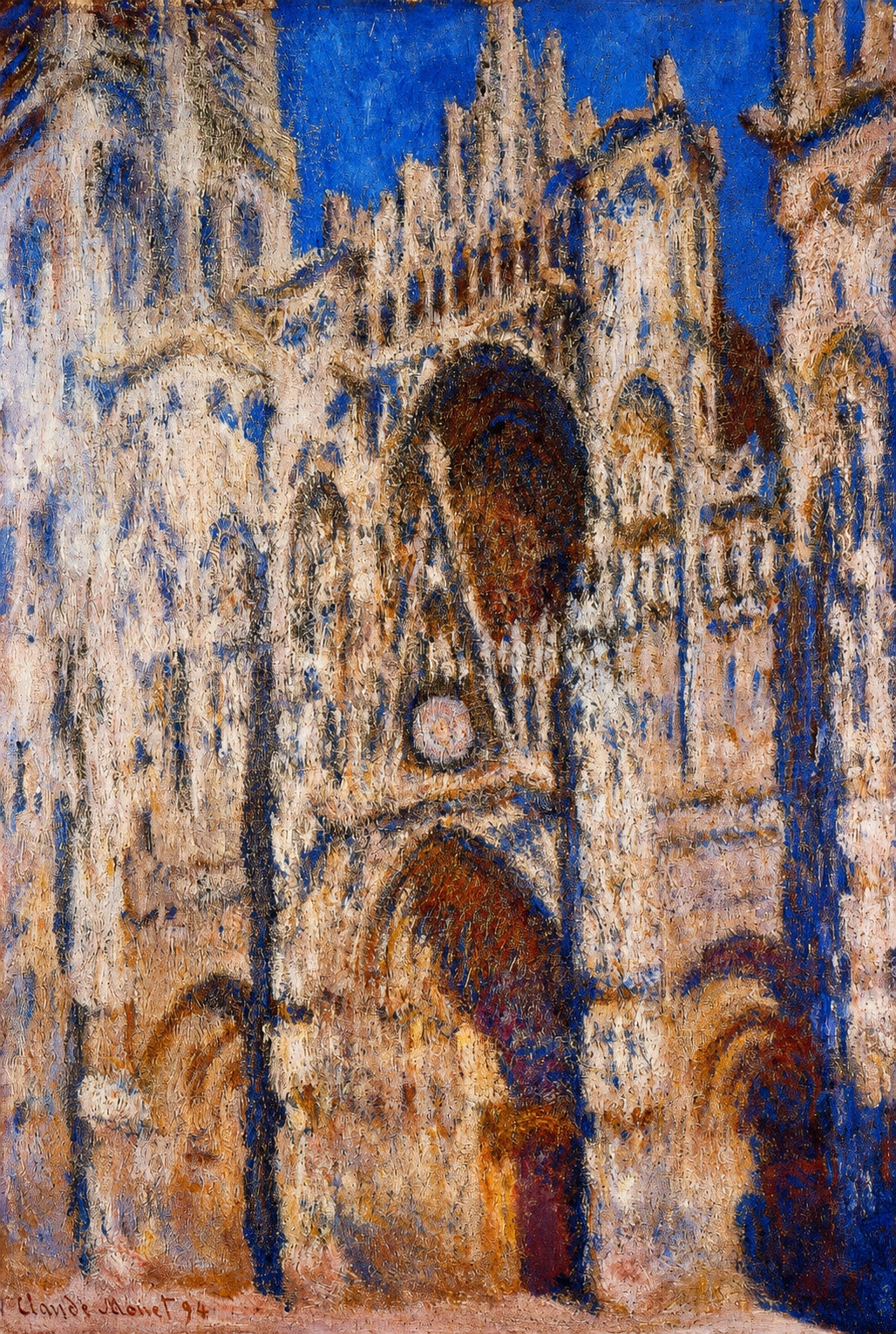
Claude Monet’s “Rouen Cathedral” from 1894 is one of the most powerful examples of his late Impressionist method, where the subject matters less as a fixed object than as a living field of light, color, air, and perception. The painting shows the Gothic façade of Rouen Cathedral, but it does not present the building in a clear architectural manner. Instead, Monet transforms stone into atmosphere. The cathedral seems to rise out of a dense veil of brushwork, its towers, portals, arches, and carvings dissolving into pale whites, violets, blues, ochres, and browns. What would normally be solid masonry becomes unstable, vibrating, almost immaterial.
The composition is dominated by the cathedral’s front elevation. Monet places the viewer very close to the building, so the façade fills nearly the entire canvas. There is little surrounding space and almost no conventional depth. This creates an intense encounter between viewer and monument. The cathedral is not seen from a comfortable distance. It presses forward, towering and fragmented, as if the viewer is standing in the square directly before it, overwhelmed by its scale. The cropped edges make the architecture feel larger than the painting itself, suggesting that the building continues beyond the frame.
Light as the True Subject
Although the title identifies the painting as “Rouen Cathedral,” the true subject is light. Monet was fascinated by how the same object could appear radically different depending on hour, weather, season, and atmospheric condition. In this version, the cathedral is bathed in cool blue and pale violet tones, with creamy highlights scattered across the surface like trembling reflections. The deep blue background intensifies the brightness of the façade, making the pale stone appear almost luminous.
The dark central portal anchors the composition. It creates a strong contrast with the lighter stone around it, drawing the eye inward. Yet even this darkness is not flat or empty. Monet fills it with warm browns, blacks, and reddish undertones, suggesting shadow as a complex mixture of color rather than the simple absence of light. This was central to Impressionist painting. Shadows were not merely gray or black; they were alive with reflected color.
The façade appears to shimmer because Monet does not define every architectural detail. Instead, he builds the image through broken strokes and textured patches. The eye completes the structure from a distance. Up close, the cathedral becomes a tapestry of marks. This tension between recognition and abstraction gives the painting its modern energy.
The Gothic Cathedral Reimagined
Rouen Cathedral was one of the great monuments of French Gothic architecture, a building associated with history, religion, civic pride, and national identity. In older traditions of painting, such a structure might have been presented with precision and reverence, emphasizing its design, symmetry, and sculptural detail. Monet approaches it differently. He does not diminish its grandeur, but he changes the meaning of that grandeur. The cathedral becomes less a symbol of permanence and more a vehicle for change.
This is one of the painting’s great paradoxes. Gothic cathedrals are built to endure across centuries, yet Monet presents Rouen Cathedral as something fleeting. Its edges blur. Its surfaces shift. Its forms seem to emerge and vanish under the pressure of light. The result is not a denial of the cathedral’s solidity, but a reminder that human perception is never fixed. Even the most permanent structures are experienced through changing conditions.
The building’s sculptural richness is suggested rather than carefully described. Pinnacles, arches, statues, and tracery appear as flickers of paint. The cathedral’s elaborate stonework becomes a surface of optical sensation. Monet was not interested in cataloguing details. He was interested in the instant when the eye receives light before the mind organizes it into stable form.
Color and Atmosphere
The color palette of this painting is restrained but deeply expressive. Cool blues dominate the sky and shadows, while pale whites, lavenders, creams, and muted ochres animate the stone. These colors create a sense of filtered light, as if the cathedral is caught in a specific atmospheric moment. The blue tones give the painting a cool, almost nocturnal feeling, while the warm browns and reddish accents around the lower arches keep the image grounded.
Monet’s handling of color turns the façade into something almost musical. Small touches of complementary hues vibrate against one another. Blue shadows sit beside warm highlights. Pale stone is enriched by violet and pink undertones. The surface does not simply describe light falling on architecture; it makes the viewer feel the sensation of light passing through air.
This approach reflects Monet’s mature Impressionism. By the 1890s, he was no longer simply painting outdoor scenes with loose brushwork. He was investigating perception itself. The Rouen Cathedral series shows how a single motif can generate endless variation. The painting becomes a study of time, weather, memory, and vision.
Brushwork and Surface
The brushwork is thick, layered, and restless. Monet applies paint in short, broken strokes that build the cathedral’s surface without locking it into hard outlines. The rough texture of the paint mirrors the roughness of stone, but it also creates a separate reality: the reality of the painted canvas. The viewer is always aware of both things at once. We see a cathedral, and we see paint.
This dual awareness is essential to the painting’s power. Monet does not hide the act of painting. He lets the brushstrokes remain visible, allowing the image to flicker between representation and abstraction. The façade becomes a living skin of pigment. The central portal, the side arches, and the upper towers are all present, but none are fully fixed. The entire painting feels like a moment caught before it disappears.
Why the Painting Matters
“Rouen Cathedral” matters because it turns one of France’s most solid architectural monuments into a study of impermanence. Monet shows that reality is not only made of objects, but also of perception. The cathedral exists, but our experience of it changes constantly. Light alters its color. Shadow alters its depth. Atmosphere alters its outline. Time alters everything.
The painting also points toward modern abstraction. Monet still begins with a recognizable subject, but his emphasis on color, surface, and sensation anticipates later artists who would push painting away from literal description. In “Rouen Cathedral,” the subject remains visible, yet it is nearly absorbed into the movement of paint and light.
This 1894 work is not just a view of a famous cathedral. It is a meditation on seeing. Monet invites the viewer to look slowly, to notice how form appears through color, how stone becomes light, and how a familiar monument can feel strange, fragile, and alive. The painting’s greatness lies in this transformation. Rouen Cathedral is ancient, massive, and historical, but in Monet’s hands it becomes immediate, atmospheric, and endlessly changing.