Theatre Box (La Loge) by Pierre-Auguste Renoir: Vibrant Color Edit
Free to Download & Reuse: You are welcome to use this image! If you republish or share it online, you must include a direct link back to this webpage for attribution.
Original Image Source: commons.wikimedia.org
Introduction
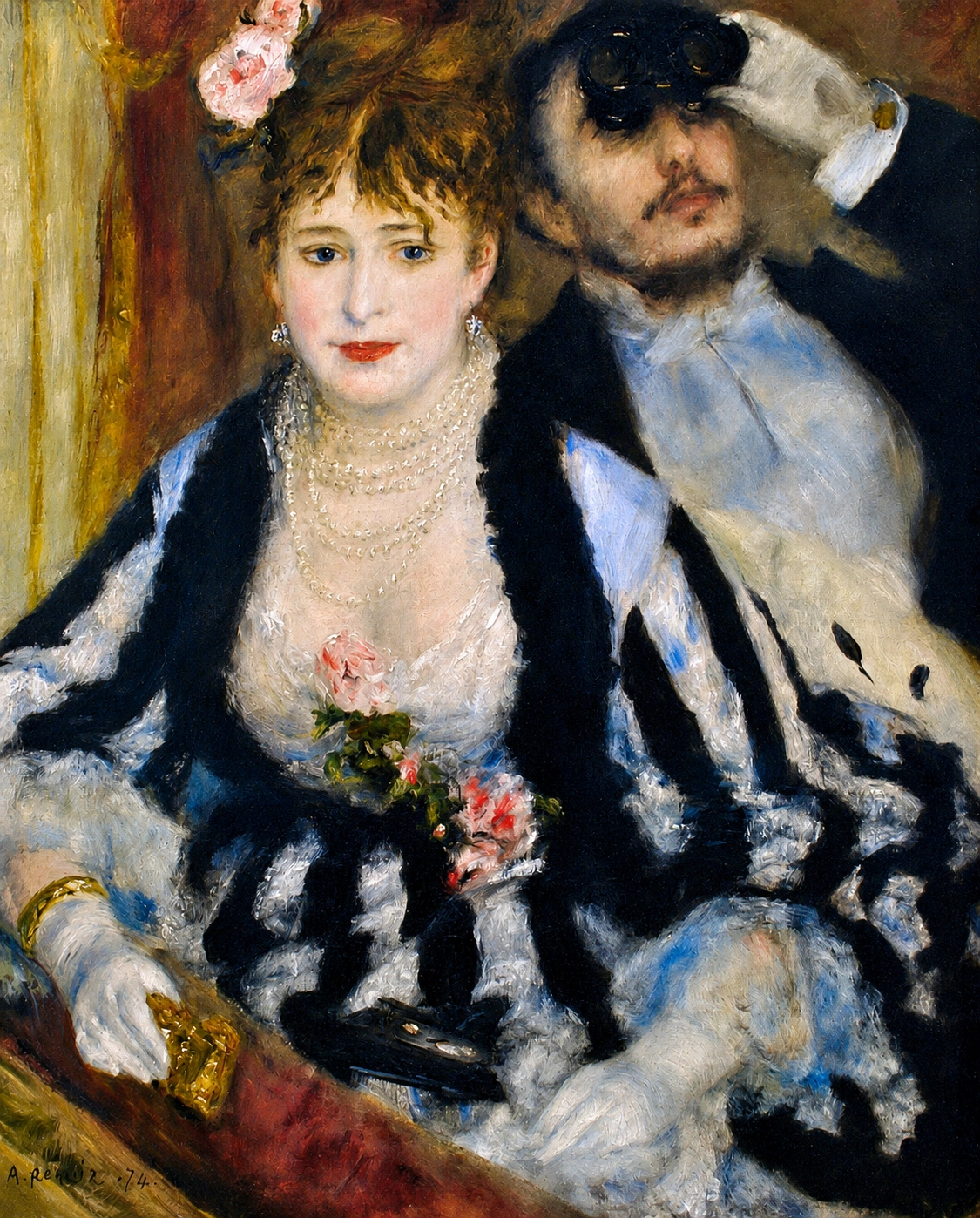
“Theatre Box (La Loge)” by Pierre-Auguste Renoir, painted in 1874, is one of the defining images of early Impressionism. At first glance, the painting appears to show a fashionable young woman and her male companion seated in a theater box, surrounded by the luxury and spectacle of modern Parisian entertainment. Yet the work is far more than a glamorous scene of evening leisure. Renoir turns the theater box into a stage of its own, where clothing, posture, beauty, attention, and social status all become part of a carefully performed public identity.
The painting captures the atmosphere of Paris in the 1870s, a city transformed by new boulevards, new places of entertainment, and a modern culture of looking. Renoir does not present the theater as a place where people simply watch a performance. Instead, he shows that the audience is also on display. The woman in the foreground becomes the visual center of the composition, while the man behind her peers through opera glasses, suggesting that the true drama of the evening may be found among the spectators rather than on the stage.
A Portrait of Modern Parisian Life
Renoir’s “Theatre Box (La Loge)” belongs to a world of cafés, theaters, promenades, dance halls, and fashionable interiors. These were favorite subjects for the Impressionists because they represented modern life in motion. Rather than painting mythological scenes or grand historical narratives, Renoir focused on the social rituals of his own time. The theater box was an especially rich subject because it combined public display with private luxury. It was a small, enclosed space, yet it was also visible to others across the theater.
The figures in the painting embody this culture of elegant visibility. The woman’s pale face, carefully arranged hair, jewelry, gloves, flowers, and striped costume all suggest refinement and attention to fashion. She sits upright, composed and self-aware, as though she understands that she is being watched. The man behind her, partially obscured and pushed into shadow, looks outward with binoculars. He is not focused on the woman beside him, nor does he appear absorbed by the stage. His gaze travels elsewhere, toward another part of the audience.
This contrast gives the painting its psychological tension. The woman is seen by us, while the man is actively looking at someone else. Renoir creates a chain of gazes that extends beyond the frame, making the viewer part of the social theater. We do not simply observe the scene from a distance. We become another spectator within the web of watching, judging, admiring, and being noticed.
Composition and Visual Focus
The composition of “Theatre Box (La Loge)” is carefully balanced between intimacy and spectacle. Renoir places the woman prominently in the foreground, filling much of the canvas. Her face is calm, pale, and luminous, framed by dark bands of fabric that lead the eye downward through her costume. The man sits behind her, his face softened and partly hidden by the opera glasses. This arrangement creates depth, but it also establishes a hierarchy. She is the visual subject. He is the social participant who activates the theme of looking.
The woman’s body is angled slightly toward the viewer, while her face turns forward with a poised, almost neutral expression. Her directness is not confrontational. It is controlled, graceful, and reserved. She appears both present and distant, inviting attention without revealing much emotion. Renoir uses this restrained expression to keep the painting from becoming a simple portrait of beauty. The viewer is encouraged to wonder what she is thinking, what role she is playing, and how much power she has within this social setting.
The cropped edges of the painting also contribute to its modern feeling. The figures seem close, as though glimpsed from a nearby box or from across a narrow theatrical space. Renoir avoids a broad view of the theater interior. Instead, he compresses the scene around the two figures, allowing the fabrics, faces, flowers, gloves, and accessories to dominate. This closeness gives the painting immediacy, while the lack of a visible stage reminds us that the main performance is social rather than theatrical.
Color, Texture, and Brushwork
Renoir’s handling of paint is one of the great pleasures of “Theatre Box (La Loge).” The surface feels alive with quick, soft, shimmering brushwork. He does not define every detail with hard precision. Instead, he builds the image through touches of color and variations of light. The woman’s costume is especially important. Its black and white stripes create a bold pattern that gives the painting structure, while the softer blues, creams, pinks, and flesh tones add warmth and delicacy.
The contrast between black and white is dramatic but not harsh. Renoir softens the edges so that fur, lace, satin, gloves, and skin seem to blend into one another. The result is a texture that feels both luxurious and fleeting. The costume is not merely clothing. It is a display of wealth, taste, and social identity. The sparkling jewelry and pale flowers near the woman’s bodice reinforce this sense of fashionable refinement.
The background is darker and looser, allowing the woman’s face and clothing to emerge with greater brightness. The man’s black coat and shadowed features recede into the upper right portion of the canvas. His presence is strong enough to shape the meaning of the painting, but visually he remains secondary. Renoir uses this imbalance to direct attention toward the woman while keeping the man as a symbol of active observation.
The Theme of Looking
The most important theme in “Theatre Box (La Loge)” is the act of looking. The theater is a place of performance, but Renoir suggests that spectators also perform for one another. The woman presents herself to be seen. The man searches the room with opera glasses. The viewer looks at both of them. Somewhere outside the painting, other people may be looking back.
This layered structure makes the painting feel unusually modern. It is not just a record of fashionable leisure. It is an image about visibility itself. In nineteenth-century Paris, public spaces were increasingly important to social life. To appear in the right place, wearing the right clothes, with the right manner, was part of belonging to fashionable society. Renoir captures that world with sympathy, but also with subtle complexity.
The woman’s stillness contrasts with the man’s restless gaze. She is the object of display, yet she also has a composed dignity. He has the tool of looking, but his face is less clear and less individualized. This reversal gives the painting its quiet ambiguity. Renoir does not reduce the woman to decoration. He allows her presence to dominate the picture, while the man, though socially active, becomes visually less substantial.
Impressionism and Social Ambiguity
Painted in 1874, the same year as the first Impressionist exhibition, “Theatre Box (La Loge)” reflects the new artistic priorities of the movement. Renoir is interested in contemporary life, optical freshness, and the fleeting effects of light on surfaces. However, the painting also shows that Impressionism was not only about outdoor landscapes or broken color. It could also explore the subtle codes of urban society.
The brushwork gives the image a sense of immediacy, as though Renoir has captured a passing moment. Yet the arrangement is too thoughtful to feel accidental. The painting is both spontaneous and carefully constructed. The figures are close enough to feel real, but they also stand for broader social roles. The woman represents elegance, display, and public femininity. The man represents looking, selection, and social appetite. Together, they form a compact study of Parisian modernity.
Conclusion
“Theatre Box (La Loge)” by Pierre-Auguste Renoir remains powerful because it transforms a fashionable evening scene into a meditation on modern life. Its beauty is immediate: the pale face, the gleaming jewelry, the striped dress, the soft flowers, and the flickering brushwork all create a rich visual experience. But beneath that beauty lies a sharper observation of society. Renoir shows a world where people go to the theater not only to watch, but also to be watched.
The painting’s lasting fascination comes from this tension between pleasure and performance. It celebrates elegance, but it also reveals the social mechanics behind elegance. The woman’s calm presence, the man’s searching gaze, and the viewer’s own act of observation all become part of the same drama. In “Theatre Box (La Loge),” Renoir captures the theater of modern Paris, not on the stage, but in the audience itself.