Dance at Bougival by Pierre-Auguste Renoir: Vibrant Color Edit
Free to Download & Reuse: You are welcome to use this image! If you republish or share it online, you must include a direct link back to this webpage for attribution.
Original Image Source: wikiart.org
Dance at Bougival by Pierre-Auguste Renoir
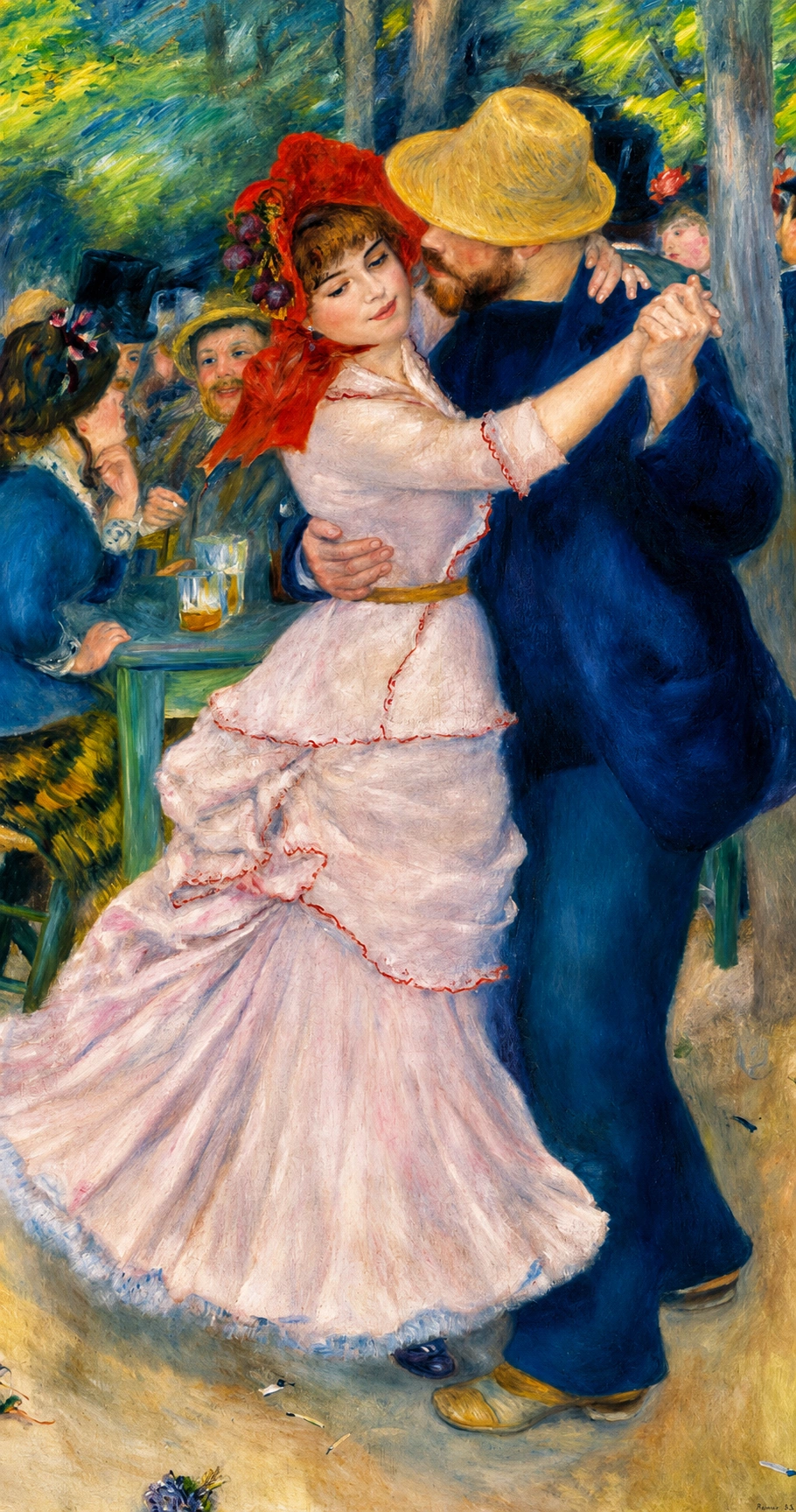
“Dance at Bougival” by Pierre-Auguste Renoir, painted in 1883, is one of the most celebrated images of modern leisure in Impressionist art. The painting captures a couple dancing outdoors in Bougival, a village near Paris that had become a fashionable destination for cafés, music, boating, and weekend entertainment. Renoir presents the scene not as a formal portrait or a carefully staged historical subject, but as a living moment of pleasure, movement, and social closeness. The dancers appear caught in the middle of a turn, their bodies pressed together, their faces partly hidden by hats, fabric, and gesture. Around them, the background dissolves into lively fragments of spectators, trees, tables, and atmosphere.
The charm of the painting comes from the way Renoir balances intimacy with public spectacle. The couple dominates the foreground, yet they are surrounded by the noise and color of a crowded outdoor dance. The woman’s pale pink dress, red-orange hat, and soft expression draw the viewer’s eye immediately. The man’s dark blue suit and yellow straw hat create a strong contrast, giving the pair a vivid visual rhythm. Renoir does not show dance as a precise sequence of steps. Instead, he paints the sensation of dancing, the slight imbalance, the closeness, the swirl of fabric, and the blurring of the world around two people absorbed in movement.
The Setting of Bougival
Bougival was an important place for the Impressionists because it represented the new culture of leisure that developed around Paris in the late nineteenth century. Improved transportation allowed city residents to escape into nearby villages along the Seine, where restaurants, dance gardens, and boating establishments offered entertainment outside the structure of urban life. Renoir was fascinated by these spaces because they brought together different classes, fashions, and moods. They were modern, informal, and visually rich.
In “Dance at Bougival,” the setting is not described through detailed architecture or exact geography. Instead, Renoir evokes Bougival through atmosphere. The blue-green shadows, the light filtering through trees, and the scattered figures in the background all suggest an outdoor café or dance garden. A small table with glasses appears at the left, reinforcing the sense of relaxed sociability. The people in the background are not sharply individualized, but they contribute to the lively environment. Their blurred forms suggest conversation, music, and passing movement.
The result is a painting that feels both specific and universal. It belongs to Bougival, but it also represents the larger world of Parisian pleasure, where ordinary people could dress up, dance, flirt, and enjoy the open air.
The Central Couple
The heart of the painting is the relationship between the two dancers. Renoir places them extremely close to the viewer, making their bodies fill most of the vertical canvas. Their dance is not distant or decorative. It feels physical, immediate, and intimate. The man leans toward the woman, his face partly hidden by his yellow hat. The woman turns slightly outward, her eyes lowered and her expression soft, dreamy, and self-contained. She is both engaged in the dance and visually available to the viewer.
Her pink dress is one of the painting’s most important features. Renoir uses loose, luminous brushwork to create the impression of layered fabric moving through air. The skirt spreads outward and downward, giving the lower half of the painting a sweeping sense of motion. The red trim along the dress adds delicate structure, guiding the eye through the folds and curves of the costume. Her red-orange hat, decorated with flowers, gives her figure warmth and theatrical brightness.
The male dancer acts as a darker anchor. His navy-blue clothing forms a strong vertical mass beside her pale dress. His posture is protective and enveloping, with one arm around her waist and the other hand holding hers. His yellow hat echoes the warm notes in her costume, connecting the two figures visually even as their colors contrast. Together, they form a rotating shape, almost like a single moving form made of light and shadow.
Color, Light, and Movement
Renoir’s color in “Dance at Bougival” is joyful but not harsh. The painting is built from soft blues, greens, pinks, yellows, and reds, all blended through quick, fluid brushwork. The background is especially Impressionist in its handling. Trees and figures seem to shimmer rather than stand still. Renoir avoids hard outlines in many areas, allowing colors to merge and vibrate. This gives the painting its feeling of movement and outdoor light.
The woman’s dress is not simply white or pink. It contains pale lavender, cream, rose, and blue shadows. These subtle variations make the fabric feel alive under changing light. The man’s dark suit also contains variations of blue and black, preventing it from becoming flat. The straw hats, glowing in yellow and ochre, add warmth to the cooler setting.
The brushwork is essential to the painting’s energy. Renoir does not paint every detail with equal clarity. The faces and hands receive enough definition to hold emotional interest, while the background remains loose and atmospheric. This contrast helps the viewer experience the scene the way it might be remembered after a dance: the partner is close and vivid, while the surrounding crowd becomes a blur of color, sound, and motion.
Impressionism and Modern Life
“Dance at Bougival” is a powerful example of Renoir’s interest in modern life. Rather than choosing a mythological or religious subject, he paints a scene of contemporary recreation. The people are not aristocrats in a palace ballroom. They are modern Parisians enjoying a popular dance venue. This focus on everyday pleasure was central to Impressionism, which often explored cafés, theaters, gardens, riversides, and city streets.
Yet Renoir’s treatment of modern life is different from a purely documentary approach. He is not interested in social analysis as much as sensory pleasure. The painting celebrates warmth, touch, color, and companionship. It turns a passing moment into something radiant. The dancers are not frozen into a formal pose. They seem to be moving through time, and that sense of movement gives the painting its emotional freshness.
The work also shows Renoir’s ability to combine modern subject matter with a deep awareness of older painting traditions. The large scale, graceful figures, and attention to the female form connect the picture to the history of figure painting. At the same time, the broken brushwork, outdoor setting, and informal composition make it unmistakably modern.
Mood and Emotional Meaning
The mood of “Dance at Bougival” is joyful, but it is not simple. The woman’s expression gives the painting a subtle emotional complexity. She does not smile broadly. Her eyes are lowered, and her face seems calm, inward, and slightly detached. This creates a fascinating tension. The dance is public and lively, but her experience appears private. She may be enjoying the music, yielding to the rhythm, or drifting into her own thoughts.
This ambiguity is part of the painting’s lasting appeal. Renoir does not explain the relationship between the dancers. Are they lovers, acquaintances, or simply partners for one dance? The closeness of their bodies suggests intimacy, but the woman’s turned face prevents the scene from becoming too direct. The viewer is invited into the atmosphere, but not given a clear story.
The background figures strengthen this feeling. The dancers are surrounded by people, yet they seem isolated within their own small world. Renoir captures a familiar paradox of crowded social spaces: a private moment can unfold in the middle of public activity. The couple’s dance becomes a temporary escape from the surrounding world.
Why Dance at Bougival Still Matters
“Dance at Bougival” remains one of Renoir’s most beloved paintings because it embodies the pleasures and tensions of Impressionist modernity. It is a painting about leisure, fashion, movement, and attraction, but also about perception itself. Renoir shows how light changes surfaces, how motion softens edges, and how memory transforms a crowded scene into a few vivid impressions.
The painting’s composition is unforgettable. The sweeping pink dress, the yellow hat, the dark blue suit, and the leafy background create a harmony that feels both spontaneous and carefully balanced. Renoir’s skill lies in making the scene appear effortless. The viewer feels the music without hearing it, senses the crowd without needing every face, and understands the dance without seeing the full choreography.
In “Dance at Bougival,” Renoir turns a moment of popular entertainment into a luminous vision of modern pleasure. The painting is not only about two people dancing. It is about the beauty of passing experience, the richness of ordinary life, and the Impressionist belief that fleeting moments could carry lasting emotional power.