Two Sisters On the Terrace by Pierre-Auguste Renoir: Vibrant Color Edit
Free to Download & Reuse: You are welcome to use this image! If you republish or share it online, you must include a direct link back to this webpage for attribution.
Original Image Source: wikiart.org
Introduction
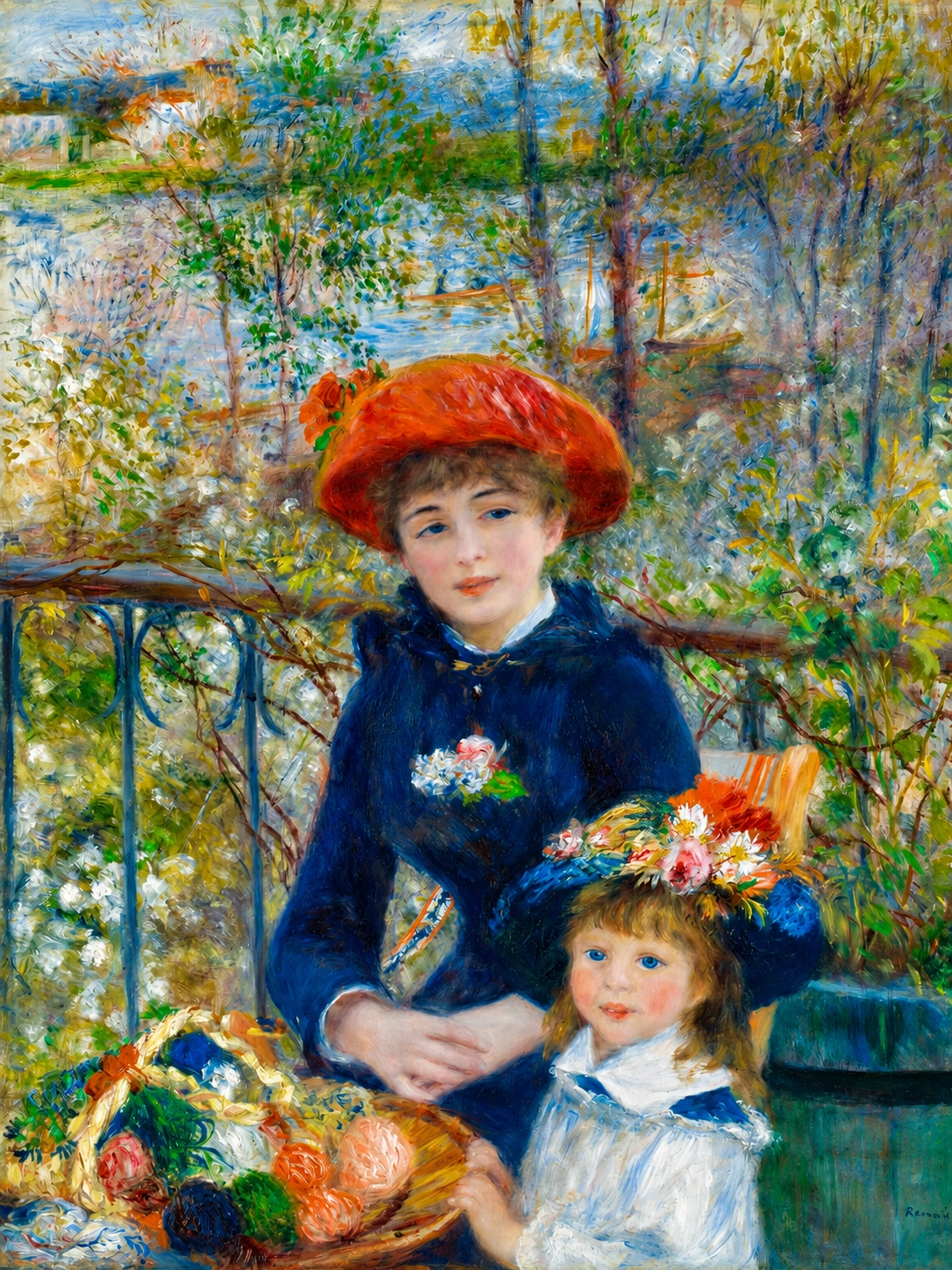
Pierre-Auguste Renoir’s “Two Sisters On the Terrace,” painted in 1881, is one of the most radiant examples of Impressionist portraiture blended with outdoor leisure painting. The work presents two young girls seated on a terrace above a river, surrounded by flowers, foliage, and shimmering natural light. At first glance, the painting feels gentle and charming, almost like a spontaneous family moment preserved in color. Yet beneath that surface warmth, Renoir creates a carefully balanced composition that brings together figure painting, landscape, fashion, and the Impressionist fascination with modern life.
The painting captures a world of calm pleasure. The two sisters appear close to the viewer, placed in the foreground with the terrace railing, basket of yarn, and surrounding flowers creating an intimate setting. Behind them, the river and boats dissolve into a soft haze of blue, green, and silvery light. Renoir does not separate the figures from nature. Instead, he lets them become part of the same atmosphere, as if their faces, clothing, hats, flowers, and the landscape all belong to one continuous field of color.
A Scene of Childhood, Leisure, and Modern Life
“Two Sisters On the Terrace” reflects Renoir’s deep interest in scenes of everyday beauty. Rather than focusing on mythology, history, or grand drama, he paints a moment of peaceful leisure. The terrace setting suggests relaxation, sociability, and the pleasures of spending time outdoors. This was central to Impressionist art, which often explored modern Parisian life, riverside resorts, gardens, cafés, and informal gatherings.
The two girls are presented with tenderness, but Renoir avoids making the scene overly sentimental. The older sister sits upright, calm and slightly reserved, while the younger child appears more animated and doll-like. Their poses create a subtle emotional contrast. The older girl seems aware of being observed, while the younger girl looks outward with a more open, innocent expression. Renoir uses this difference to give the painting psychological variety without turning it into a formal portrait.
The title suggests a family relationship, though Renoir’s interest is less about biography than visual harmony. The figures become a way to study youth, color, texture, and atmosphere. Their placement on the terrace also connects them to a wider social world. They are not isolated in a studio. They are part of a modern outdoor environment, where private feeling and public leisure quietly meet.
Composition and Visual Balance
The composition is carefully arranged despite its spontaneous appearance. The older sister occupies the central vertical axis of the painting, with her red hat forming the strongest accent near the top of the foreground. Her dark blue dress anchors the scene, providing weight and contrast against the pale, flickering background. The younger girl sits slightly lower and to the right, her white dress brightening the lower half of the canvas.
This arrangement creates a graceful diagonal movement from the older girl’s red hat down through her dark dress, across the younger child’s face and clothing, and toward the basket of colorful yarn in the lower left. The viewer’s eye moves naturally between faces, flowers, fabric, and landscape. Nothing feels rigid, yet everything is connected.
The railing behind the girls gives structure to the composition. Its horizontal line separates foreground from background, while the vertical and curved elements help frame the figures. The river beyond the terrace adds depth, but Renoir softens it so that it does not compete with the sisters. The background is spacious yet delicate, more atmospheric than descriptive.
Renoir’s Use of Color
Color is the emotional heart of “Two Sisters On the Terrace.” Renoir builds the painting around contrasts between warm reds, cool blues, soft whites, and fresh greens. The older sister’s vivid red hat immediately attracts attention. It glows against the cooler background and gives the entire painting a sense of liveliness. This red is echoed in the flowers, the yarn, and small touches throughout the scene, creating unity across the canvas.
The deep blue of the older girl’s clothing provides a rich counterpoint to the red hat. It also helps define her figure against the surrounding greenery and pale river light. The younger girl’s white dress is not simply white. Renoir fills it with subtle blue, gray, and lavender tones, allowing it to reflect the atmosphere around it. This approach is typical of Impressionism, where shadows are rarely plain black or brown. Instead, they are alive with color.
The basket of yarn in the lower left is especially important. It introduces a cluster of intense hues, including orange, rose, green, yellow, and blue. These colors echo the flowers on the hats and connect the human figures to the decorative abundance of the terrace. The yarn also adds a domestic detail, suggesting quiet activity and feminine craft, while serving as a brilliant color accent.
Light, Atmosphere, and Brushwork
Renoir’s brushwork gives the painting its sense of movement and life. The surface appears soft, flickering, and open. Leaves, blossoms, water, and distant forms are created with loose strokes rather than hard outlines. This gives the background a shimmering quality, as if it is being seen through air, light, and gentle motion.
The figures are more defined than the landscape, but they are still painted with softness. Renoir avoids sharp realism in favor of warmth and sensation. The girls’ faces are rounded and luminous, with smooth transitions of pink, cream, and pale blue. Their features are delicate, but not photographic. They seem formed by light as much as by line.
This balance between clarity and softness is one of the painting’s greatest strengths. Renoir wants the viewer to recognize the figures immediately, yet he also wants them to feel immersed in the same atmosphere as the flowers, foliage, and river. The result is a painting that feels both intimate and airy.
The Terrace as a Symbolic Space
The terrace is more than a physical setting. It acts as a threshold between domestic comfort and the open world of nature. The girls sit close to the viewer, surrounded by flowers and personal objects, while the river and boats in the distance suggest movement, travel, and modern leisure. The terrace becomes a place where childhood, family life, and the wider world quietly overlap.
This setting also allows Renoir to combine portraiture and landscape. The sisters are the emotional focus, but the surrounding environment is essential to the painting’s beauty. The terrace flowers, tangled branches, and watery background create a sense of abundance. Nature is not wild or threatening here. It is decorative, friendly, and full of light.
Impressionist Beauty and Human Warmth
“Two Sisters On the Terrace” shows Renoir at his most appealing. The painting does not depend on dramatic narrative. Its power lies in harmony, color, and mood. Renoir transforms a simple scene into a celebration of visual pleasure. The children, the flowers, the river, and the springlike atmosphere all contribute to a feeling of freshness and ease.
At the same time, the painting is not merely pretty. Its sophistication comes from the way Renoir organizes color, texture, and space. The red hat, blue dress, white clothing, floral details, and luminous background are all carefully balanced. The looseness of the brushwork gives the scene spontaneity, but the composition remains strong and deliberate.
Conclusion
Pierre-Auguste Renoir’s “Two Sisters On the Terrace” remains one of the most beloved paintings of the Impressionist period because it captures beauty without heaviness. It presents childhood and leisure through a world of color, softness, and natural light. The two girls appear close and immediate, while the landscape behind them opens into a dreamlike riverside setting.
The painting reveals Renoir’s gift for making everyday life feel graceful and memorable. Through his luminous palette, tender figures, and fluid brushwork, he turns a quiet terrace scene into an image of warmth, youth, and visual delight. “Two Sisters On the Terrace” is not only a portrait of two children. It is a portrait of a fleeting moment made permanent through color and light.