A Bar at the Folies-Bergère by Édouard Manet: Vibrant Color Edit
Free to Download & Reuse: You are welcome to use this image! If you republish or share it online, you must include a direct link back to this webpage for attribution.
Original Image Source: wikiart.org
Introduction
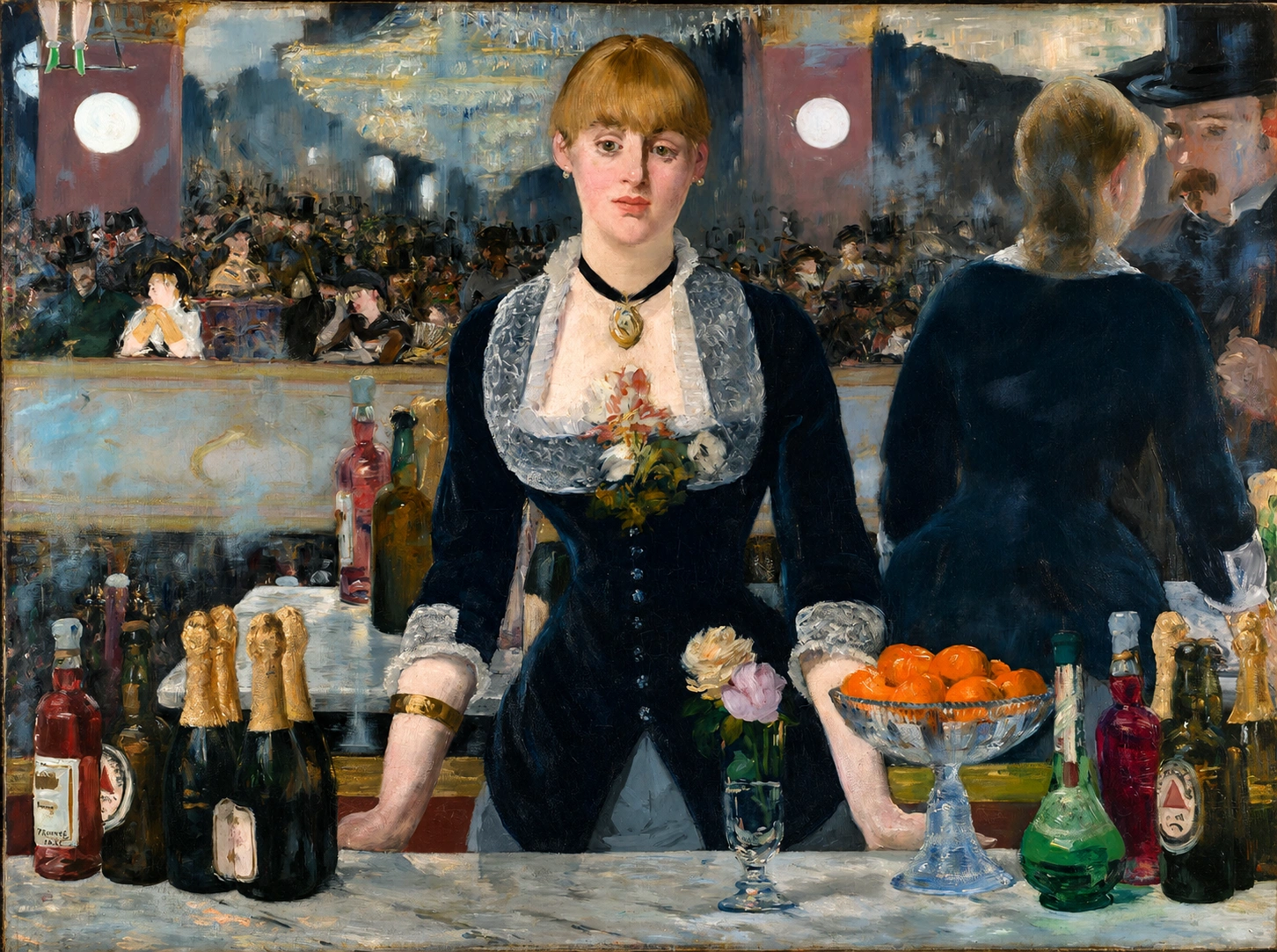
Édouard Manet’s “A Bar at the Folies-Bergère” is one of the most fascinating paintings of modern Parisian life. Created in 1882, near the end of Manet’s career, the work captures a scene inside the famous Folies-Bergère, a popular entertainment hall known for music, drinking, spectacle, fashion, and social display. At first glance, the painting seems direct: a young barmaid stands behind a marble counter, surrounded by bottles, fruit, flowers, and the reflected crowd behind her. Yet the longer one looks, the more unstable and mysterious the scene becomes. Manet turns a place of pleasure into a quiet study of isolation, desire, commerce, and modern urban life.
The painting is not simply a portrait of a woman at work. It is a meditation on seeing and being seen. The barmaid stands before us with a calm, distant expression, while the mirror behind her reveals a lively world of chandeliers, spectators, performers, and a male customer who appears to be speaking with her. Manet uses this visual puzzle to create tension between surface glamour and emotional detachment. “A Bar at the Folies-Bergère” is both a dazzling image of Paris nightlife and a subtle critique of the social world that produced it.
The Barmaid as the Center of the Painting
The young woman at the center of the composition immediately commands attention. She is placed frontally, almost symmetrically, with both hands resting on the counter. Her dark dress, pale lace collar, floral decoration, and small pendant create an image of elegance, but her expression is not theatrical or inviting. She looks outward, yet she does not seem fully engaged with the viewer. Her face is composed, tired, inward, and slightly melancholic.
This emotional distance is one of the painting’s great strengths. In a setting associated with excitement and entertainment, Manet presents a figure who appears strangely alone. She is surrounded by abundance, bottles of champagne, liqueurs, oranges, flowers, and glassware, yet none of these objects seem to bring pleasure. They function as signs of consumption. The woman herself is also part of this commercial environment. She serves drinks, receives customers, and becomes an object of visual attention.
Manet does not sentimentalize her, but he does not reduce her either. Her presence is dignified, complex, and psychologically rich. She appears both available to the public and emotionally unreachable. This contradiction gives the painting much of its modern power.
The Mirror and the Puzzle of Perspective
The mirror behind the barmaid is one of the most discussed elements of “A Bar at the Folies-Bergère.” It reflects the crowded interior of the music hall, including the back of the barmaid and a man standing close to her. Yet the reflection does not behave in a fully logical way. If the barmaid is facing us directly, her reflection should appear differently. The man in the mirror also seems to occupy the position of the viewer, which creates uncertainty about our own role in the scene.
This deliberate distortion is not a mistake. Manet uses the mirror to make the act of looking feel unstable. The viewer is placed in a position that is both intimate and uncertain. Are we standing before the barmaid as a customer? Are we replacing the man in the mirror? Are we observing a real interaction, or are we seeing a constructed image of social exchange? The painting refuses to settle these questions.
The mirror expands the space of the picture while also complicating it. It shows the Folies-Bergère as a glittering world of leisure, but it also makes that world feel fragmented and artificial. Reflections, appearances, and performances become more important than direct truth. In this sense, the mirror becomes a symbol of modern life itself: dazzling, unstable, seductive, and difficult to read.
Modern Paris and the Culture of Spectacle
The Folies-Bergère was a major symbol of Parisian modernity. It brought together entertainment, nightlife, fashion, and public sociability. Manet captures this atmosphere through the blurred crowd, bright lights, chandeliers, and smoky depth of the reflected background. The setting feels alive, but it is not painted with precise detail. Instead, Manet suggests movement and noise through loose brushwork and shifting patches of color.
This treatment reflects the experience of the modern city. Paris in the late nineteenth century was changing rapidly, with new boulevards, cafés, department stores, theaters, and places of mass entertainment. People gathered in public not only to enjoy themselves, but also to watch others and be watched in return. Manet understood this culture of display. In “A Bar at the Folies-Bergère,” everyone seems to be part of a visual economy.
The barmaid stands at the center of that economy. She sells drinks, but she also represents the atmosphere of the establishment. Her polished appearance helps create the illusion of pleasure. Yet Manet’s painting shows the emotional cost of this performance. The glittering world behind her contrasts sharply with her quiet, detached gaze.
Objects, Color, and Surface
The still life elements on the counter are painted with remarkable freshness. Bottles, oranges, roses, and glasses create a rich display of textures and colors. The orange fruit glows warmly against the cooler blues, blacks, silvers, and whites of the surrounding scene. The bottles vary in shape and transparency, giving the foreground a sense of material abundance. The marble bar, with its pale surface and subtle reflections, provides a cool horizontal base for the composition.
These objects are not decorative filler. They reinforce the painting’s theme of consumption. Everything on the counter is for sale, and the arrangement resembles a display. The oranges, champagne, and liqueurs suggest pleasure, luxury, and appetite. The flowers on the barmaid’s bodice echo the flowers in the glass, linking her visually to the objects around her. This connection is subtle but important, since it suggests that she too is part of the spectacle being offered to the public.
Manet’s brushwork is loose yet controlled. He does not hide the painted surface. Faces in the background dissolve into strokes, and the chandelier becomes a shimmering haze of light. This painterly freedom gives the image a sense of immediacy, as though the scene is being glimpsed in passing. At the same time, the firm placement of the barmaid creates a powerful stillness in the middle of all this visual motion.
The Barmaid’s Gaze
The barmaid’s gaze is one of the most haunting aspects of the painting. She looks forward, but not with the brightness expected from a scene of entertainment. Her eyes seem heavy, distracted, or resigned. This expression creates a gap between the public role she performs and her private interior life.
Manet’s modernity lies partly in this refusal to explain her. She is not presented as a simple moral lesson, a romantic figure, or a cheerful worker. She remains unknowable. The viewer can observe her, but cannot possess her thoughts. This distance protects her dignity while also deepening the painting’s emotional ambiguity.
The gaze also changes how we understand the viewer’s position. Because the reflected male customer may stand where we stand, the painting implicates us in the exchange. We become part of the social world that looks at her, questions her, and perhaps consumes the image of her. Manet turns spectatorship into a subject of the painting.
A Masterpiece of Ambiguity
“A Bar at the Folies-Bergère” is often seen as Manet’s final great masterpiece, and its power comes from its layered ambiguity. It is a painting of nightlife, but also of loneliness. It is a scene of pleasure, but also of labor. It is a display of luxury, but also a study of emotional distance. It uses the visual glamour of modern Paris to reveal the hidden tensions beneath that glamour.
The painting remains unforgettable because it does not resolve its contradictions. The barmaid is present and distant, central and isolated, visible and mysterious. The mirror clarifies the setting while confusing the space. The crowd suggests excitement, while the central figure suggests stillness. Manet holds all these tensions together with extraordinary intelligence.
In “A Bar at the Folies-Bergère,” Édouard Manet created more than an image of a fashionable Parisian venue. He created one of the defining paintings of modern life. Its brilliance lies in the way it transforms a bar, a mirror, a woman, and a crowd into a profound meditation on appearance, desire, labor, and the uneasy beauty of the modern city.