Mona Lisa by Leonardo da Vinci: Vibrant Color Edit
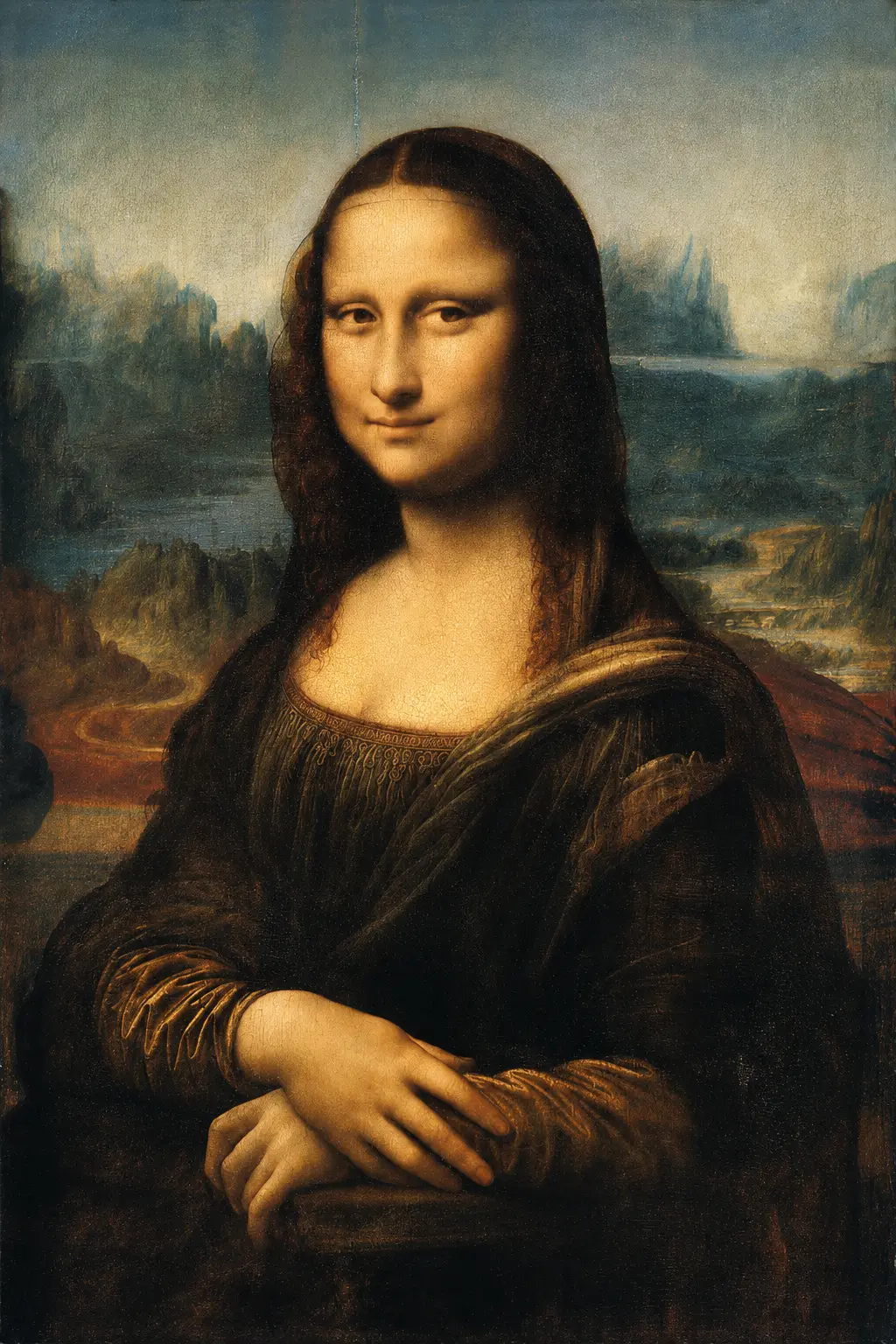
Free to Download & Reuse: You are welcome to use this image! If you republish or share it online, you must include a direct link back to this webpage for attribution.
Original Image Source: wikiart.org
The Enduring Power of “Mona Lisa” by Leonardo da Vinci
“Mona Lisa” by Leonardo da Vinci is one of the most recognized paintings in the world, but its fame is not simply the result of celebrity or museum attention. The portrait has remained powerful because it combines technical mastery, psychological mystery, and visual restraint in a way that still feels alive centuries after its creation. Associated with Leonardo’s final years and his death in 1519, the painting represents the height of Renaissance portraiture, where observation, science, emotion, and artistic imagination meet in a single image.
At first glance, the painting appears simple. A seated woman faces the viewer, her hands folded calmly, her body turned slightly, and her face softened by a faint, unreadable smile. Behind her stretches a dreamlike landscape of winding roads, distant water, rocky formations, and misty atmosphere. Yet this apparent simplicity is deceptive. Every part of the composition has been carefully designed to hold the viewer’s attention. Leonardo does not rely on dramatic gesture, rich jewelry, or elaborate costume. Instead, he creates depth through subtle transitions of light, delicate modeling of the face, and a mood of quiet inner life.
The Portrait and Its Subject
The woman traditionally identified as Lisa Gherardini, the wife of Florentine merchant Francesco del Giocondo, is shown with remarkable dignity and calm. Unlike many formal portraits of the period, she is not presented as a stiff symbol of wealth or status. Her clothing is dark and modest, her jewelry absent, and her expression restrained. Leonardo shifts attention away from social display and toward presence. The sitter becomes fascinating not because of what she owns, but because of what she seems to think and feel.
Her pose is central to the painting’s intimacy. She sits close to the picture plane, turned slightly toward the viewer, while her folded hands create a stable base for the composition. The hands are painted with the same sensitivity as the face, suggesting elegance, stillness, and control. Their placement also guides the eye upward toward the chest, neck, and face, where the painting’s emotional tension is concentrated.
The famous smile is neither fully joyful nor clearly ironic. It seems to appear and disappear depending on where the viewer looks. This effect gives the portrait a sense of movement, even though the figure remains completely still. Leonardo understood how human perception works, and he used soft edges and shadow to create an expression that feels unstable in the most compelling way. The smile is not a fixed statement. It is an invitation.
Leonardo’s Use of Sfumato
One of the most important features of “Mona Lisa” is Leonardo’s use of sfumato, a technique based on extremely gradual transitions between light and shadow. Rather than outlining the face sharply, he allows forms to emerge through haze. The cheeks, mouth, eyes, and chin are modeled with soft tonal shifts that make the figure seem almost breathing. This is one reason the portrait feels so lifelike. The viewer does not see hard borders; instead, the face seems to exist within atmosphere.
The sfumato is especially important around the mouth and eyes. The corners of the lips are softened, making the smile difficult to define. The eyes are also shaded in a way that gives the sitter a calm but penetrating gaze. She does not stare aggressively, yet she seems fully aware of the viewer. The result is a psychological exchange. The painting does not simply show a woman; it makes the viewer feel seen by her.
Leonardo’s scientific curiosity also shaped this technique. His studies of anatomy, optics, and the behavior of light helped him understand how faces appear in real life. Human expression is rarely made of sharp lines. It shifts through muscles, shadows, and tiny changes in perception. In “Mona Lisa,” Leonardo translated that knowledge into paint.
The Landscape as a Mirror of Mystery
The background of “Mona Lisa” is as important as the sitter herself. Behind her, Leonardo paints a strange and distant landscape that does not look like a straightforward view of a real location. Roads curve through valleys, bridges cross water, and mountains dissolve into mist. The horizon line seems uneven, creating a subtle sense of disorientation. This background gives the portrait a timeless quality, as if the sitter belongs not only to Florence or Renaissance Italy, but to a larger world of nature, memory, and imagination.
The landscape also deepens the painting’s mystery. The woman is calm and composed, while the world behind her feels vast, ancient, and unstable. This contrast creates a poetic tension between the human figure and the natural universe. Leonardo often explored the relationship between humanity and nature, and here the sitter appears almost like a bridge between the two. Her curved body, soft skin, and flowing hair echo the winding paths and rivers behind her.
The atmospheric perspective in the background also shows Leonardo’s mastery. Distant forms become cooler, lighter, and less distinct, creating a convincing illusion of space. The landscape seems to recede endlessly, but it never distracts from the sitter. Instead, it surrounds her with a sense of depth that is both physical and emotional.
Composition and Balance
The composition of “Mona Lisa” is built on stability and subtle movement. The sitter’s body forms a pyramid, with the folded hands at the base and the head at the top. This triangular structure gives the painting calm authority. At the same time, the slight turn of the body and the gentle rotation of the head prevent the image from feeling rigid. Leonardo creates balance without stiffness.
The dark clothing frames the illuminated face and hands, drawing attention to the most expressive parts of the body. The face is the emotional center, while the hands provide grace and composure. The muted color palette also contributes to the painting’s power. Instead of bright decoration, Leonardo uses browns, greens, golds, and smoky grays to create harmony. The effect is quiet but deeply absorbing.
The sitter’s placement before a parapet adds another layer of structure. It separates her from the landscape while also connecting her to it. She belongs to the viewer’s space and to the distant world behind her. This careful positioning helps explain why the painting feels both intimate and monumental.
Why “Mona Lisa” Still Matters
“Mona Lisa” remains important because it changed what a portrait could be. Earlier portraits often emphasized rank, costume, lineage, or public identity. Leonardo’s portrait turns inward. It suggests personality without explaining it. It gives the sitter emotional complexity without using dramatic expression. This was a major achievement in Renaissance art and a lasting influence on later portraiture.
The painting’s fame has sometimes made it difficult to see clearly. Because “Mona Lisa” is so often reproduced, parodied, and discussed, viewers may approach it as an icon rather than as a painting. Yet when considered closely, its greatness lies in its restraint. Leonardo does not overwhelm the viewer. He whispers. The more one looks, the more the painting seems to change.
The expression, the soft modeling, the folded hands, and the dreamlike landscape all work together to create a portrait that resists final interpretation. Is she smiling at the viewer, hiding a thought, or simply resting in quiet self-possession? The painting never answers directly. That uncertainty is part of its genius. “Mona Lisa” continues to feel alive because it does not give itself away all at once.