The Starry Night by Vincent van Gogh: Vibrant Color Edit
Free to Download & Reuse: You are welcome to use this image! If you republish or share it online, you must include a direct link back to this webpage for attribution.
Original Image Source: wikiart.org
A Complete Analysis of “The Starry Night” by Vincent van Gogh
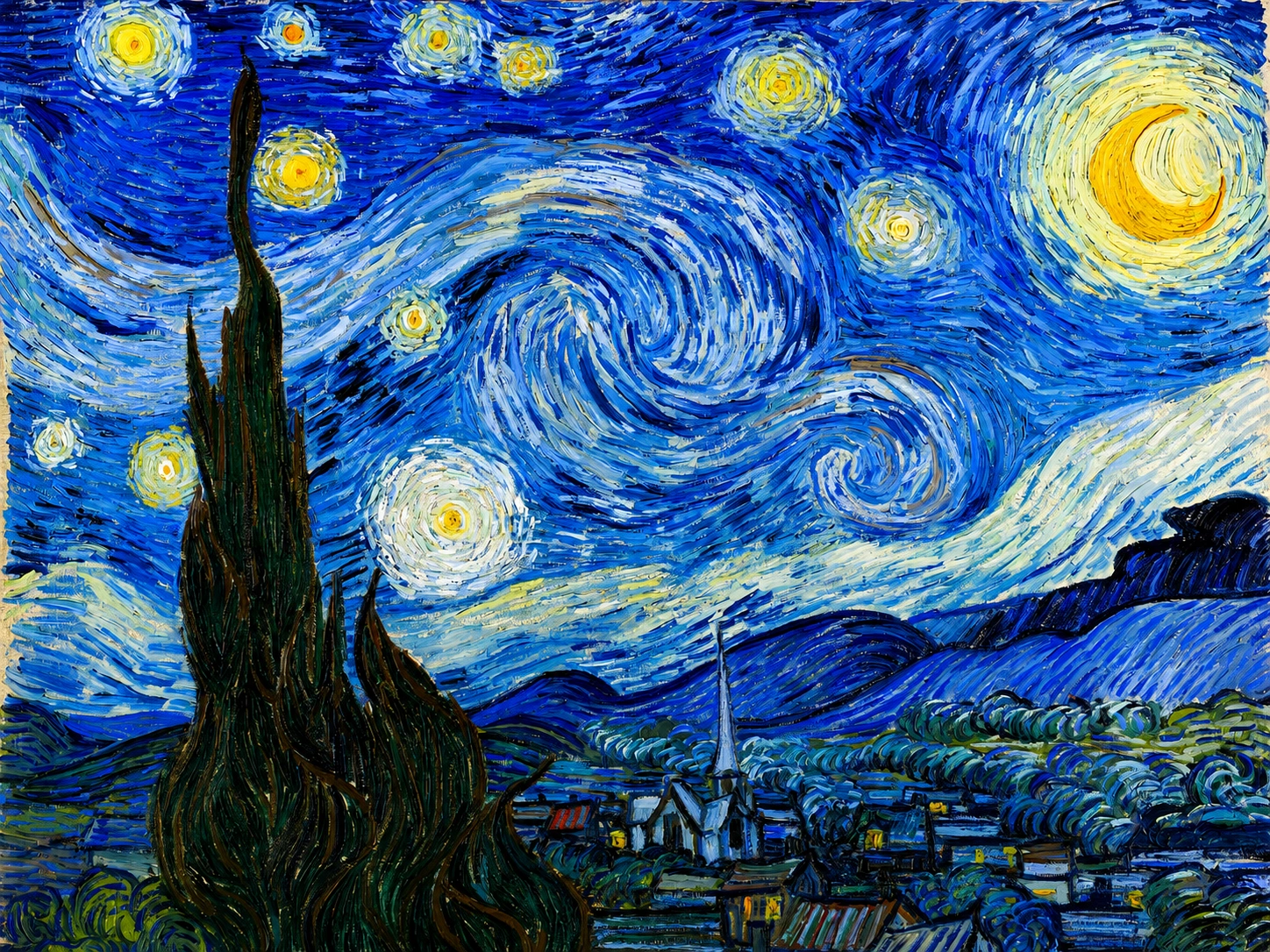
Vincent van Gogh’s “The Starry Night,” painted in 1889, is one of the most recognizable images in the history of Western art. It presents a night landscape seen from an elevated viewpoint, with a sleeping village beneath a sky filled with stars, a glowing crescent moon, and enormous currents of blue, white, yellow, and green. At first glance, the painting appears dreamlike and almost fantastical, yet it is rooted in observation, memory, and emotional interpretation. Van Gogh was not simply recording a view. He was transforming the night into a vision of inner intensity, spiritual longing, and restless beauty.
The painting was created while Van Gogh was staying at the asylum of Saint-Paul-de-Mausole in Saint-Rémy-de-Provence. From his room, he could see the surrounding countryside, though the village in the painting is partly invented. This mixture of reality and imagination is central to the power of the work. “The Starry Night” does not feel like a neutral landscape. It feels like a world charged with feeling, where nature, sky, trees, hills, and human dwellings are all animated by the same pulsing energy.
The Sky as the Emotional Center
The sky dominates the composition. It occupies most of the canvas and immediately pulls the viewer’s attention upward. Rather than presenting the night as still and silent, Van Gogh paints it as alive with movement. The stars are not small points of light. They are radiant orbs surrounded by halos of yellow, white, and pale green. The moon shines in the upper right corner like a burning celestial presence, far larger and more forceful than a realistic moon would appear.
The most striking feature is the great spiral motion that sweeps across the center of the sky. This swirling form gives the painting its famous sense of motion. It looks like wind, cloud, wave, and cosmic force at once. The brushstrokes curve, coil, and surge, creating the impression that the heavens are in constant transformation. Van Gogh turns the night sky into a living organism, one that breathes and trembles above the quiet village below.
This dramatic sky reflects Van Gogh’s ability to make color and brushwork carry emotional meaning. The blues are deep and varied, ranging from dark indigo to lighter turquoise. The yellows of the stars and moon do not merely illuminate the sky. They vibrate against the blue, creating a strong contrast that makes the whole image feel electric. The result is not a calm nocturne, but a night filled with urgency and wonder.
The Cypress Tree and Vertical Drama
On the left side of the painting, the tall cypress tree rises like a dark flame. Its shape is one of the most important visual anchors in the composition. It begins in the lower foreground and reaches almost to the top edge of the canvas, linking the earth to the sky. Its dark, twisting form contrasts strongly with the luminous heavens behind it.
The cypress has often been associated with mourning and cemeteries, but in “The Starry Night” it is more than a symbol of death. It functions as a bridge between the human world and the cosmic world. Its upward movement echoes the motion of the stars and sky, while its roots and base remain connected to the land. Like the sky, the tree appears animated by inner force. Its brushstrokes are dense, vertical, and flame-like, suggesting growth, tension, and aspiration.
The cypress also gives the painting a sense of depth. It is close to the viewer, while the village and hills recede into the distance. This creates a dramatic layering of space: foreground tree, middle-ground village, distant mountains, and vast sky. Through this structure, Van Gogh makes the viewer feel suspended between the intimate and the infinite.
The Village Beneath the Stars
The village below the sky is much quieter than the heavens above. Its houses are small, orderly, and mostly dark, with a few warm yellow windows glowing in the night. At the center stands a church with a tall steeple, its pointed shape echoing the vertical rise of the cypress. The village seems peaceful, almost asleep, yet it is not painted with photographic precision. It feels remembered or imagined, simplified into roofs, walls, windows, and a central church.
This contrast between the calm village and the turbulent sky is essential to the painting’s emotional effect. Human life appears small beneath the immense energy of the universe. The houses are fragile and still, while the sky moves with overwhelming force. Yet Van Gogh does not present this relationship as frightening. Instead, there is a strange harmony between the village and the heavens. The same rhythmic brushwork that shapes the stars also shapes the hills and fields. Everything belongs to one visual language.
The church steeple gives the village a spiritual dimension. It points upward, toward the stars, suggesting the human desire to reach beyond earthly limits. At the same time, the steeple is much smaller than the cypress and the celestial bodies. Van Gogh seems to suggest that traditional structures of faith are present, but nature itself has become the greater spiritual force.
Brushwork, Rhythm, and Color
Van Gogh’s brushwork is one of the defining features of “The Starry Night.” Every part of the painting is built from visible strokes of paint. These strokes do not hide the artist’s hand. They reveal it. The surface is energetic, textured, and expressive. The sky is made of flowing curves. The cypress is made of upward, twisting marks. The hills roll in wave-like bands. The village is constructed with shorter, more stable strokes.
This variety of brushwork creates rhythm across the whole canvas. The viewer’s eye moves from the cypress to the stars, from the moon to the swirling sky, from the hills down to the village, then back upward again. The painting never feels static. Even the quiet parts participate in a larger visual movement.
Color is equally important. Van Gogh uses blue as the emotional foundation of the painting, but he refuses to make it monotonous. His blues shift constantly, producing depth and atmosphere. Against them, yellow becomes a color of revelation. The stars and moon feel almost sacred because their light is so intense against the dark sky. This contrast gives the painting its unforgettable glow.
Meaning and Lasting Power
“The Starry Night” endures because it balances opposites with extraordinary force. It is both peaceful and turbulent, earthly and cosmic, observed and imagined, intimate and vast. The village suggests shelter and ordinary life, while the sky suggests mystery beyond human control. The cypress is dark and grounded, yet it reaches upward with extraordinary energy. The painting is full of tension, but also full of beauty.
Van Gogh’s achievement lies in his ability to make the landscape emotional without making it chaotic. The painting feels intensely personal, yet it remains open to many interpretations. Some viewers see loneliness in it. Others see hope, faith, nature, or the grandeur of the universe. Its power comes from the fact that it does not reduce itself to one meaning. It allows the viewer to feel the night as something alive, immense, and deeply moving.
In “The Starry Night,” Van Gogh created more than an image of stars over a village. He created a vision of the world as charged with invisible energy. The painting suggests that reality is not only what the eye sees, but also what the heart and mind experience. Its swirling sky, glowing stars, dark cypress, and quiet village continue to speak because they transform a simple night scene into a universal image of longing, wonder, and emotional intensity.