The Last Supper by Leonardo da Vinci: Vibrant Color Edit
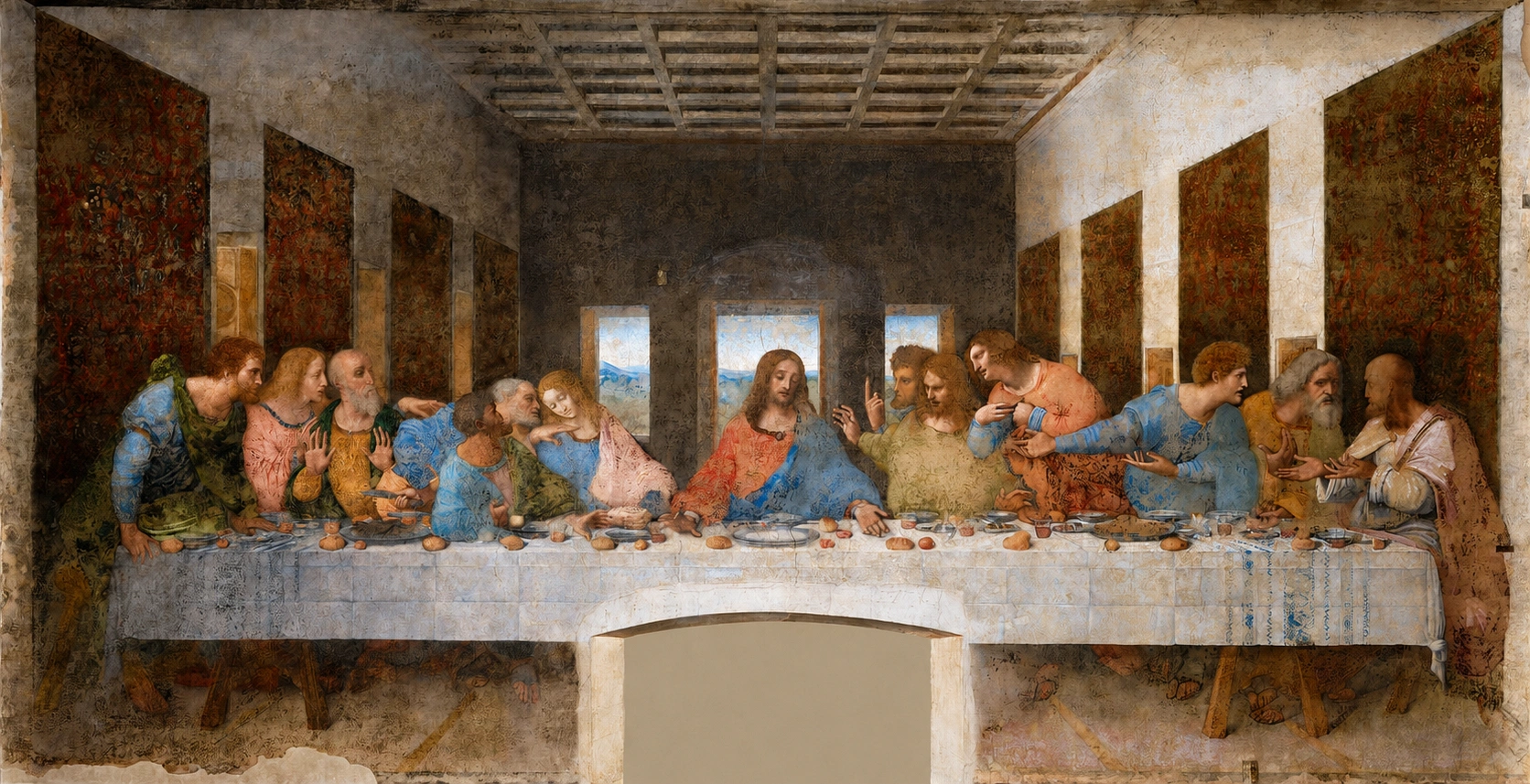
Free to Download & Reuse: You are welcome to use this image! If you republish or share it online, you must include a direct link back to this webpage for attribution.
Original Image Source: www.wikiart.org
The Last Supper by Leonardo da Vinci: An Analysis
Leonardo da Vinci’s “The Last Supper,” begun in 1495, is one of the most influential religious paintings in Western art because it turns a familiar biblical episode into an intense study of human emotion, spiritual order, and dramatic revelation. Painted for the refectory of Santa Maria delle Grazie in Milan, the work was designed not as a distant decorative image, but as a scene that seems to extend the dining room itself. Leonardo places Christ and the apostles at a long table, facing the viewer directly, as though the sacred meal is unfolding in the same architectural space as the observer. This fusion of illusion, theology, and psychological drama gives the painting its enduring power.
The subject is the moment after Christ tells his disciples that one of them will betray him. Rather than presenting the Last Supper as a calm ritual, Leonardo chooses the instant when certainty breaks apart. The apostles react with shock, disbelief, anger, sorrow, and confusion. Each figure becomes a visible response to the invisible weight of Christ’s words. The painting is therefore not only about a meal before the Crucifixion, but about the human difficulty of understanding divine fate.
Composition and Perspective
The structure of the painting is remarkably controlled. Leonardo arranges the apostles in four groups of three, with Christ alone at the center. This organization prevents the crowded scene from becoming chaotic, even though the gestures and facial expressions are full of movement. The number three carries obvious Christian meaning, suggesting the Holy Trinity, while the repeated groupings create visual rhythm across the long horizontal format.
The architectural setting is essential to the painting’s authority. The ceiling beams, wall tapestries, side openings, and rear windows all lead the eye toward Christ. Leonardo uses linear perspective so that the vanishing point falls around Christ’s head, making him the visual and spiritual center of the entire composition. Even before the viewer consciously notices the perspective system, the eye is drawn to him. The room itself seems to acknowledge his importance.
Christ’s triangular pose adds to this sense of stability. His head, shoulders, and outstretched arms form a calm geometric shape amid the agitation around him. While the disciples lean, point, question, and recoil, Christ remains still. This contrast makes his isolation more powerful. He is surrounded by followers, yet emotionally alone. Leonardo captures not only the announcement of betrayal, but also the loneliness of divine knowledge.
The Apostles’ Reactions
One of the painting’s greatest achievements is its treatment of the apostles as distinct personalities. Leonardo does not show them as identical holy men. Instead, each disciple reacts according to temperament. Some turn toward Christ in alarm, some question one another, and some gesture outward as though trying to reject the accusation. The table becomes a stage of emotional response.
On the viewer’s left, the apostles lean together in a tight cluster of discussion and shock. Their bodies overlap, creating a sense of urgent whispering. Near Christ, Judas, Peter, and John form one of the painting’s most psychologically charged groups. Judas withdraws into shadow, clutching the small bag associated with betrayal. His body pulls backward even as the others move forward. Leonardo does not need to make him grotesque. His separation is enough. Peter leans sharply, full of tension, while John appears sorrowful and inward, creating a contrast between action and grief.
On the viewer’s right, the apostles react with broader gestures. Some open their hands in disbelief, while others lean toward Christ as if demanding explanation. Their gestures create waves of movement that spread from the center outward. The emotional energy begins with Christ’s statement, travels through the disciples, and returns to him through their gaze and questions. This makes the painting feel alive, as if the scene has just occurred and is still unfolding.
Christ as the Spiritual Center
Christ’s calmness is the emotional heart of the painting. His expression is solemn, resigned, and compassionate. Leonardo does not depict him as detached from suffering. Instead, he appears fully aware of the betrayal, the coming Passion, and the weakness of those around him. His lowered eyes and open hands suggest both acceptance and sacrifice. One hand reaches toward the bread, while the other opens near the wine, quietly connecting the scene to the Eucharist.
The placement of Christ before the central window gives him a subtle halo without using a traditional golden circle. Light surrounds his head naturally through the architecture. This choice reflects Leonardo’s ability to transform religious symbolism into believable visual experience. Christ is not separated from the world by artificial decoration. His holiness is revealed through order, light, and stillness.
The landscape visible beyond the windows also deepens the painting’s meaning. Behind the enclosed room, there is an open world of blue distance and soft light. This contrast between interior drama and exterior calm suggests a reality beyond the immediate human crisis. The apostles are trapped in confusion, but Christ’s fate belongs to a larger divine plan.
Light, Color, and Atmosphere
Although the painting has suffered greatly over time, its color and atmosphere still communicate Leonardo’s original ambition. The figures are softened by a muted, smoky quality that reflects his interest in subtle transitions of light and shadow. The blues, reds, ochres, and pale flesh tones create a restrained but expressive harmony. Christ’s red and blue garments stand out near the center, balancing warmth and coolness, humanity and divinity.
The worn surface of the painting gives it a fragile presence today. Instead of diminishing its emotional force, the fading can make the image feel even more haunting. The scene appears like a memory emerging through time, damaged but still legible. The deterioration also reminds viewers that “The Last Supper” is not only an image of sacred history, but an object with its own history of survival.
The tablecloth, plates, bread, and gestures root the event in the physical world. Leonardo gives the sacred moment ordinary details, making it feel immediate and human. The apostles are not floating symbols. They are men seated at a meal, confronted by a truth they cannot easily bear.
Meaning and Legacy
“The Last Supper” remains powerful because it combines perfect structure with emotional instability. Its geometry is calm, but its human drama is intense. Its religious message is clear, but its psychological richness makes it endlessly interpretable. Leonardo shows betrayal not as an abstract theological event, but as something that passes through faces, hands, bodies, and relationships.
The painting also changed the way artists imagined narrative. Instead of showing several moments at once or relying on fixed symbolic poses, Leonardo focuses on one charged instant. The result feels cinematic before cinema, dramatic before modern theater, and psychologically modern in its attention to individual response.
At its deepest level, “The Last Supper” is a painting about revelation. Christ reveals betrayal, and the apostles reveal themselves. Their reactions expose fear, loyalty, doubt, anger, love, and confusion. Around the still figure of Christ, human emotion breaks open. That balance between divine calm and human turmoil is what makes Leonardo’s masterpiece unforgettable.