The Birth of Venus by Sandro Botticelli: Vibrant Color Edit
Free to Download & Reuse: You are welcome to use this image! If you republish or share it online, you must include a direct link back to this webpage for attribution.
Original Image Source: wikiart.org
The Birth of Venus by Sandro Botticelli: A Renaissance Vision of Beauty
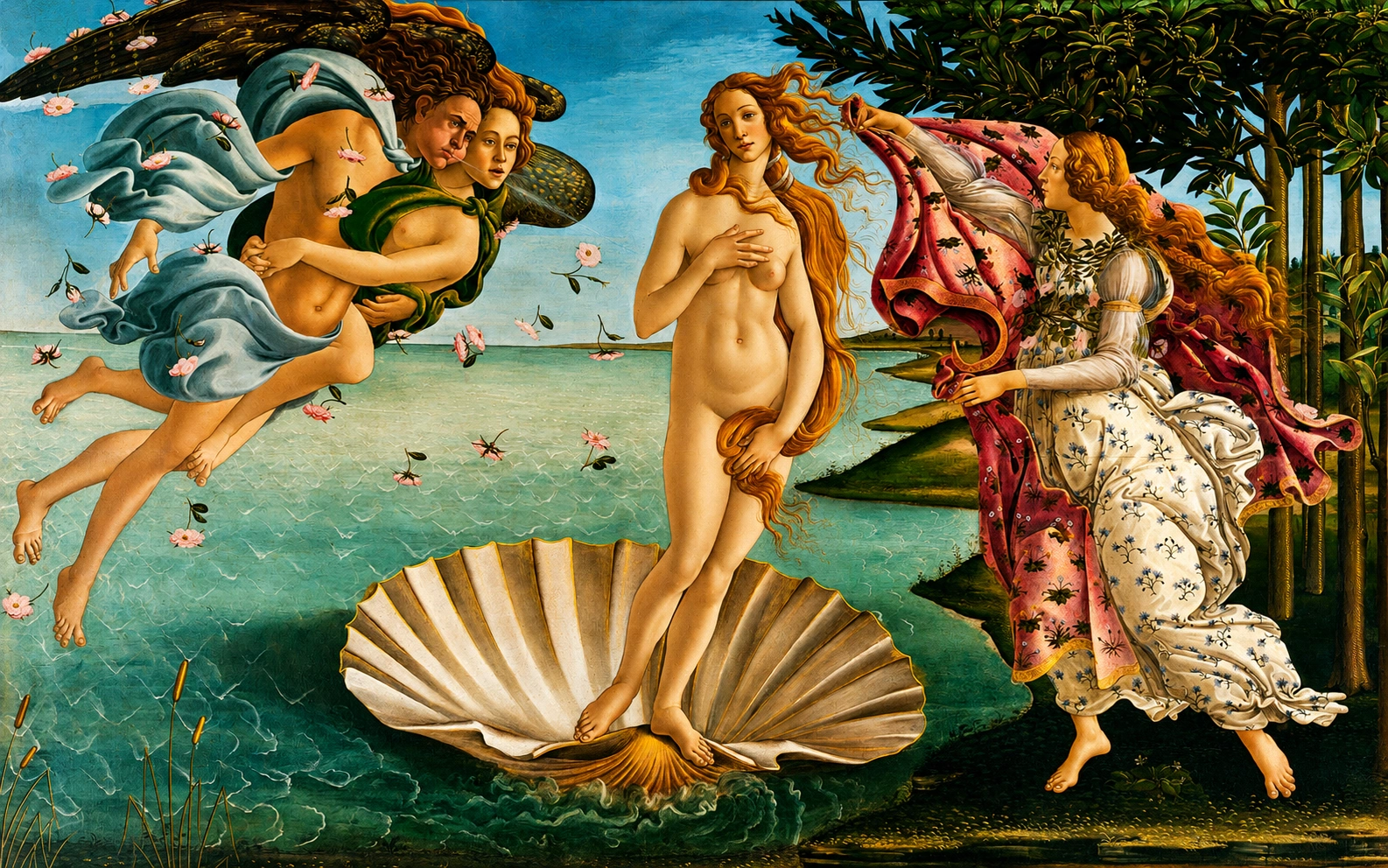
Sandro Botticelli’s “The Birth of Venus,” painted around 1485, is one of the most recognizable images of the Italian Renaissance. The painting presents the goddess Venus arriving at the shore after her miraculous birth from the sea, standing on a large scallop shell as the winds guide her toward land. At the right, a female attendant waits with a richly patterned cloak, ready to cover the goddess. At the left, two wind figures fly through the air, sending roses across the pale sky and rippling water. The scene is mythological, poetic, and deeply refined, but its power comes from more than beauty alone. Botticelli turns a classical story into an image of grace, spiritual longing, and idealized harmony.
Unlike many Renaissance paintings that emphasize heavy realism, architectural depth, or dramatic physical weight, “The Birth of Venus” feels light and dreamlike. The figures seem to float rather than stand firmly in a believable world. Venus’s body is elongated, her posture delicate, and her hair moves in golden waves around her. The landscape is simple, almost stage-like, allowing the viewer’s attention to remain fixed on the rhythm of the figures and the symbolic meaning of the scene. Botticelli is not trying to recreate a natural event. He is presenting an ideal vision of divine beauty entering the human world.
The Mythological Subject
The subject comes from classical mythology. Venus, the Roman goddess of love and beauty, is shown arriving after being born from the sea. Botticelli chooses the moment when she reaches the shore, not the moment of her birth itself. This gives the painting a ceremonial quality. Venus appears like a sacred figure being revealed, greeted by the forces of nature and prepared for earthly life.
The winged figure on the left is commonly identified as Zephyrus, the west wind, who blows Venus toward land. He is joined by a female figure, often interpreted as Aura or Chloris. Together, they create the movement that sends roses scattering across the air. On the right, the richly dressed woman is usually associated with one of the Horae, goddesses connected with the seasons. Her floral gown and vine-like decoration suggest spring, renewal, and fertility. The entire painting therefore becomes an image of arrival, awakening, and transformation.
Botticelli’s mythological subject also reflects the intellectual atmosphere of Renaissance Florence. Classical myths were not treated only as ancient stories. They could be read as moral, philosophical, and spiritual allegories. Venus may represent earthly beauty, but she can also suggest a higher kind of beauty that leads the mind toward divine love. In this sense, the painting speaks to both the senses and the intellect.
Venus as an Ideal Figure
Venus stands at the center of the composition, isolated against the pale sea and sky. Her pose is modest, with one hand covering her chest and the other drawing her hair across her body. This gesture recalls ancient statues of Venus, especially the classical type known as the “Venus Pudica,” or modest Venus. Botticelli adapts this pose into a figure who is graceful rather than physically solid.
Her body is not anatomically strict. Her neck is long, her shoulders slope gently, and her stance would be unstable in real life. Yet these distortions are intentional. Botticelli is more interested in elegance and expressive line than in muscular realism. Venus’s body becomes a flowing pattern, almost like music translated into visual form. Her golden hair forms curling ribbons, echoing the movement of the wind and the waves below.
Her expression is calm but slightly distant. She does not smile or react dramatically to the figures around her. Instead, she gazes outward with a quiet, inward-looking sadness. This gives the painting emotional depth. Venus is not merely an emblem of physical attractiveness. She seems thoughtful, fragile, and mysterious, as though beauty itself has arrived in the world with both wonder and melancholy.
Composition and Movement
The composition of “The Birth of Venus” is carefully balanced. Venus stands in the center, while the flying wind figures on the left and the attendant on the right frame her body. The sea behind her stretches horizontally, creating a calm backdrop. The shell beneath her acts almost like a pedestal, raising her into a position of honor.
Movement flows from left to right. Zephyrus blows Venus toward the shore, the roses travel through the air, the waves ripple beneath the shell, and the attendant leans forward with the cloak. At the same time, Venus remains still. This contrast between motion and stillness gives the painting its special tension. The world moves around Venus, but she appears timeless.
Botticelli’s use of line is central to this effect. The outlines of the figures are crisp and graceful, giving the painting a decorative clarity. The curves of the bodies, garments, hair, shell, and shoreline all create a visual rhythm. Rather than relying on deep perspective, Botticelli builds beauty through contour, pattern, and repetition. This makes the painting feel closer to poetry than to ordinary observation.
Color, Light, and Surface Beauty
The color palette of “The Birth of Venus” is gentle but memorable. The sea is a pale green-blue, the sky is soft and open, and Venus’s skin glows against the cool background. Her hair provides one of the strongest visual accents, with warm golden-orange tones that draw the eye immediately. The pink cloak on the right, covered with dark floral patterns, adds richness and contrast.
The painting’s surface has a refined decorative quality. The roses floating through the air are not random details. They are symbols of love and beauty, but they also create a delicate pattern across the left side of the composition. The shell, with its radiating ridges, mirrors Venus’s central importance. The trees on the right form a dark vertical screen, helping the lighter figure of Venus stand out even more clearly.
Light in the painting is even and gentle. There is little dramatic shadow. This gives the scene an otherworldly atmosphere, as though it exists outside ordinary time. Botticelli’s beauty is not based on strong physical volume. It is based on clarity, delicacy, and the sensation of a vision appearing before the viewer.
Symbolism and Renaissance Meaning
“The Birth of Venus” is often understood as a celebration of beauty, but its meaning is richer than that. Venus can be seen as a symbol of love, fertility, and sensual attraction. At the same time, Renaissance thinkers often connected beauty with spiritual elevation. A beautiful form could lead the soul toward a higher understanding of truth and goodness.
The painting may therefore present two levels of meaning at once. On the surface, it shows the goddess of love arriving in the world. On a deeper level, it suggests the birth of ideal beauty in the human imagination. Venus’s modest pose and serene expression keep the image from becoming merely sensual. She appears as an emblem of purity, grace, and contemplative beauty.
The cloak offered by the attendant may also suggest the transition from divine nakedness to earthly existence. Venus arrives from the sea in a state of ideal perfection, but she is about to be clothed and brought into the human realm. This moment between exposure and covering, sea and land, myth and reality, gives the painting its lasting fascination.
Why The Birth of Venus Still Matters
“The Birth of Venus” remains powerful because it combines simplicity with mystery. The scene is easy to recognize, yet it never feels fully explained. Venus is beautiful, but also distant. The setting is clear, but also dreamlike. The story is ancient, but Botticelli gives it a fresh emotional life.
The painting also captures a central ambition of the Renaissance: the revival of classical antiquity through a new visual language. Botticelli does not copy the ancient world mechanically. He reimagines it through Florentine elegance, poetic line, and philosophical symbolism. His Venus is both pagan goddess and Renaissance ideal, both physical presence and spiritual sign.
More than five centuries after its creation, “The Birth of Venus” continues to define how many people imagine Renaissance beauty. Its flowing hair, shell, pale sea, and windblown roses have become part of visual culture itself. Yet the painting’s greatness lies not only in its fame. It lies in Botticelli’s ability to make beauty feel like an event, something that arrives, transforms the world, and remains suspended forever in a moment of delicate wonder.