The Girl with a Pearl Earring by Johannes Vermeer: Vibrant Color Edit
Free to Download & Reuse: You are welcome to use this image! If you republish or share it online, you must include a direct link back to this webpage for attribution.
Original Image Source: wikiart.org
Introduction
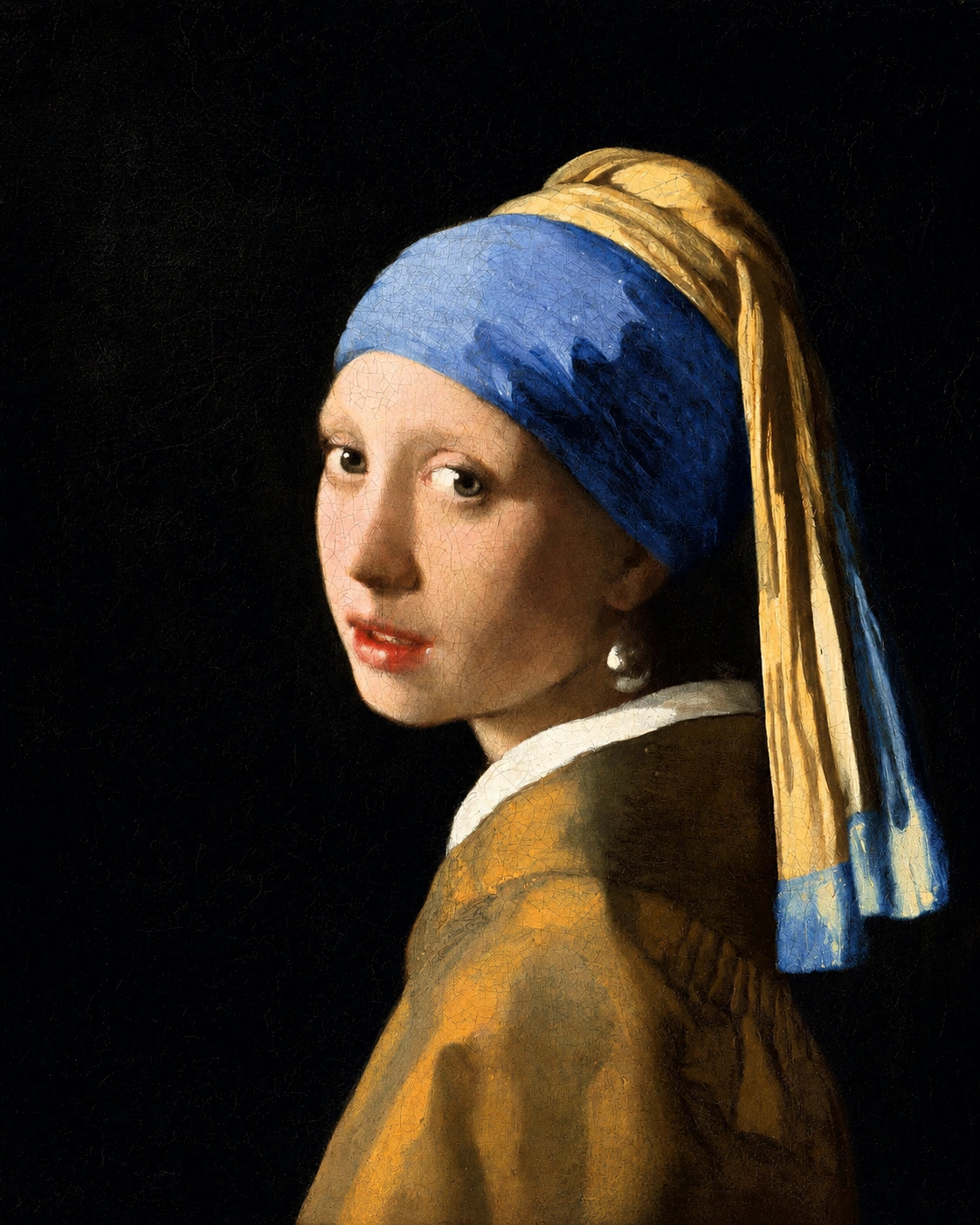
Johannes Vermeer’s “The Girl with a Pearl Earring,” painted around 1665, is one of the most recognizable images in Western art. Its power comes not from elaborate storytelling, crowded symbolism, or grand historical drama, but from stillness, mystery, and concentrated visual beauty. The painting presents a young woman turning toward the viewer, her lips slightly parted, her gaze direct yet unreadable. She wears a blue and yellow headscarf, a golden brown garment, and a luminous pearl earring that catches the light with extraordinary delicacy. Against the deep dark background, her face emerges with a softness that feels both intimate and distant.
The painting is often called a portrait, but it is more accurately understood as a tronie, a type of Dutch Golden Age study of a figure, expression, costume, or character. Rather than recording the identity of a specific sitter, Vermeer creates an idealized image of presence. The girl becomes less a documented person than a vision of youth, light, and suspended emotion. This ambiguity is central to the painting’s lasting appeal. Viewers are drawn in because the work seems personal, yet it never fully explains itself.
The Power of Simplicity
One of the most striking qualities of “The Girl with a Pearl Earring” is its simplicity. Vermeer removes nearly everything that might distract from the figure. There is no interior setting, no window, no furniture, no symbolic object placed nearby. The dark background acts almost like a silent stage, allowing the girl’s face, turban, and earring to become the entire focus of the composition.
This restraint gives the painting a modern feeling. Many seventeenth-century portraits included signs of status, wealth, family identity, or profession. Vermeer instead concentrates on the immediate encounter between figure and viewer. The girl turns over her shoulder, as though she has just been called. This momentary pose gives the image a sense of life. She does not appear fixed or ceremonial. She appears caught in transition, between movement and stillness, speech and silence.
The composition is balanced with remarkable precision. Her face occupies the emotional center, while the blue headscarf creates a broad arc across the upper portion of the painting. The pale yellow cloth falling behind her head adds vertical rhythm and softness. The pearl hangs near the lower edge of her face, visually connecting the brightness of her skin with the darker tones of her clothing. Every element feels necessary.
Light, Skin, and Vermeer’s Painterly Technique
Vermeer’s handling of light is one of the painting’s greatest achievements. The illumination falls gently across the girl’s face from the left, touching her forehead, cheek, nose, lips, and earring. The transitions between light and shadow are extremely delicate. Her skin does not look sharply outlined; it appears to breathe within the soft atmosphere of the painting.
The face is built through subtle tonal shifts rather than hard detail. Vermeer avoids excessive description, yet the illusion is convincing. The eyes are especially important. They are dark, reflective, and slightly moist, giving the figure a feeling of awareness. Her gaze is direct, but not confrontational. It suggests recognition, curiosity, or perhaps the beginning of a response.
Her lips add another layer of intimacy. They are parted just enough to imply breath or speech. This small detail transforms the image. The girl does not seem like a remote object of display. She seems alive in the instant before or after communication. Vermeer’s genius lies in making this quiet moment feel charged with emotion without defining exactly what that emotion is.
Color and Costume
The painting’s color palette is limited but unforgettable. The blue of the headscarf is the dominant color accent, set against the dark background and the warmer tones of the face and garment. This blue has become one of the most iconic features of the image. It gives the painting freshness, clarity, and visual distinction.
The yellow fabric wrapped around the top and falling behind the girl’s head adds warmth and contrast. Together, the blue and yellow create a rich harmony that frames the face. The costume is not typical everyday Dutch dress, which supports the idea that the painting is a tronie rather than a conventional portrait. The turban gives the figure an exoticized and theatrical quality, reflecting seventeenth-century Dutch fascination with foreign fabrics, trade goods, and imaginative costume.
The garment itself is painted in subdued golden brown tones. It does not compete with the face or headscarf, but it contributes to the painting’s warmth. Vermeer uses clothing less as fashion documentation than as a tool for color, shape, and atmosphere.
The Pearl as a Center of Meaning
The pearl earring is small, yet it gives the painting its title and much of its symbolic force. It is painted with astonishing economy. Vermeer does not describe the jewel with meticulous detail. Instead, he suggests it through a few carefully placed touches of light and shadow. The result is more optical than literal. The pearl seems to glow because the viewer’s eye completes the illusion.
Its meaning remains open. Pearls were associated with wealth, refinement, beauty, and purity, but in this painting the jewel also functions as a visual echo of the girl’s face. Its roundness, brightness, and softness repeat qualities found in her skin and eyes. It becomes a concentrated point of light, a small mirror of the larger mystery of the image.
The earring also creates tension between simplicity and luxury. The girl’s presentation is not heavily adorned, yet the pearl introduces elegance and value. This contrast deepens the painting’s fascination. She appears both ordinary and extraordinary, approachable and idealized.
Mystery and Emotional Ambiguity
Much of the painting’s fame comes from the girl’s expression. She looks at the viewer with a gaze that seems intimate, but Vermeer gives no clear narrative explanation. Is she surprised? Is she about to speak? Is she turning toward someone she knows? The painting invites these questions but does not answer them.
This emotional ambiguity makes the work endlessly renewable. Each viewer can project a slightly different feeling onto the image. The girl can seem innocent, thoughtful, curious, distant, vulnerable, or self-possessed. The painting remains alive because it resists being reduced to a single interpretation.
Vermeer’s restraint is essential here. He does not dramatize the face. He does not force emotion through gesture. Instead, he creates a delicate balance in which the viewer senses feeling without being told what to feel. That quiet uncertainty is one of the reasons “The Girl with a Pearl Earring” continues to feel so immediate centuries after it was painted.
Vermeer’s Place in Dutch Art
Vermeer is best known for quiet domestic interiors, carefully ordered spaces, and subtle effects of light. “The Girl with a Pearl Earring” differs from many of his interior scenes because it removes the setting entirely, but it still reflects his deepest artistic concerns. The painting is about light, perception, silence, and the poetry of everyday presence.
In the context of Dutch Golden Age art, the painting stands apart for its intimacy and focus. Many Dutch painters excelled at realism, detail, and social observation. Vermeer’s realism is different. He is less interested in recording every surface than in creating a convincing sensation of presence. The girl seems real not because every detail is described, but because the light, pose, and expression feel psychologically true.
Why the Painting Still Captivates
“The Girl with a Pearl Earring” endures because it combines clarity with mystery. It is easy to recognize, easy to remember, and easy to feel connected to, yet it remains impossible to fully explain. The dark background, glowing face, vivid headscarf, and luminous earring create an image of extraordinary visual purity. Nothing is excessive. Nothing feels accidental.
The painting also speaks to the human desire for connection. The girl’s gaze crosses the distance between the seventeenth century and the present with unusual directness. She seems to notice us. At the same time, she remains unreachable, protected by silence and time. This combination of intimacy and distance gives the painting its emotional depth.
Vermeer created a work that feels both simple and inexhaustible. “The Girl with a Pearl Earring” is not only a masterpiece of Dutch painting; it is a masterpiece of suggestion. Its beauty lies in what is shown, but also in what is withheld. The girl turns, the pearl shines, the lips part, and the mystery remains.