The Creation of Adam by Michelangelo: Vibrant Color Edit
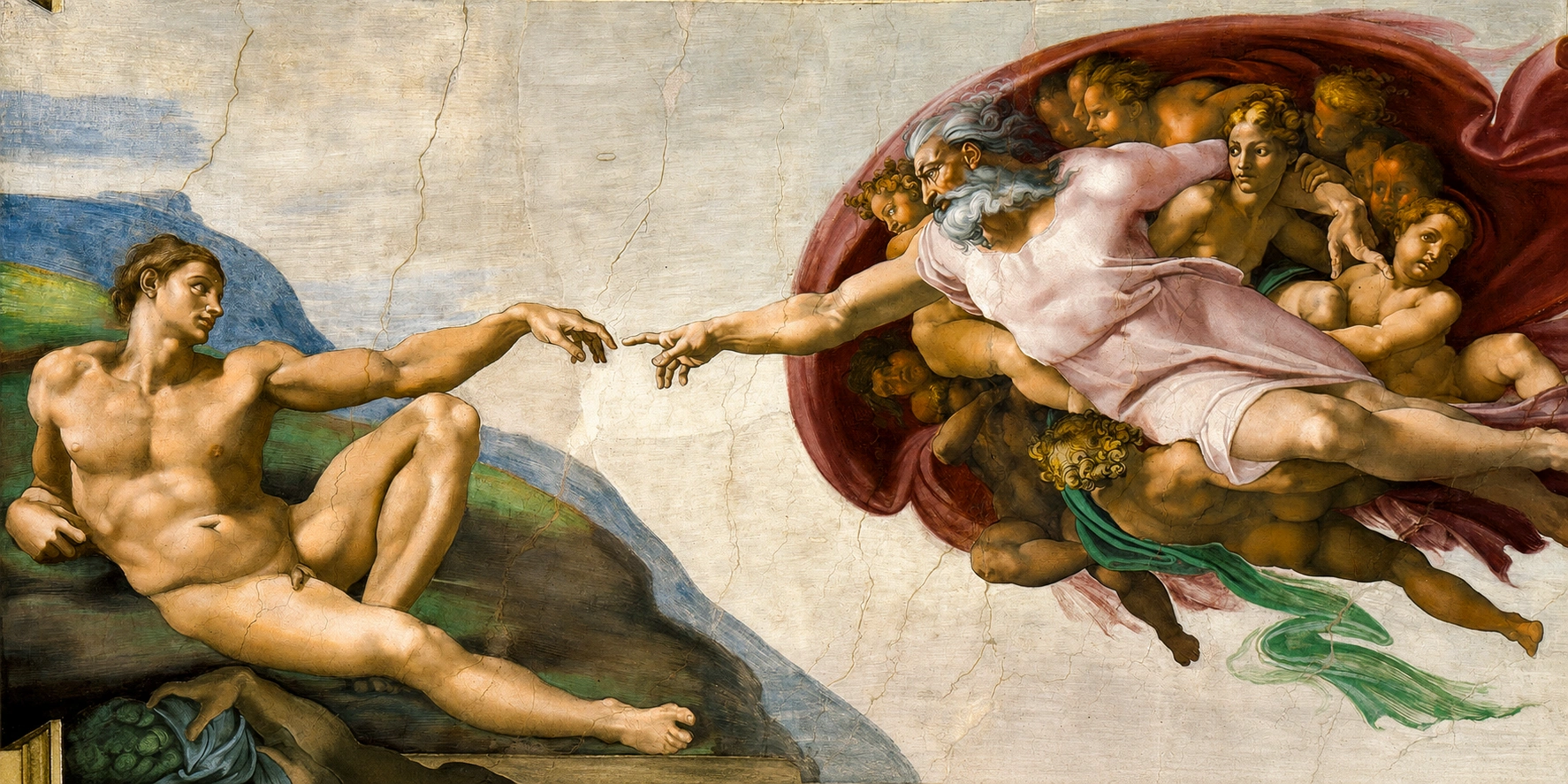
Free to Download & Reuse: You are welcome to use this image! If you republish or share it online, you must include a direct link back to this webpage for attribution.
Original Image Source: wikiart.org
Introduction
“The Creation of Adam” by Michelangelo, completed in 1512 as part of the Sistine Chapel ceiling, is one of the most recognizable images in Western art. Painted in fresco for Pope Julius II, the scene belongs to the Book of Genesis and represents the moment when God gives life to the first man. Yet Michelangelo does not show creation as a dramatic explosion of light or a physical act of making. Instead, he focuses on a pause, a charged instant in which two hands almost touch. That narrow space between God’s finger and Adam’s finger has become one of the most powerful symbols in art history, suggesting divine energy, human potential, and the mystery of life itself.
Composition and Visual Structure
The composition is built around a striking contrast between stillness and motion. Adam reclines on the left side of the fresco, his body stretched along the curve of the earth. He appears newly formed, beautiful, strong, and not yet fully animated. His arm reaches outward, but his hand is relaxed, as if waiting for the spark that will awaken him completely. On the right, God surges forward with tremendous energy, surrounded by a group of figures and wrapped in a flowing reddish mantle. Unlike Adam, God is active, purposeful, and dynamic.
Michelangelo organizes the entire image around the diagonal line created by the two extended arms. This line draws the viewer’s eye directly to the almost touching fingers at the center. The hands are small compared with the bodies, yet they carry the emotional and theological weight of the fresco. The space between them is empty, but it feels intensely alive. By refusing to let the fingers touch, Michelangelo creates suspense. Creation becomes not only an event, but a moment of anticipation.
Adam as the Ideal Human Form
Adam’s body reflects Michelangelo’s deep knowledge of anatomy and his admiration for classical sculpture. His figure is muscular, balanced, and graceful, yet he is not shown as aggressively heroic. He is powerful but passive, complete in form but incomplete in spirit. His posture suggests both beauty and dependency. He lies against the earth, visually connected to the material world from which he was formed.
The softness of Adam’s gesture is especially important. His hand does not grasp at God. His wrist bends gently, and his fingers extend with less force than God’s. This difference suggests that life, consciousness, and spiritual energy are not generated by Adam himself. They come from beyond him. At the same time, Michelangelo gives Adam a noble presence. He is not small or insignificant before God. He is made in the divine image, and his body carries dignity, intelligence, and latent strength.
The Image of God
Michelangelo’s God is one of the most memorable representations of the divine in Renaissance art. He appears as an elderly, bearded figure, but he is not weak or distant. His body is vigorous, his movement forceful, and his gaze focused. He flies through space surrounded by figures who may be angels, souls, or symbolic presences. The reddish mantle around them creates a sense of movement and enclosure, almost like a living cloud.
God’s extended arm is firm and commanding. Unlike Adam’s relaxed hand, God’s finger points with intention. This contrast makes the divine act visible. The life-giving force is not painted as light or flame, but as gesture. Michelangelo turns the hand into a vehicle of creation. The simplicity of this idea is part of its genius. A single movement becomes enough to communicate power, love, will, and the origin of humanity.
The Meaning of the Almost Touching Hands
The almost touching hands are the emotional center of “The Creation of Adam.” Their separation is tiny, but it transforms the entire fresco. If the fingers touched, the scene might feel completed and fixed. Because they do not, the viewer experiences creation as something still happening. The gap becomes a visual metaphor for the relationship between humanity and God: close, intimate, dependent, yet never entirely collapsed into sameness.
This space also allows the image to speak beyond its biblical subject. It can suggest the awakening of consciousness, the birth of creativity, or the transmission of spiritual energy. Adam’s hand receives, while God’s hand gives. Yet both gestures mirror each other, reminding us that humanity reflects the divine. Michelangelo captures a profound Renaissance idea: human beings are earthly creatures, but they possess a divine likeness that gives them freedom, intellect, and creative power.
Color, Light, and Fresco Technique
The color palette of the fresco is relatively restrained, but highly effective. Adam’s pale flesh tones stand out against the muted greens, blues, and browns of the earth. God’s group is richer and warmer, dominated by the reddish mantle that frames the divine figure and separates him from the empty background. This contrast helps distinguish the earthly from the heavenly without making the two worlds feel completely separate.
The background is spare, almost blank, which gives the figures monumental clarity. Michelangelo avoids unnecessary detail so that the viewer’s attention remains fixed on the bodies and gestures. This simplicity is one reason the image remains so powerful even when seen from a distance. The fresco was designed for the vast ceiling of the Sistine Chapel, yet its central idea is readable instantly. The drama does not depend on elaborate setting, but on form, movement, and symbolic space.
Renaissance Humanism and Spiritual Meaning
“The Creation of Adam” is deeply religious, but it is also deeply humanist. Renaissance humanism did not necessarily reject faith. Instead, it emphasized the dignity, beauty, and intellectual potential of human beings. Michelangelo’s Adam embodies this idea perfectly. He is not portrayed as a frail creature of dust, but as a magnificent being capable of receiving divine life.
The fresco suggests that the human body itself can reveal spiritual truth. Michelangelo’s mastery of anatomy is not merely technical. It becomes theological. The beauty of Adam’s form expresses the greatness of creation. The body is not treated as something shameful or unworthy. It is the visible sign of humanity’s special place in the created order.
At the same time, Adam’s passivity reminds viewers that human greatness is not self-sufficient. His beauty awaits animation. His strength needs the touch of God. Michelangelo balances human dignity with divine dependence, creating an image that feels both exalted and humble.
Why “The Creation of Adam” Still Matters
The lasting fame of “The Creation of Adam” comes from its extraordinary clarity. Many artworks illustrate biblical stories, but Michelangelo condenses a vast theological idea into one unforgettable gesture. The fresco speaks to viewers who know the Book of Genesis, but it also communicates visually to people outside that tradition. The image of one hand reaching toward another is universal. It suggests connection, origin, desire, distance, and possibility.
The painting remains powerful because it does not overexplain itself. Michelangelo leaves the crucial moment unresolved. The viewer completes the act imaginatively, feeling the energy that is about to pass from God to Adam. In that suspended instant, the fresco becomes more than a scene from scripture. It becomes an image of what it means to be human: formed from the earth, drawn toward the divine, and alive with potential.