Las Meninas by Diego Velázquez: Vibrant Color Edit
Free to Download & Reuse: You are welcome to use this image! If you republish or share it online, you must include a direct link back to this webpage for attribution.
Original Image Source: wikiart.org
Las Meninas by Diego Velázquez: A Masterpiece of Seeing and Being Seen
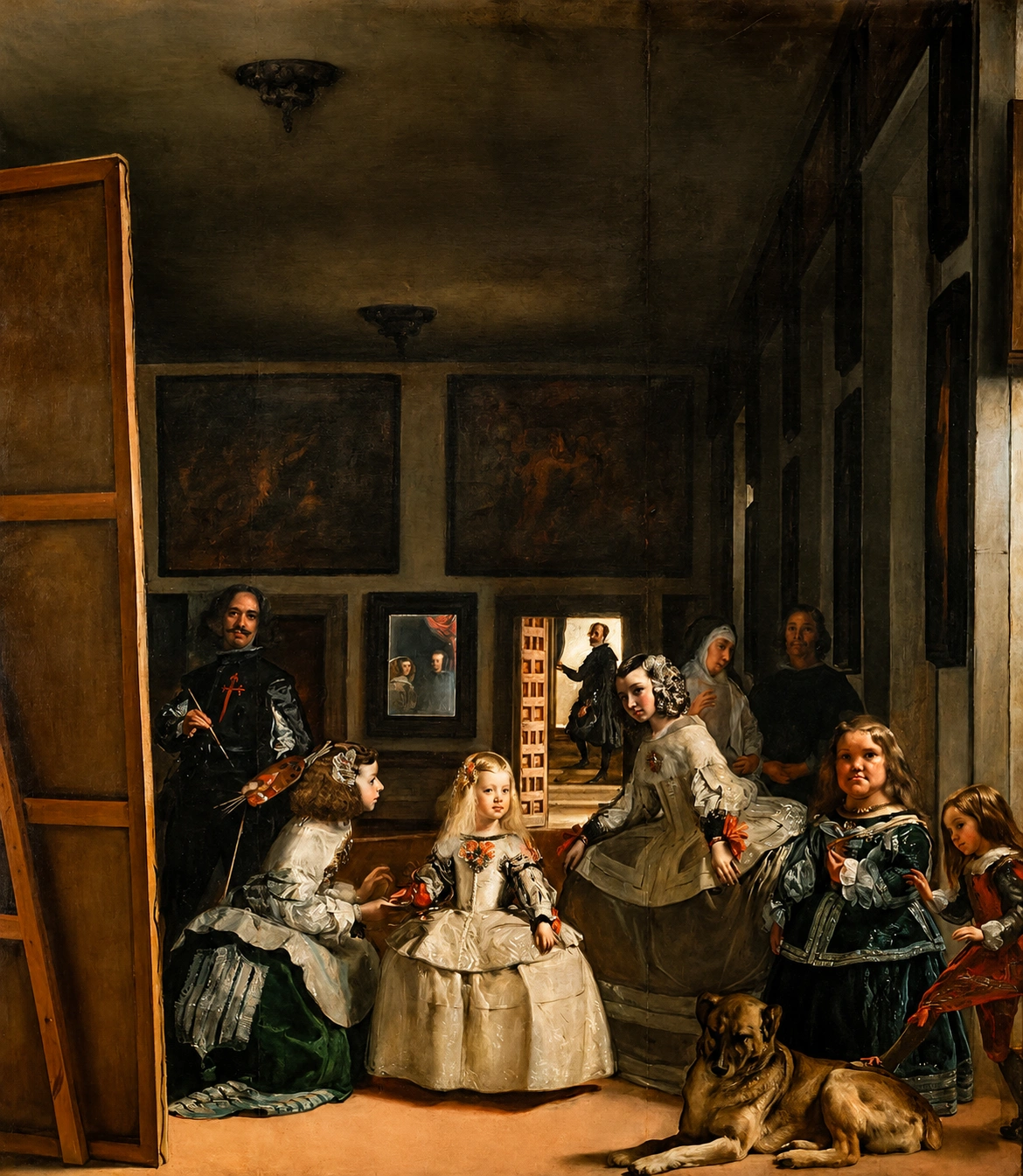
Diego Velázquez’s “Las Meninas,” painted in 1656, is one of the most fascinating and intellectually ambitious paintings in Western art. At first glance, it appears to show a moment inside the royal household of King Philip IV of Spain. A young princess stands near the center, surrounded by attendants, a dog, court figures, and the artist himself. Yet the longer one looks, the less simple the scene becomes. “Las Meninas” is not only a royal portrait or a court interior. It is a painting about vision, status, illusion, and the mysterious relationship between artist, subject, and viewer.
The central figure is the Infanta Margarita Teresa, daughter of Philip IV and Mariana of Austria. She appears in a pale, luminous dress that immediately draws the eye. Her small body is framed by the darker interior around her, making her seem almost like a source of light within the room. Around her are the meninas, or ladies-in-waiting, who give the painting its title. One kneels to offer her a small red cup, while another bends toward her with careful attention. Their gestures create a sense of ceremony, but also of intimacy. This is a royal child, but she is shown in a living moment rather than in a stiff formal pose.
A Court Scene Filled with Mystery
The setting is a large room in the Royal Alcázar of Madrid, probably Velázquez’s own studio or a space connected to the royal apartments. The room is dim, spacious, and filled with paintings on the back wall. Velázquez uses deep shadow to create atmosphere, but he also arranges light with extraordinary precision. The brightest area falls on the Infanta and her attendants, while the upper half of the canvas remains dark and almost empty. This contrast gives the painting a dramatic rhythm. The lower half is active and inhabited, while the upper half feels silent, heavy, and theatrical.
On the left, Velázquez includes himself standing before a large canvas. He holds a brush and palette, dressed not as a craftsman but as a dignified court figure. This self-portrait is one of the boldest elements of the painting. By placing himself within the royal space, Velázquez elevates the status of the painter. He is not hidden behind the work. He is part of the world he represents. His calm, intelligent gaze suggests that painting is not merely manual labor, but a noble act of perception and invention.
The Role of the Viewer
One of the great puzzles of “Las Meninas” is the position of the viewer. Many of the figures seem to look outward, toward the space in front of the painting. The Infanta, Velázquez, and other members of the court appear aware of someone outside the picture. At the back of the room, a mirror reflects the faint images of King Philip IV and Queen Mariana. This reflection suggests that the king and queen may be standing in the very position occupied by the viewer.
This creates a remarkable reversal. The viewer does not simply look at the royal household. The viewer is placed where the monarchs might be. The painting turns ordinary looking into a royal position, but it also makes that position unstable. Are we seeing what the king and queen see? Are they the subjects Velázquez is painting on the large canvas? Or are they entering the room and being reflected in the mirror? The painting does not answer clearly. Its brilliance lies in keeping several possibilities alive at once.
Light, Space, and Psychological Presence
Velázquez’s handling of light is subtle rather than decorative. He does not flood the room with brightness. Instead, he lets light move through the painting in selective touches: the Infanta’s dress, the faces of the attendants, the open doorway in the background, the mirror, and the dog’s fur. These illuminated areas guide the eye through the scene and create a complex spatial experience.
The open doorway at the back is especially important. A man stands on the steps, partly turned toward the room and partly toward the light beyond it. His figure forms a visual escape from the enclosed interior. While the mirror pulls attention toward the unseen king and queen, the doorway pulls the eye into depth. Together, these two background elements make the painting feel wider than its physical frame. The scene seems to extend both behind and in front of the canvas.
The figures are also psychologically rich. The Infanta appears calm but slightly distant. Her attendants show alertness and discipline. The dwarf María Bárbola looks outward with striking directness, while Nicolasito Pertusato nudges the resting mastiff with his foot. The dog remains still, heavy, and indifferent, grounding the painting in physical reality. These details prevent the scene from becoming purely ceremonial. Velázquez gives the royal household human texture, variety, and movement.
A Painting About Painting
“Las Meninas” is often described as a painting about painting itself. Velázquez shows the act of creation while also demonstrating its power. He paints himself painting, but the canvas he works on is turned away from us. We cannot see what he is making. This hidden canvas becomes one of the painting’s deepest mysteries. It invites us to wonder about what art reveals and what it conceals.
The mirror, the unseen canvas, the gazes of the figures, and the position of the viewer all create a meditation on representation. Velázquez asks us to think about who is looking, who is being looked at, and who controls the image. In a royal court, appearance is tied to power. Portraits preserve authority, lineage, and status. Yet in “Las Meninas,” the painter becomes the one who organizes this world. Through composition, light, and perspective, Velázquez controls how royalty is seen.
The Importance of Composition
The composition of “Las Meninas” is carefully balanced despite its natural appearance. The Infanta anchors the foreground, while Velázquez on the left and the figures on the right create a broad horizontal arrangement. The mirror and doorway in the background provide focal points that deepen the structure. The large canvas on the left forms a dark vertical mass, balanced by the wall and figures on the right. Nothing feels accidental, even though the scene has the freshness of a moment captured in passing.
This balance between spontaneity and control is central to Velázquez’s genius. The painting feels alive because the figures are not arranged like statues. They seem caught in transition. Someone has entered, someone has turned, someone is offering a drink, someone is teasing the dog. Yet every movement belongs to a larger visual order. Velázquez creates the illusion of chance through supreme artistic discipline.
Why Las Meninas Still Matters
“Las Meninas” remains powerful because it refuses to become a simple image. It is a portrait, a self-portrait, a court scene, a study of childhood, a statement about artistic status, and a philosophical puzzle. It draws the viewer into the painting and then makes the act of viewing uncertain. Few works combine such visual beauty with such intellectual complexity.
Velázquez presents the Spanish court with grandeur, but also with ambiguity. The monarchy appears through reflection, the artist appears with quiet authority, and the viewer becomes part of the scene. The result is a painting that feels both historical and modern. “Las Meninas” does not merely show the world of Philip IV. It shows how images create worlds, how power depends on visibility, and how art can transform a single room into an endless field of perception.