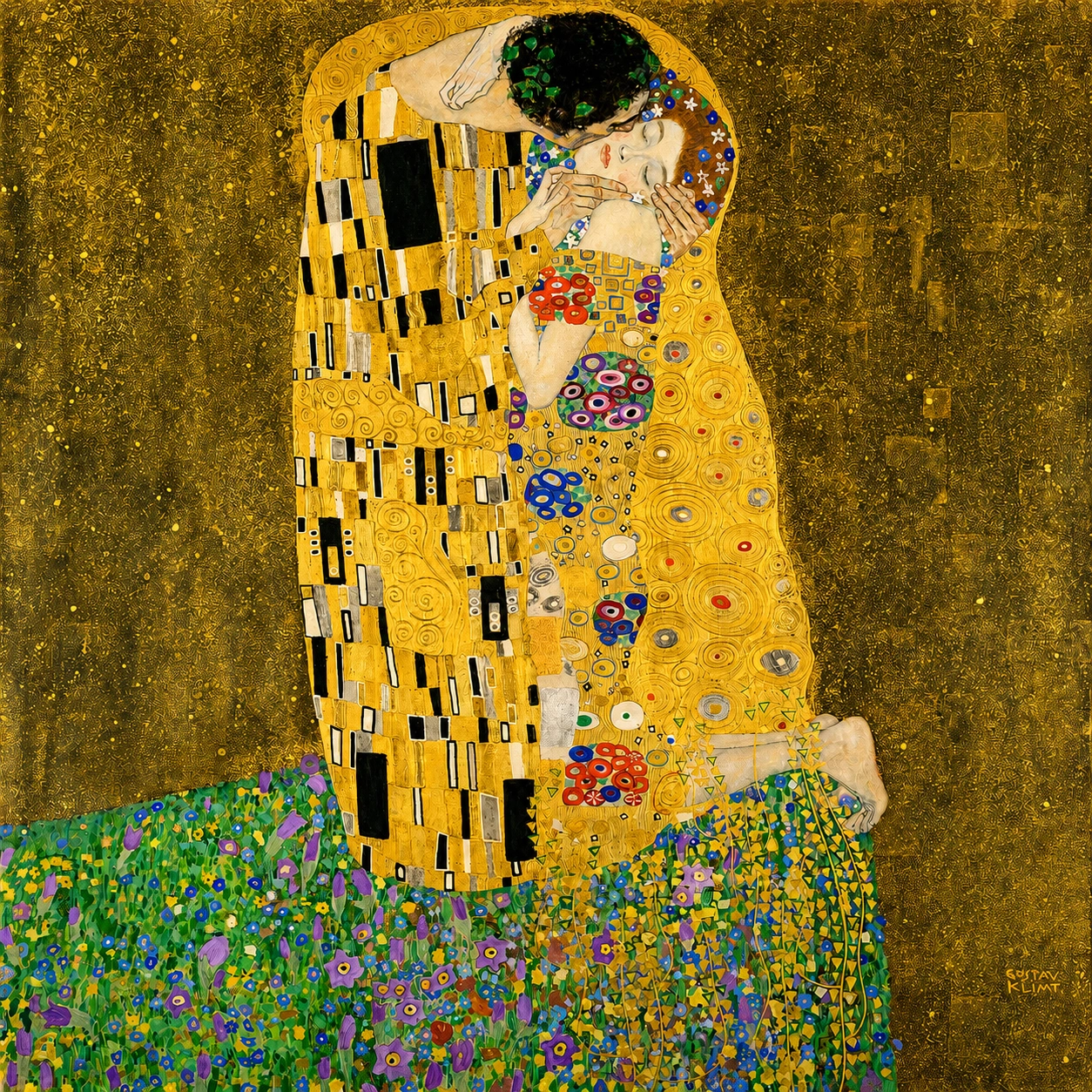
The Kiss by Gustav Klimt: Vibrant Color Edit
Free to Download & Reuse: You are welcome to use this image! If you republish or share it online, you must include a direct link back to this webpage for attribution.
Original Image Source: wikiart.org
“The Kiss” by Gustav Klimt: A Complete Analysis
Gustav Klimt’s “The Kiss,” completed in 1908, is one of the most recognizable paintings of the early twentieth century and a defining masterpiece of the Vienna Secession. It presents a couple locked in an embrace, surrounded by a radiant field of gold, flowers, pattern, and ornament. At first glance, the painting appears simple: two lovers kneel together at the edge of a meadow while the man bends toward the woman’s face. Yet the power of “The Kiss” comes from how Klimt transforms this intimate moment into something symbolic, decorative, and almost sacred.
The painting belongs to Klimt’s famous “Golden Phase,” when he used gold leaf and metallic surfaces to create works that resemble icons, mosaics, jewelry, and dream images. Rather than painting love as an ordinary human scene, Klimt elevates it into a glowing vision. The couple seems removed from daily life. There is no clear setting, no recognizable room, no detailed landscape, and no narrative clue beyond the embrace itself. This lack of everyday context gives the image a timeless quality. It is not only a painting of two individuals, but a meditation on desire, union, tenderness, and transformation.
The Composition and the Power of the Embrace
The composition of “The Kiss” is strikingly vertical and enclosed. The two figures form a single golden mass, almost like a monument or shrine. Their bodies are wrapped in richly patterned robes, which merge them into one decorative shape. This visual fusion is central to the painting’s meaning. Klimt does not simply show two people standing beside each other. He shows them becoming visually connected through color, surface, and pattern.
The man’s body bends over the woman in a protective, enclosing gesture. His head is lowered, his hands hold her face gently, and his robe is covered with strong rectangular forms in black, white, silver, and gold. These geometric shapes give him a structured, angular presence. The woman, by contrast, is decorated with rounded, floral, and circular motifs. Her robe and the surrounding meadow echo one another, linking her to softness, growth, and natural beauty.
This contrast between masculine geometry and feminine ornament is one of Klimt’s most famous visual strategies. The man is associated with blocks, verticals, and firmness. The woman is associated with curves, blossoms, and flowing decoration. Yet the painting does not keep them fully separate. Their patterns meet and overlap, creating a visual language of union. The kiss becomes more than a physical gesture. It becomes the moment where difference is absorbed into harmony.
Gold, Ornament, and Sacred Atmosphere
Gold dominates the entire painting. It covers the background, the robes, and much of the space around the figures. This gold is not merely decorative. It changes the emotional and symbolic tone of the image. The couple does not appear in ordinary light. They seem to exist inside a luminous, spiritual field. The surface suggests Byzantine mosaics, religious icons, and precious objects, all of which Klimt would have known through art history and travel.
The gold background flattens the space. There is no traditional depth, no distant horizon, and no realistic atmosphere. Instead, the painting feels like a sacred panel. The figures are pressed forward toward the viewer, surrounded by shimmering texture. This flattening was important to Klimt’s modern style. He rejected the idea that painting had to imitate reality perfectly. Instead, he treated the canvas as a decorative surface where pattern, rhythm, and symbolism could carry emotional meaning.
The ornament in “The Kiss” is incredibly detailed. Spirals, circles, flowers, rectangles, and dots fill the robes and the ground. These details invite the viewer to look slowly. The painting works both from a distance and up close. From far away, it is a bold image of golden love. Up close, it becomes a world of tiny visual pleasures. This balance between grand emotional impact and delicate surface detail is one reason the painting remains so popular.
The Woman’s Expression and Emotional Ambiguity
One of the most important parts of “The Kiss” is the woman’s face. Her eyes are closed, her lips are slightly parted, and her head tilts toward the man. Her expression is often read as peaceful, receptive, and absorbed in the moment. However, there is also ambiguity. Her body kneels at the edge of the flowered ground, and her feet appear close to a drop or boundary. This creates a subtle tension beneath the painting’s beauty.
Klimt often explored complicated images of intimacy, femininity, and desire. In “The Kiss,” the woman’s face is calm, but the pose is not completely passive. Her hand rests against the man, and her body leans into the embrace. At the same time, the man’s body surrounds her, and his patterned robe visually dominates much of the composition. The painting therefore contains both tenderness and intensity.
This emotional ambiguity makes “The Kiss” richer than a simple romantic image. It can be seen as a celebration of love, but also as a study of surrender, closeness, and the loss of individual boundaries. Klimt paints intimacy as beautiful, but also overwhelming. The couple’s bodies are covered, hidden, and transformed by gold. Their physical identities almost disappear into ornament. Love becomes a force that beautifies, but also consumes.
Nature, Flowers, and the Edge of the World
The lower part of the painting contains a flowered meadow filled with bright greens, purples, blues, and yellows. This natural area gives the painting freshness and life. It contrasts with the heavy gold background, making the figures seem both earthly and otherworldly. The flowers suggest fertility, spring, and renewal. They also soften the monumentality of the golden forms.
The couple kneels at the edge of this meadow, which makes the scene feel suspended. They are not placed securely in the middle of a landscape. Instead, they appear near a boundary, almost at the edge of the known world. This edge adds drama to the embrace. It suggests that love carries the couple outside ordinary experience, toward a place where reality becomes uncertain and symbolic.
Klimt’s use of nature is not realistic in a traditional sense. The flowers are decorative rather than botanically precise. They function like patterns, blending with the woman’s robe and reinforcing the sense that the entire painting is a unified design. In this world, human bodies, clothing, flowers, and gold all belong to the same visual rhythm.
Why “The Kiss” Remains So Famous
“The Kiss” remains famous because it combines immediate beauty with deep symbolic complexity. It is easy to recognize and emotionally accessible, but it also rewards careful looking. The gold makes it luxurious. The embrace makes it intimate. The patterns make it modern. The flatness and ornament connect it to decorative art, while the emotional subject connects it to universal human experience.
Klimt created a painting that feels both private and monumental. The kiss is a small personal act, yet he gives it the scale and radiance of a sacred event. This is the genius of the work. It turns affection into an image of transcendence. The lovers do not simply occupy space. They become an icon of union, beauty, and longing.
In “The Kiss,” Gustav Klimt reached one of the highest points of his artistic vision. The painting gathers together his love of ornament, his fascination with sensuality, his interest in symbolism, and his ability to turn the human figure into a decorative masterpiece. More than a century after its creation, it continues to feel immediate because it speaks through both surface and emotion. It is dazzling, tender, mysterious, and unforgettable.