The Garden of Earthly Delights by Hieronymus Bosch: Vibrant Color Edit
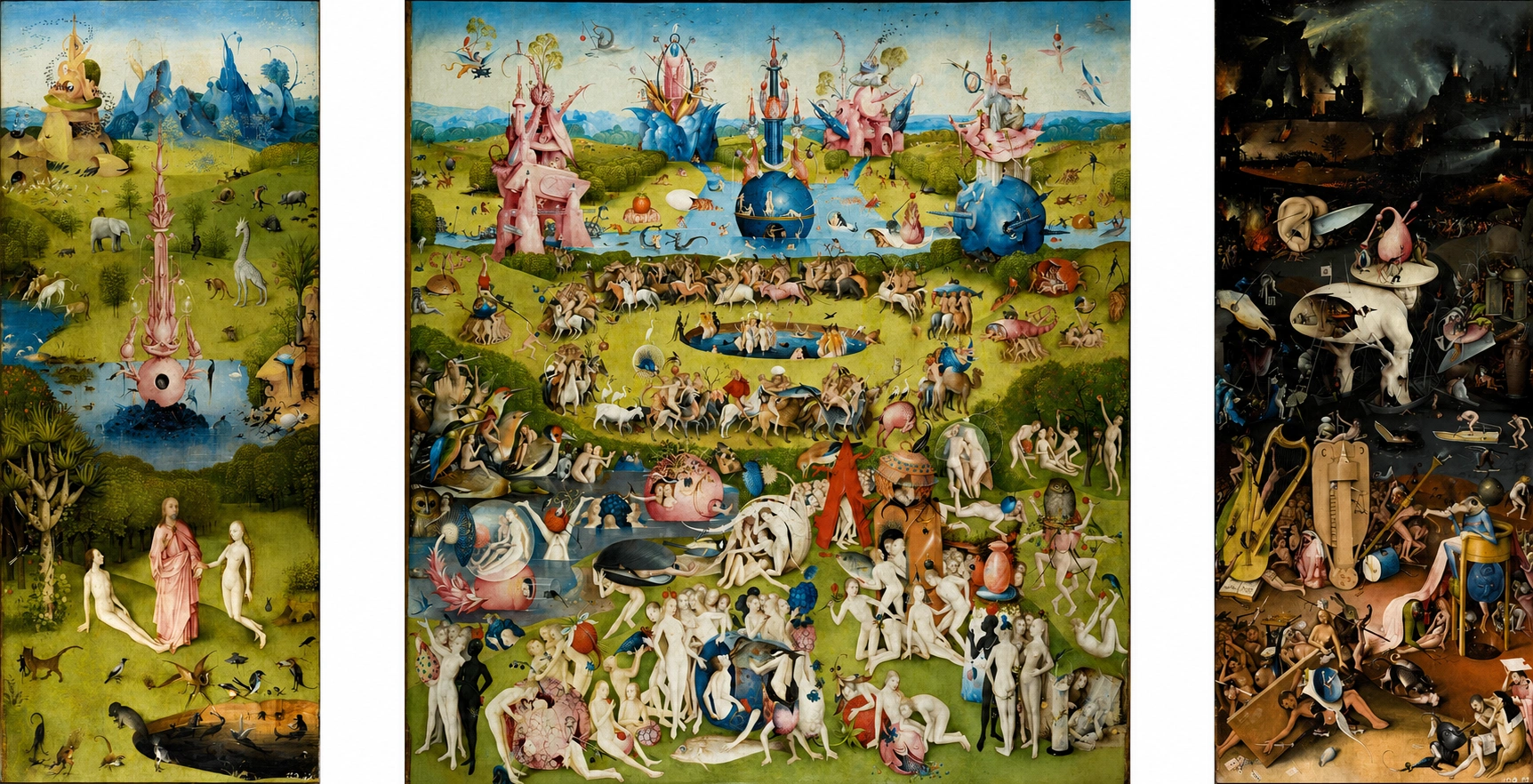
Free to Download & Reuse: You are welcome to use this image! If you republish or share it online, you must include a direct link back to this webpage for attribution.
Original Image Source: wikiart.org
The Visionary Structure of “The Garden of Earthly Delights” by Hieronymus Bosch
“The Garden of Earthly Delights” by Hieronymus Bosch is one of the most mysterious and visually overwhelming paintings of the Northern Renaissance. Created as a triptych, the work unfolds like a moral universe in three stages: innocence, temptation, and punishment. Its power comes not only from its strange creatures and dreamlike landscapes, but from the way Bosch turns the human condition into a vast visual puzzle. The painting invites viewers to look closely, yet the more one looks, the more uncertain the meaning becomes.
The left panel shows the Garden of Eden. God introduces Eve to Adam in a luminous landscape filled with animals, plants, and delicate natural forms. At first glance, this scene appears peaceful. The grass is green, the water is clear, and the figures seem untouched by shame or conflict. Yet Bosch’s paradise is not entirely calm. Strange animals wander through the garden, some familiar and some fantastical. A tall pink fountain rises from the center like an organic tower, beautiful but unsettling. Even before sin has entered the world, Bosch suggests that creation contains mystery, instability, and the possibility of disorder.
The Central Panel and the World of Desire
The central panel is the most famous and most difficult part of the triptych. It shows a vast landscape filled with nude figures, animals, fruits, birds, pools, and strange architectural forms. The human figures appear absorbed in pleasure, curiosity, and play. They ride animals, gather inside transparent spheres, carry oversized berries, and move through the landscape in flowing circular rhythms. Bosch creates a world where desire has expanded into a complete environment.
The central garden is not painted as a simple celebration of pleasure. Its beauty is fragile, almost too perfect, and its pleasures feel temporary. The enormous fruit is especially important. Strawberries, cherries, and other soft fruits appear throughout the scene, suggesting sweetness, sensuality, and the short-lived nature of physical satisfaction. Fruit ripens quickly and decays quickly, making it a fitting symbol for pleasures that feel intense but do not last.
Bosch’s figures often seem weightless and passive, as though they are being carried along by the movement of the crowd rather than acting with clear moral awareness. This gives the central panel an eerie quality. It is crowded with activity, but strangely quiet in emotional tone. The people do not appear deeply joyful. Instead, they seem enchanted, distracted, and absorbed in a world that has lost its spiritual center.
Symbolism, Fantasy, and Moral Ambiguity
One reason “The Garden of Earthly Delights” remains so fascinating is that Bosch does not explain his symbols in a simple way. His imagery feels both religious and dreamlike. Birds, fish, shells, glass vessels, musical instruments, and hybrid creatures all appear with symbolic force, yet their meanings shift depending on where they appear.
Birds may suggest temptation, appetite, or spiritual distortion. Transparent spheres can suggest fragility and entrapment. Water can appear cleansing in one place and dangerous in another. The fantastic buildings in the background look like natural growths, artificial towers, and alchemical objects all at once. Bosch’s world is not divided neatly between reality and imagination. Instead, imagination becomes the tool through which moral truth is revealed.
The painting’s ambiguity is part of its genius. Bosch does not simply show sin as ugly. He shows it as beautiful, colorful, seductive, and communal. The central panel attracts the eye with its brightness and invention, while also creating unease. Viewers are drawn into the same visual pleasure that the painting seems to warn against. In this way, the work becomes self-reflective. Looking itself becomes part of the experience of temptation.
The Right Panel and the Consequence of Disorder
The right panel shifts dramatically into darkness. Often called the “Hell” panel, it shows a nightmarish world of punishment, confusion, and spiritual ruin. The clear daylight of the center is replaced by black skies, burning buildings, and sharp contrasts of light and shadow. Here, Bosch transforms the pleasures of the central panel into instruments of torment and humiliation.
Musical instruments, which might normally symbolize harmony, become signs of disorder. Objects associated with entertainment and appetite are enlarged into oppressive forms. Human bodies are trapped, exposed, or overwhelmed by monstrous figures. Bosch’s hell is not only a place of physical suffering. It is a place where meaning has collapsed. The world has become inverted, and everything once used for pleasure has become part of punishment.
The transition from the central panel to the right panel gives the triptych its moral structure. Bosch shows a movement from innocence to indulgence to consequence. Yet the painting is not simplistic. The hell panel is not merely a warning added after a joyful scene. It feels like the hidden truth of the central garden, as though the chaos of the final panel was already present beneath the surface of pleasure.
Composition and Visual Rhythm
Despite its extraordinary detail, “The Garden of Earthly Delights” is carefully organized. Bosch uses the triptych format to create a sequence, but each panel also has its own internal rhythm. The left panel is relatively calm and vertical, centered around the meeting of Adam, Eve, and God. The central panel expands horizontally, creating a broad panorama of movement and abundance. The right panel compresses the space into darkness, crowding the figures into a more claustrophobic world.
Color also guides the meaning. The left and central panels are filled with pale greens, blues, pinks, and soft flesh tones. These colors create a seductive atmosphere of freshness and wonder. In the right panel, the palette becomes darker, with blacks, browns, reds, and harsh flashes of light. The shift in color makes the moral shift immediately visible. Bosch does not need to explain the fall from delight to despair because the painting’s atmosphere makes the change clear.
The tiny scale of many figures encourages slow looking. Bosch rewards attention with endless discoveries, yet this abundance also produces a sense of overwhelm. The viewer becomes almost lost inside the image. This is central to the painting’s effect. The world of earthly delights is too full, too busy, too captivating. Its visual richness becomes part of its warning.
A Northern Renaissance Masterpiece of Moral Imagination
“The Garden of Earthly Delights” stands apart from much Renaissance art because it does not idealize the human figure in the classical sense. Bosch is less interested in perfect anatomy than in spiritual psychology. His bodies are pale, delicate, and often anonymous. What matters is not individual identity, but humanity as a collective condition.
The painting reflects a deeply religious worldview, yet it speaks through fantasy rather than ordinary doctrine. Bosch understood that moral failure often begins not with obvious evil, but with fascination, appetite, and forgetfulness. The central panel is powerful because it shows a world where people are not violently wicked. They are absorbed. They are entertained. They are surrounded by beauty and have forgotten judgment, time, and God.
That is why the painting still feels modern. It presents pleasure as a dazzling environment, not merely a private act. It shows how easily desire can become a world of its own, complete with its own rules, symbols, and rituals. Bosch’s imagination makes this world unforgettable.
Why “The Garden of Earthly Delights” Still Captivates Viewers
The enduring appeal of “The Garden of Earthly Delights” comes from its combination of beauty, mystery, and warning. It is a religious painting, a fantasy landscape, a moral drama, and a psychological labyrinth all at once. Its images feel ancient and strangely contemporary, as though Bosch saw something permanent in human nature.
The triptych does not offer a simple lesson that can be reduced to one sentence. Instead, it stages a visual journey through creation, temptation, and consequence. Its central question remains open: is the garden a vision of human innocence before corruption, or a portrait of humanity already lost in pleasure? Bosch leaves the viewer suspended between wonder and judgment.
In the end, “The Garden of Earthly Delights” is unforgettable because it makes morality visible through imagination. Bosch paints desire as beautiful, sin as enchanting, and punishment as terrifyingly inventive. Few paintings in Western art contain so much detail, ambiguity, and symbolic force. It remains one of the great masterpieces of early Netherlandish painting because it does not merely show a world. It creates one, then asks the viewer to decide what kind of world it is.