Liberty Leading the People by Eugène Delacroix: Vibrant Color Edit
Free to Download & Reuse: You are welcome to use this image! If you republish or share it online, you must include a direct link back to this webpage for attribution.
Original Image Source: wikiart.org
Liberty Leading the People by Eugène Delacroix
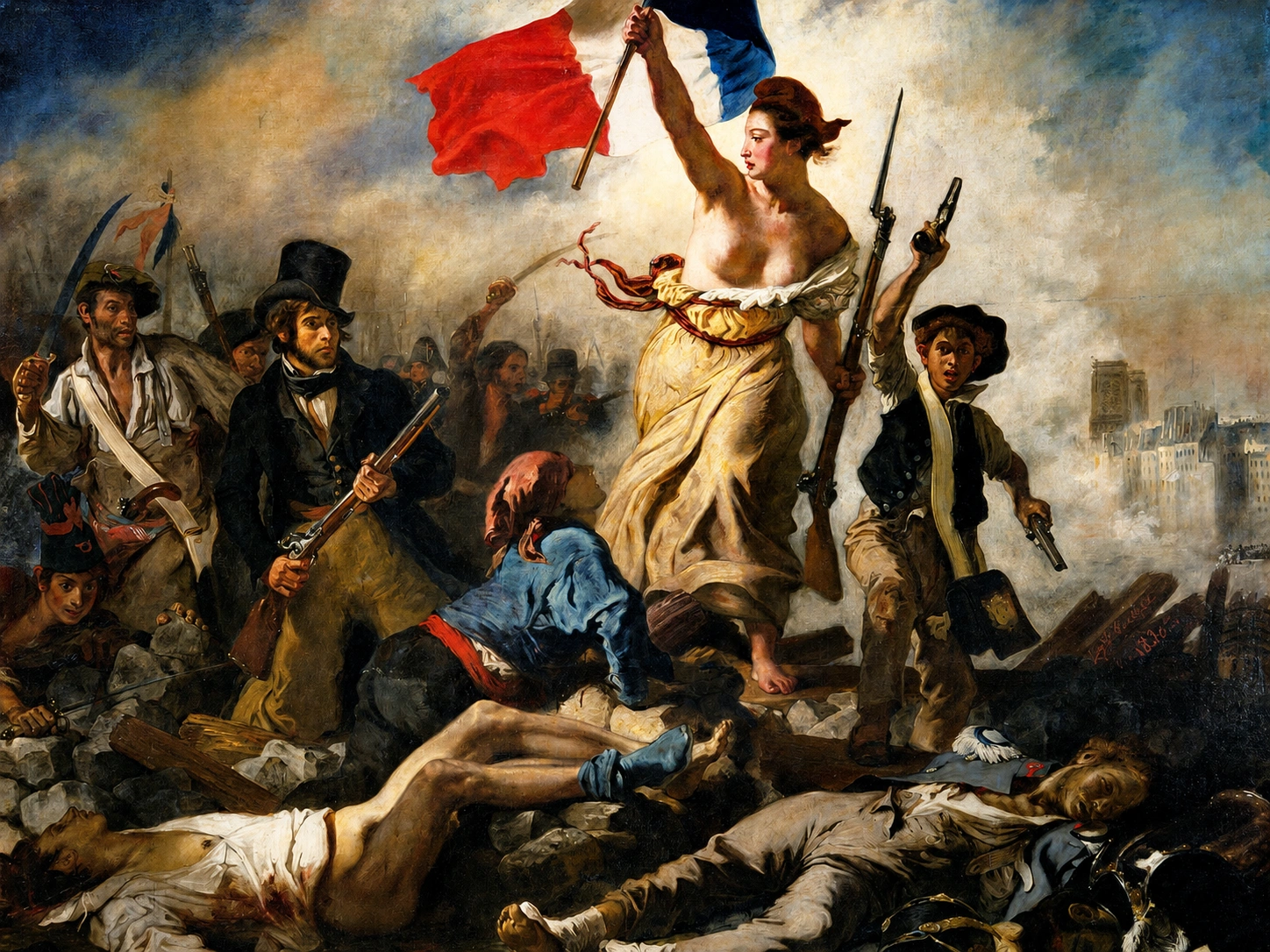
Eugène Delacroix’s “Liberty Leading the People,” painted in 1830, is one of the most powerful political images in nineteenth-century European art. The painting was created in response to the July Revolution in France, when citizens rose against King Charles X after he attempted to restrict civil liberties and tighten royal control. Rather than showing a calm historical scene from a safe distance, Delacroix presents revolution as immediate, smoky, physical, and emotionally charged. The viewer is placed almost at street level, facing the crowd as it surges forward over a barricade. This directness gives the painting its enduring force.
At the center stands Liberty, a personification of freedom who also evokes Marianne, the symbolic figure of the French Republic. She strides forward with the French tricolor raised high in one hand and a musket in the other. Her exposed chest recalls classical sculpture and allegorical tradition, but her energy belongs to the modern street. She is not a distant goddess floating above events. She moves through smoke, rubble, weapons, and fallen bodies, urging ordinary people into action. This blend of ideal beauty and real political struggle is central to the painting’s meaning.
A Painting of the July Revolution
“Liberty Leading the People” responds specifically to the revolution of July 1830, sometimes called the Three Glorious Days. The uprising took place in Paris and led to the fall of Charles X. Delacroix did not paint himself as a fighter at the barricades, but he clearly wanted to create an image that captured the spirit of the moment. The painting is not a literal documentary record. It is a dramatic interpretation of collective resistance.
The figures surrounding Liberty represent different parts of French society. On the left, a working-class man with a saber joins the charge. Near the center, a bourgeois figure in a top hat holds a firearm, suggesting that the revolution united people across class lines. On the right, a young boy raises pistols with fearless urgency. This boy has often been seen as a symbol of youthful rebellion and may have helped inspire later revolutionary characters in French literature. Together, these figures make the painting feel less like the victory of one leader and more like the awakening of a people.
Composition and Movement
Delacroix organizes the painting around a strong triangular structure. The fallen figures at the bottom form the base, while Liberty and the flag create the peak. This pyramidal composition gives the scene order even though the subject is chaos. The crowd rises from darkness and smoke toward the bright tricolor above, creating a visual movement from suffering to hope.
The forward motion is one of the painting’s greatest achievements. Liberty steps over the barricade with a powerful diagonal movement, while the men around her push forward in different poses of urgency. Weapons, arms, and gazes all direct attention toward the advance. The viewer is not allowed to remain neutral. The composition seems to move outward from the canvas, as if the revolution is crossing into our space.
The background adds to this sense of historical immediacy. Through the haze, the towers of Notre-Dame can be seen, placing the scene unmistakably in Paris. The smoke softens the architecture, making the city appear both real and symbolic. Paris becomes more than a setting. It becomes the stage on which liberty, monarchy, class, and national identity collide.
Color, Light, and Symbolism
The French flag is the emotional and visual center of “Liberty Leading the People.” Its blue, white, and red appear not only in the flag itself, but also in scattered accents across the composition. Delacroix uses these colors to unify the painting and reinforce its national meaning. The tricolor had been associated with the French Revolution, and in this painting it becomes a sign of renewed political energy.
Light falls most strongly on Liberty’s body, the flag, and selected faces in the crowd. This lighting gives the central figure a heroic presence while still keeping her within the dust and danger of the scene. The contrast between illuminated flesh, dark clothing, gray smoke, and bright national colors makes the image visually unforgettable.
Liberty’s Phrygian cap is another important symbol. Associated with freedom and revolution, it links the events of 1830 to the earlier French Revolution. Her dress, partly classical and partly improvised, strengthens the connection between timeless allegory and modern uprising. She is both an idea and a participant. She represents freedom, but she also acts.
Romanticism and Emotional Power
Delacroix was one of the leading figures of French Romanticism, and this painting shows many Romantic qualities. Instead of emphasizing perfect calm, strict order, and polished idealization, Delacroix embraces passion, movement, dramatic contrast, and emotional intensity. The scene is theatrical, but not empty spectacle. Its drama serves a political and human purpose.
The brushwork contributes to this effect. Delacroix does not smooth every detail into a rigid finish. Many areas feel smoky, energetic, and alive. The figures emerge from atmosphere and movement rather than from clean outlines alone. This painterly approach gives the work a sense of urgency, as though the event is still unfolding.
The painting also reveals the Romantic fascination with freedom, heroism, sacrifice, and national identity. Yet Delacroix complicates heroism by showing its cost. The bodies at the bottom of the painting remind viewers that revolution is not abstract. Political change comes through risk, loss, and confrontation. The painting celebrates liberty, but it does not make the struggle look easy.
Why Liberty Leading the People Still Matters
“Liberty Leading the People” remains famous because it transforms a political event into a universal image of resistance. Even viewers who do not know the details of the July Revolution can understand the basic force of the scene. A woman raises a flag. A crowd follows. The old order is challenged. Hope rises from danger.
The painting has become one of the most recognizable images of French national identity. It connects the idea of France with revolution, citizenship, and the demand for freedom. At the same time, it remains visually complex. Liberty is noble but forceful. The crowd is heroic but imperfect. The scene is inspiring but unsettled. That tension is what keeps the painting alive.
Delacroix’s masterpiece also helped shape the visual language of political art. Its image of a symbolic female figure leading real people into action has influenced posters, monuments, book covers, and protest imagery across generations. The painting demonstrates how art can turn history into myth without losing its connection to lived experience.
“Liberty Leading the People” is not simply a painting about 1830. It is a painting about the moment when ordinary people imagine themselves as historical actors. Delacroix gives that moment a body, a flag, and a movement forward. Through color, composition, symbolism, and emotion, he created an image that still stands for the dangerous and inspiring pursuit of freedom.