Vase with Fifteen Sunflowers by Vincent van Gogh: Vibrant Color Edit
Free to Download & Reuse: You are welcome to use this image! If you republish or share it online, you must include a direct link back to this webpage for attribution.
Original Image Source: wikiart.org
Introduction
Vincent van Gogh’s “Vase with Fifteen Sunflowers” from 1888 is one of the most recognizable flower paintings in Western art, but its fame can sometimes make it appear simpler than it really is. At first glance, it seems to be a bright still life: a vase, a table, a pale yellow background, and a group of sunflowers at different stages of bloom. Yet the painting is far more than a decorative arrangement. It is a study of color, friendship, artistic ambition, mortality, and emotional intensity. Van Gogh transforms a humble vase of flowers into a radiant image of life’s energy, fragility, and impermanence.
Painted in Arles, in the south of France, “Vase with Fifteen Sunflowers” belongs to Van Gogh’s celebrated Sunflowers series. These works were connected to his dream of creating an artists’ community, especially his hope that Paul Gauguin would join him in the Yellow House. The sunflower, with its bold face and burning color, became a symbol of welcome, vitality, and artistic identity. In this painting, Van Gogh does not merely copy nature. He uses the sunflower as a vehicle for feeling.
The Power of Yellow
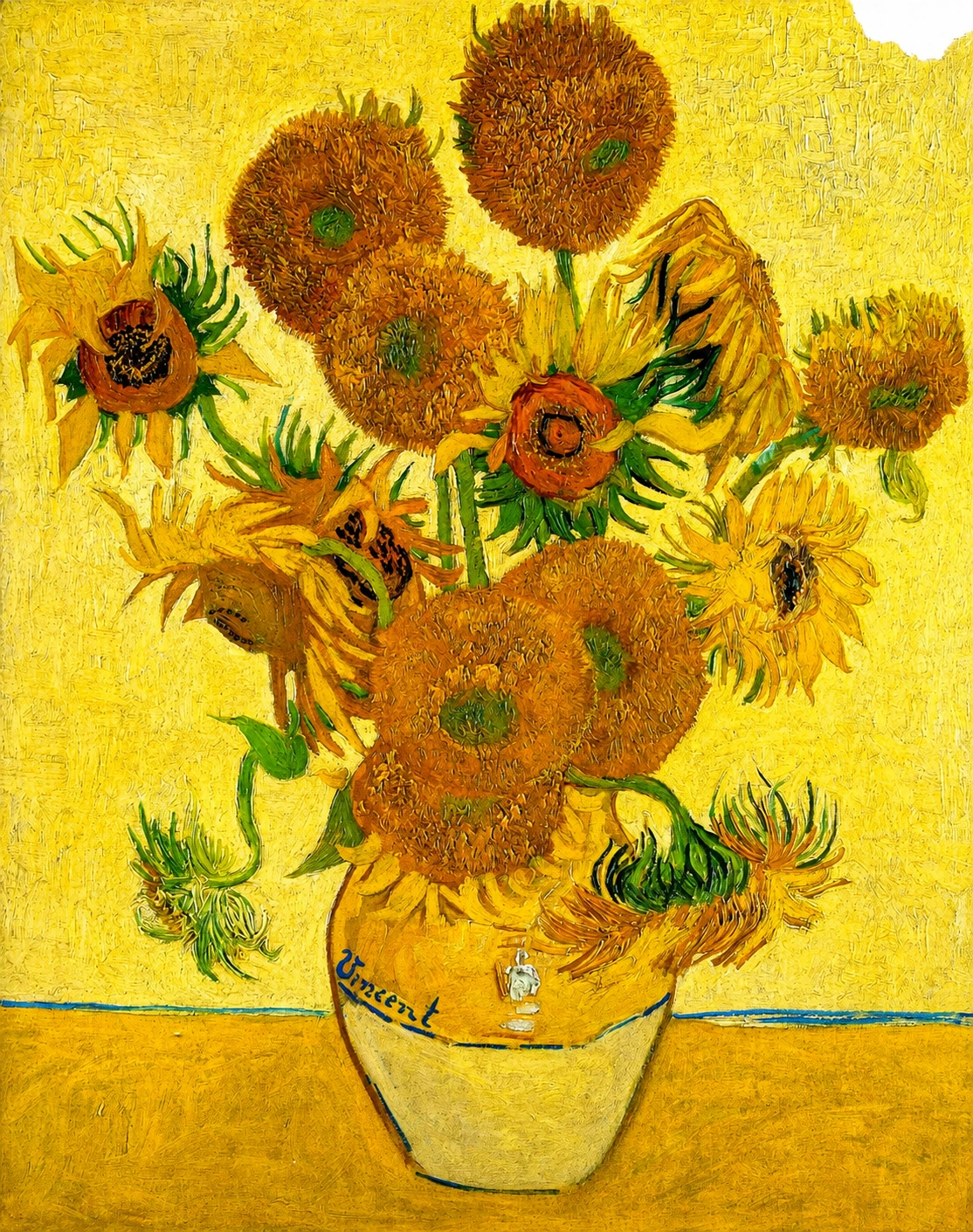
The most striking feature of “Vase with Fifteen Sunflowers” is its almost overwhelming use of yellow. The flowers, vase, table, and background all belong to a closely related range of golden, ochre, lemon, and brownish yellow tones. Instead of relying on strong contrasts between many different colors, Van Gogh creates intensity through variation within a single dominant color family.
This use of yellow gives the painting a glowing, sunlit quality. The background seems to vibrate with warmth, while the table and vase feel as though they are made from the same solar substance as the flowers. The entire image appears saturated with light. Van Gogh’s yellows are not flat or decorative. They shift constantly, from pale cream to deep amber, from dry straw to rich gold. This makes the painting feel alive, as though the color itself is breathing.
Yellow also carries emotional meaning. It suggests warmth, hope, friendship, and spiritual brightness. At the same time, some of the yellows have a dry, earthy quality, reminding us that these flowers are cut from their roots and already beginning to fade. The color is joyful, but it is not innocent. It contains both celebration and decline.
Composition and Balance
The composition of “Vase with Fifteen Sunflowers” is carefully arranged, even though it feels spontaneous. The vase sits near the center of the lower half of the painting, anchoring the image. From it, the flowers spread outward in a loose, irregular bouquet. Some sunflowers face the viewer directly, while others bend, droop, twist, or turn away. This variety gives the arrangement a sense of movement and personality.
The tallest flowers rise toward the upper edge of the canvas, creating a strong vertical rhythm. The lower blooms curve outward and downward, balancing the height with a sense of weight and fullness. The vase itself is simple and rounded, its blue signature offering one of the few cool accents in the composition. This small touch of blue is important because it sharpens the surrounding yellows and gives the eye a point of rest.
The background is divided by a horizontal line between the wall and the table. This line stabilizes the image, but Van Gogh keeps it subtle. The real drama belongs to the flowers, which seem to push forward from the shallow space. The painting does not aim for traditional depth. Instead, it creates presence. The sunflowers feel immediate, almost confrontational, as if they are not objects but living characters.
Texture and Brushwork
Van Gogh’s brushwork is central to the painting’s emotional force. The surface is built from visible strokes, ridges, dabs, and swirling marks. The centers of the sunflowers are especially textured, with dense, rough applications of paint that suggest seeds, dried petals, and organic roughness. These areas feel tactile and earthy, contrasting with the flatter planes of the background and table.
The petals are painted with quick, energetic strokes that bend and flick in different directions. Some are sharp and flame-like, while others appear limp or curling. This variety makes each flower feel distinct. Van Gogh is not painting an ideal bouquet. He is painting flowers as living forms caught in different moments of their existence.
The background also contains visible brushwork, though it is quieter than the flowers. Its textured surface prevents the pale yellow wall from becoming empty. Instead, it becomes an active field of light. Every part of the canvas carries the mark of Van Gogh’s hand. The painting feels handmade in the strongest sense, with emotion embedded in the physical movement of the brush.
Sunflowers as Symbols of Life and Time
The sunflowers in this painting are not all fresh and perfect. Some are open and radiant, while others are bent, drying, or losing their petals. This range gives the work a subtle meditation on time. The bouquet contains different stages of life at once: blooming, maturity, decay, and near-collapse.
This makes “Vase with Fifteen Sunflowers” more complex than a simple image of brightness. The flowers are beautiful, but their beauty is temporary. They have been cut and placed in a vase, which makes their display possible while also marking their separation from the living earth. Van Gogh captures them during a brief interval between fullness and disappearance.
The sunflower itself is associated with the sun, and Van Gogh uses that association powerfully. These flowers seem to absorb and reflect sunlight. Yet they also show how quickly natural radiance can fade. In this way, the painting holds joy and melancholy together. It celebrates life by showing its intensity, but it also reminds us that intensity does not last forever.
The Arles Context
Van Gogh painted “Vase with Fifteen Sunflowers” during his time in Arles, a period of extraordinary productivity and experimentation. He had moved to the south of France in search of stronger light, clearer color, and a renewed artistic life. Arles offered him a landscape and atmosphere very different from the gray tones he had known earlier in the Netherlands and Paris.
The Sunflowers paintings were also connected to Van Gogh’s desire to decorate the Yellow House, where he hoped to establish a shared studio with Gauguin. In that context, “Vase with Fifteen Sunflowers” becomes more than a still life. It becomes an act of hospitality. The painting was meant to welcome, to brighten a room, and to express the personality of the artist who made it.
This personal context helps explain the painting’s emotional openness. Van Gogh was not only painting flowers. He was painting hope, expectation, and the dream of artistic companionship. The sunflowers stand like guests, companions, or emblems of the creative life he wanted to build.
Why the Painting Still Matters
“Vase with Fifteen Sunflowers” remains powerful because it turns ordinary subject matter into something unforgettable. Van Gogh does not rely on luxury, narrative, or grand historical drama. He takes a common vase of flowers and fills it with psychological and visual intensity. The painting’s greatness lies in this transformation.
Its appeal also comes from its directness. The image is easy to recognize, but difficult to exhaust. A viewer can enjoy it immediately as a warm and beautiful flower painting, yet closer attention reveals its tensions: freshness and decay, simplicity and complexity, joy and loneliness, decoration and emotional confession.
Van Gogh’s Sunflowers have become symbols of the artist himself because they seem to embody his way of seeing. They are humble but radiant, rough but beautiful, fragile but forceful. In “Vase with Fifteen Sunflowers,” the flowers are not passive decorations. They seem to burn with inner life.
Conclusion
“Vase with Fifteen Sunflowers” by Vincent van Gogh is one of the clearest examples of how still life painting can carry profound emotional meaning. Through his bold use of yellow, vigorous brushwork, compressed composition, and sensitive attention to the life cycle of flowers, Van Gogh creates an image that feels both joyful and deeply human. The painting glows with warmth, but it also acknowledges change, aging, and loss.
Its enduring popularity comes from this balance. It is bright without being shallow, simple without being empty, and beautiful without ignoring impermanence. Van Gogh gives the sunflower a new artistic identity, turning it into a symbol of light, friendship, creativity, and vulnerability. More than a vase of flowers, “Vase with Fifteen Sunflowers” is a portrait of life at its most vivid and fleeting.