The Arnolfini Portrait by Jan van Eyck: Vibrant Color Edit
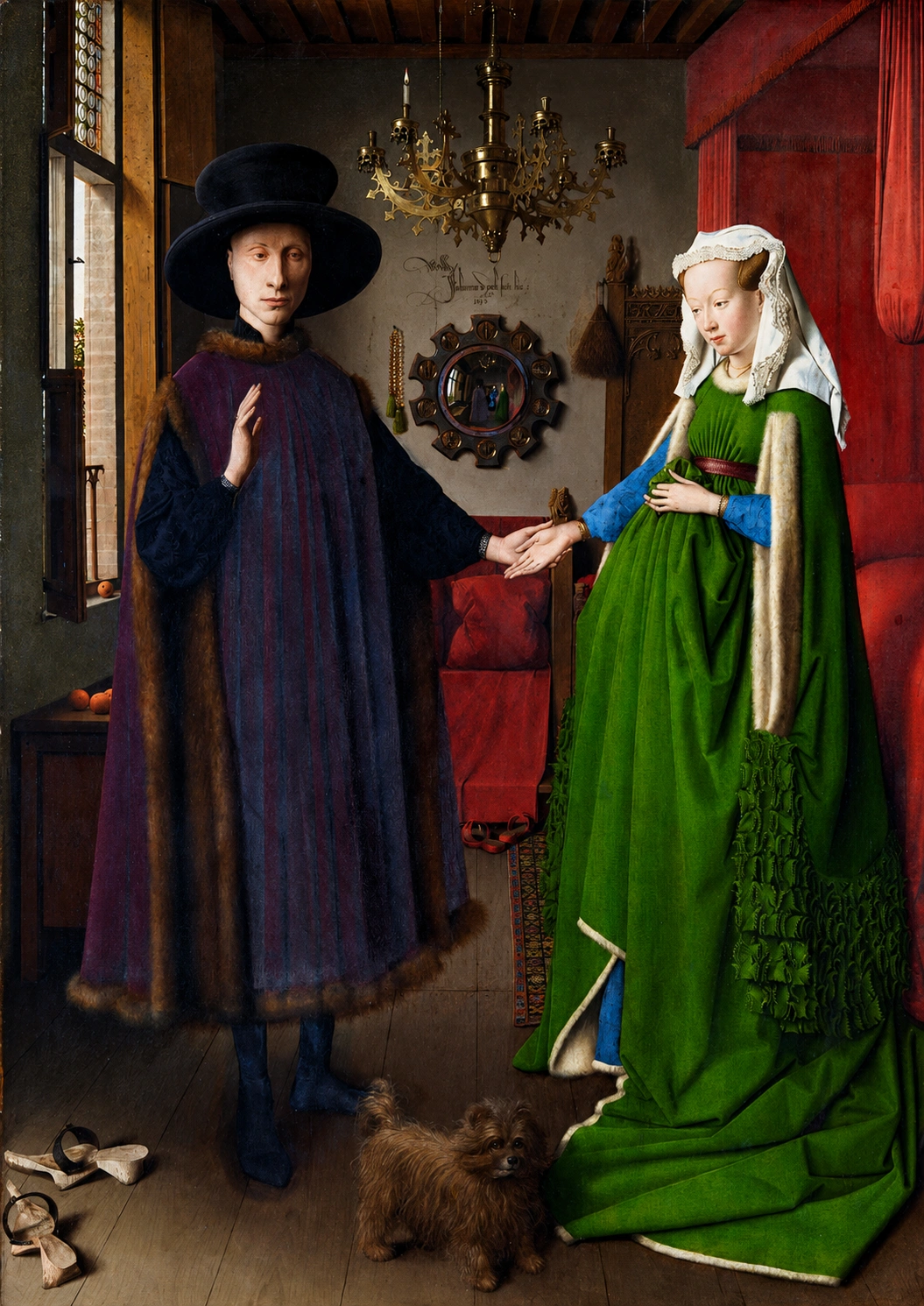
Free to Download & Reuse: You are welcome to use this image! If you republish or share it online, you must include a direct link back to this webpage for attribution.
Original Image Source: wikiart.org
Introduction
Jan van Eyck’s “The Arnolfini Portrait,” painted in 1434, is one of the most fascinating works of Northern Renaissance art. At first glance, it appears to show a wealthy couple standing inside a richly furnished room. Yet the more closely the viewer looks, the more mysterious and complex the painting becomes. Every object seems deliberate: the dog in the foreground, the discarded shoes, the glowing chandelier, the convex mirror, the fruit by the window, the red bed, the woman’s green dress, and the man’s solemn gesture. Van Eyck transforms a domestic interior into a world of symbols, status, intimacy, and visual intelligence.
The painting is often discussed as a marriage portrait, though its exact meaning has been debated for many years. It may represent a wedding, a legal agreement, a memorial image, or a display of family identity and social ambition. Whatever its precise function, “The Arnolfini Portrait” remains powerful because it feels both private and ceremonial. The room is quiet, but it is charged with meaning. The couple does not smile or move casually. They stand as if participating in a solemn act, witnessed not only by each other, but also by the viewer, the mirror, and perhaps even the artist himself.
The Couple and Their Formal Presence
The two figures dominate the composition. The man, usually identified as Giovanni Arnolfini, stands on the left in dark clothing and a large black hat. His raised hand gives him an authoritative, almost ritual presence. His costume is luxurious but restrained, with heavy fabric and fur suggesting wealth, taste, and social rank. His pale face, narrow features, and reserved expression create a mood of seriousness. He does not appear romantic in a sentimental sense. Instead, he seems composed, formal, and conscious of his role.
The woman stands opposite him in a brilliant green gown. Her dress is one of the most visually striking elements in the painting. The green fabric falls in deep folds, spreading across the floor with sculptural weight. Although modern viewers sometimes interpret the rounded shape of her dress as a sign of pregnancy, this was also a fashionable way of arranging fabric in the fifteenth century. Van Eyck is not simply recording a body. He is displaying wealth through cloth, color, and carefully controlled posture.
Her lowered gaze and delicate hand gesture contrast with the man’s raised hand. The couple’s joined hands form the emotional and symbolic center of the composition. Their connection is subtle rather than passionate. The touch is restrained, almost legalistic, which gives the image its famous ambiguity. Is this a marriage vow, a promise, a contract, or a symbolic union? Van Eyck does not answer directly. Instead, he allows the pose to hold several meanings at once.
The Interior as a Symbolic World
The room is small, but it feels full of significance. Van Eyck’s genius lies in making ordinary objects appear meaningful without turning them into simple puzzles. The wooden floor, window, bed, chair, chandelier, mirror, and hanging brush all suggest a prosperous household. This is not a grand palace interior, but it is unmistakably the home of people with money and social position.
The red bed on the right is especially important. In wealthy households, beds were not only private objects. They could also function as symbols of lineage, marriage, fertility, and domestic authority. Its rich red color warms the composition and balances the deep greens of the woman’s dress. The bed also makes the room feel intimate, reminding the viewer that marriage, family, and inheritance may be part of the painting’s meaning.
The fruit near the window adds another layer. It may suggest prosperity, trade, and luxury, since imported fruit would have been costly in northern Europe. It may also carry religious associations, recalling innocence, temptation, or paradise. Van Eyck’s objects often work in this way. They belong naturally to the world of the painting, but they also invite symbolic reading.
The small dog at the couple’s feet is one of the most memorable details. It may represent loyalty, domestic affection, or marital fidelity. At the same time, Van Eyck paints it with such lively attention that it feels like a real pet, not merely a symbol. Its shaggy fur and alert face bring warmth into a scene otherwise marked by formality.
Light, Detail, and Van Eyck’s Technical Brilliance
“The Arnolfini Portrait” is a masterpiece of oil painting. Van Eyck’s handling of light, texture, and reflection is astonishing. The window on the left lets in a cool natural light that moves across the room, illuminating faces, fabric, metal, wood, and glass. Each surface responds differently. Fur absorbs light. Brass glows. Glass reflects. Cloth folds into shadow. Skin appears smooth and pale. The effect is not theatrical, but precise and quietly radiant.
Van Eyck’s detail is not decorative excess. It creates credibility. The viewer believes in the room because every object has weight, surface, and position. The chandelier above the couple is especially impressive. Its complex metal structure is painted with sharp accuracy, yet it also contributes to the symbolic atmosphere. Only one candle appears to be burning, which has often been read as a sign of divine presence, spiritual witness, or the solemnity of the moment.
The convex mirror on the back wall is perhaps the painting’s most famous detail. It reflects the backs of the couple and also shows two additional figures standing near the doorway. Around the mirror are tiny scenes from the Passion of Christ, which bring a religious dimension into the domestic setting. The mirror expands the space of the painting and complicates the viewer’s position. We are not simply looking at the couple. We are placed where witnesses might stand.
Above the mirror is the inscription “Johannes de Eyck fuit hic 1434,” meaning “Jan van Eyck was here 1434.” This phrase is unusual because it sounds more like a witness statement than a simple signature. It strengthens the sense that the painting records an event or formal act. Van Eyck presents himself not only as an artist, but as someone present at the scene, someone whose vision gives authority to what is shown.
Color and Composition
The composition is carefully balanced. The man’s dark figure anchors the left side, while the woman’s green dress fills the right with color and volume. The couple’s hands meet near the center, just below the mirror and chandelier. These central elements create a vertical axis that gives the painting order and stability. The room may be full of objects, but nothing feels accidental.
Color plays a major role in the emotional effect. The man’s dark robe gives him gravity and restraint. The woman’s green dress suggests richness, vitality, and elegance. The red bed and curtains create warmth and intensity. The pale window light softens the scene and gives the interior a devotional calm. Van Eyck’s palette is vivid but controlled, allowing each color to carry meaning without overwhelming the whole.
Why “The Arnolfini Portrait” Still Matters
The lasting power of “The Arnolfini Portrait” comes from its combination of realism and mystery. It seems to show a specific room, a specific couple, and a specific moment. Yet the more the viewer studies it, the less simple it becomes. It is a portrait, but also a symbolic interior. It is a domestic image, but also a public statement. It feels intimate, but also formal. It may record love, law, memory, wealth, faith, or all of these together.
Van Eyck’s achievement is not only technical perfection. It is his ability to make the visible world feel intellectually and spiritually charged. In this painting, a room becomes a stage for identity, status, devotion, and human relationship. “The Arnolfini Portrait” remains one of the defining images of the Northern Renaissance because it shows how painting can transform everyday objects into enduring mysteries.