Dance by Henri Matisse: Vibrant Color Edit
Free to Download & Reuse: You are welcome to use this image! If you republish or share it online, you must include a direct link back to this webpage for attribution.
Original Image Source: commons.wikimedia.org
Introduction
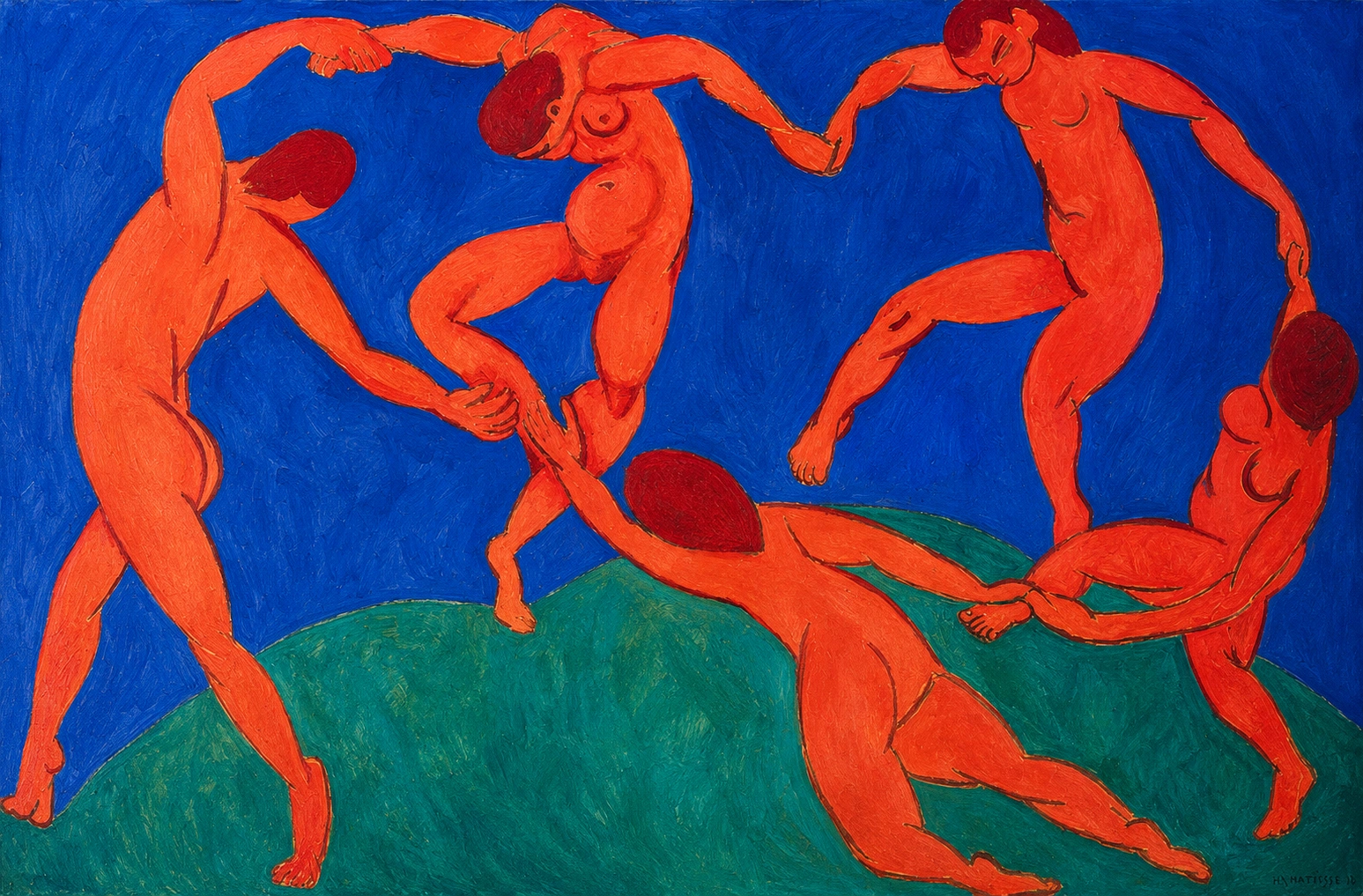
Henri Matisse’s “Dance,” painted in 1910, is one of the defining images of modern art. At first glance, the painting appears almost shockingly simple: five red figures join hands in a circular rhythm across a green hill beneath a deep blue sky. Yet this simplicity is exactly what gives the work its power. Matisse removes almost everything that traditional painting had long depended on, including detailed anatomy, realistic space, delicate modeling, and narrative complexity. What remains is color, movement, line, and feeling.
“Dance” is not a painting that asks to be read like a story. It asks to be felt physically. The figures seem to move beyond the frame, pulled by a force larger than themselves. Their bodies bend, stretch, and tilt in a chain of energy. The image becomes a visual expression of rhythm, instinct, unity, and freedom. In this sense, “Dance” is one of Matisse’s clearest statements about what painting could become in the twentieth century: not an imitation of the visible world, but an independent language of emotion and sensation.
The Composition of “Dance”
The composition of “Dance” is built around the circle. Five figures form a ring, though the circle is not perfectly closed. At the lower center, two hands fail to meet, creating a small but important break in the chain. This gap gives the painting tension. The dance feels both complete and unstable, as though the movement is still unfolding before us.
Matisse places the figures across a curved green ground that rises like a stage or hill. The slope gives the scene a sense of elevation, as if the dancers are performing on the rounded surface of the earth itself. Above them, the blue background is vast and empty. There are no trees, buildings, shadows, or decorative details. The figures exist in a simplified world made from only three dominant colors: red, green, and blue.
This reduction makes the composition extremely direct. The viewer’s eye follows the arms, legs, and torsos around the circle. The bodies are not arranged according to classical balance, but according to rhythm. Each figure leads into the next. One dancer leans forward, another arches backward, another seems to float or leap. The entire painting functions almost like a piece of music, with repetition, variation, and momentum.
Color and Emotional Force
Color is the emotional engine of “Dance.” Matisse uses red for the bodies, green for the earth, and blue for the sky. These colors are not naturalistic. The dancers are not painted in realistic flesh tones, and the landscape is not described with atmospheric detail. Instead, color becomes symbolic, expressive, and structural.
The red figures feel warm, intense, and alive. Against the cool blue background, their bodies seem to pulse with energy. The green ground anchors the scene, but it also curves upward in a way that makes the dancers appear connected to nature. The painting’s color scheme creates a primal atmosphere, suggesting life, movement, and collective vitality.
Matisse was associated with Fauvism, a movement known for bold, non-naturalistic color. In “Dance,” that interest in expressive color becomes monumental. The colors are not decorative additions to the image. They are the image. They define space, mood, and meaning. The result is a painting that feels ancient and modern at the same time, like a ritual scene created with the visual language of the twentieth century.
The Human Figure Simplified
The bodies in “Dance” are deliberately simplified. Matisse does not idealize them in the academic tradition, nor does he render them with anatomical precision. The figures are elongated, flattened, and distorted according to the needs of rhythm. Their limbs stretch in sweeping arcs, and their poses emphasize movement rather than physical accuracy.
This simplification gives the dancers a universal quality. They are not portraits of specific individuals. They become symbols of the human body in motion. Their faces are mostly indistinct, which shifts attention away from personality and toward collective action. The dancers are joined by gesture, not identity.
The nudity in the painting also contributes to this sense of timelessness. Matisse presents the figures without modern clothing, social markers, or historical setting. They appear outside ordinary time, closer to myth, ritual, or instinctive celebration. The body becomes a vehicle for rhythm and emotion rather than a subject of realism.
Movement, Rhythm, and Unity
The most important subject of “Dance” is movement itself. The figures are linked in a circular motion, but the dance does not feel calm or controlled. It feels urgent, almost wild. The tilted bodies and uneven poses suggest that the dancers are being carried by the rhythm rather than carefully performing it.
The broken handclasp near the bottom of the composition is especially significant. It prevents the circle from becoming static. Because the hands do not quite touch, the viewer senses a moment of suspense. Will the dancers reconnect? Is the rhythm about to continue, or has it been interrupted? This small gap gives the entire painting emotional electricity.
The circle also suggests unity. The dancers are separate bodies, but they move as one. Their joined hands create a chain of shared energy. In this way, “Dance” can be read as an image of human connection, communal joy, and the power of collective movement. It is not a private scene, but a shared ritual.
Modern Art and the Power of Simplicity
“Dance” is revolutionary because of what Matisse leaves out. Traditional Western painting often valued illusion, depth, detail, and polished finish. Matisse rejects those values in favor of clarity and intensity. The painting does not try to convince us that we are looking into a realistic space. Instead, it openly declares itself as a painted surface organized by color and line.
This makes “Dance” a key work in the development of modern art. It shows how a painting can be powerful without realistic detail. It shows how form can be simplified without becoming weak. In fact, the simplicity of “Dance” makes it more memorable. The image is almost impossible to forget because it is built from such strong visual essentials.
Matisse’s achievement lies in transforming a basic subject into an icon of modern expression. A group of dancers becomes a statement about life, rhythm, freedom, and artistic liberation. The painting feels both joyful and intense, harmonious and unstable. Its power comes from this balance between simplicity and emotional depth.
Conclusion
Henri Matisse’s “Dance” remains one of the most important paintings of the early twentieth century because it captures movement with extraordinary economy. Through five red figures, a green hill, and a blue sky, Matisse creates an image of pure visual energy. The painting is not concerned with realism, storytelling, or decorative elegance. It is concerned with rhythm, color, and the deep human impulse to move together.
“Dance” feels timeless because it reaches beyond the specifics of place and identity. The dancers belong to no single culture or moment. They seem to represent something older and more universal: the body’s response to music, the joy of communal movement, and the force of life itself. With its bold colors, simplified forms, and unforgettable circular composition, “Dance” stands as one of Matisse’s greatest achievements and one of the clearest examples of modern art’s break from tradition.