The Sleeping Gypsy by Henri Rousseau: Vibrant Color Edit
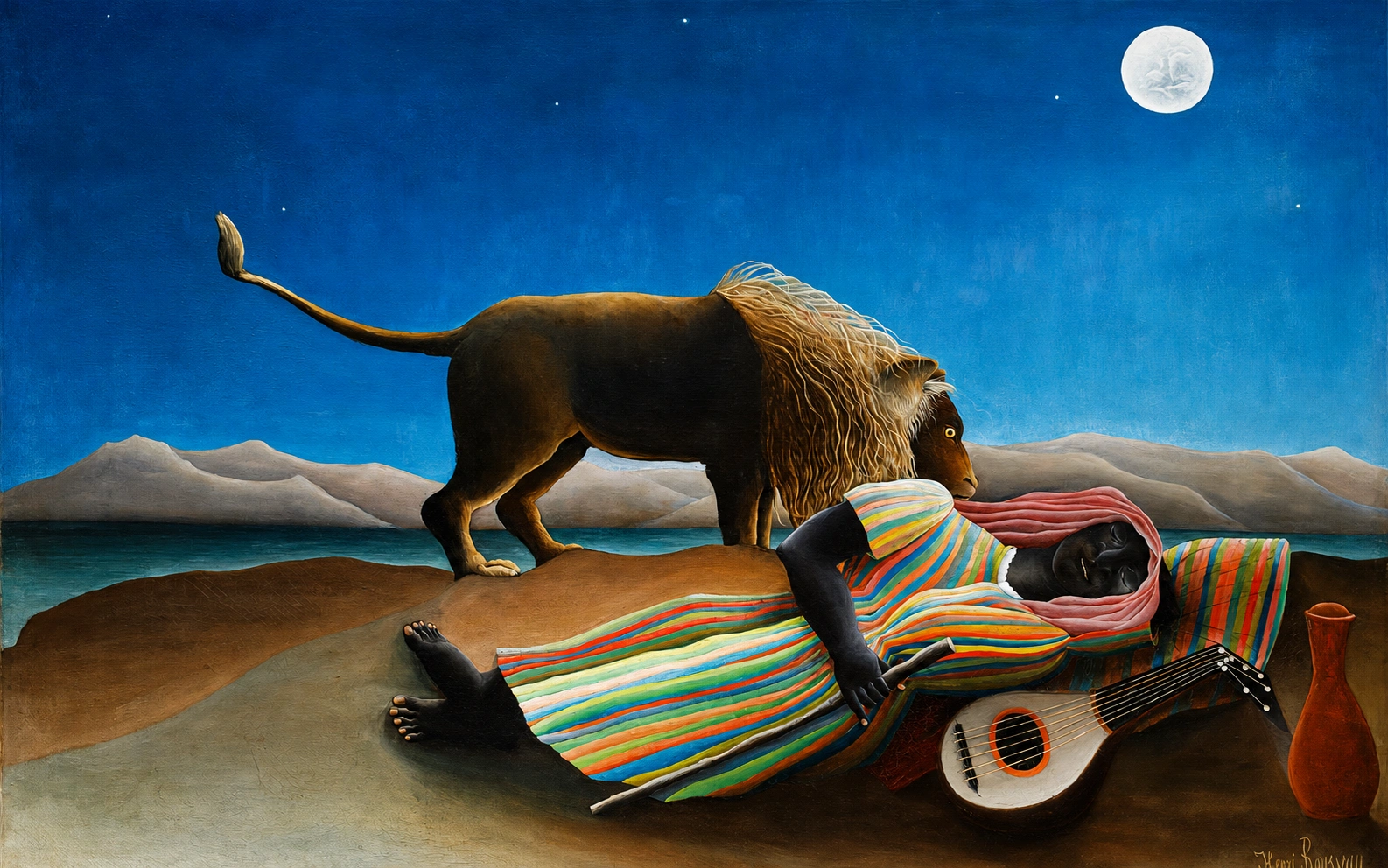
Free to Download & Reuse: You are welcome to use this image! If you republish or share it online, you must include a direct link back to this webpage for attribution.
Original Image Source: wikiart.org
A Dreamlike Encounter in “The Sleeping Gypsy”
Henri Rousseau’s “The Sleeping Gypsy”, painted in 1897, is one of the most haunting and memorable images in modern art. At first glance, the painting appears simple: a sleeping woman lies in a desert landscape beneath a bright moon, while a lion stands close to her body, calmly sniffing or observing her. Beside her are a stringed instrument, a walking stick, a water jar, and a striped garment that glows with unexpected color. Yet the more one looks at the scene, the stranger and more mysterious it becomes. Rousseau creates a world that feels suspended between danger and peace, reality and dream, innocence and threat.
The painting is often described as dreamlike because it does not behave like a realistic scene. The lion does not attack. The sleeper does not wake. The desert is silent. The moon shines with theatrical clarity. Every object seems carefully arranged, almost like a symbol in a story whose meaning is never fully explained. This sense of mystery is central to the painting’s power. Rousseau does not tell us what has happened before this moment or what will happen after it. He gives us a single, unforgettable vision.
Henri Rousseau’s Unique Style
Rousseau was not trained in the academic tradition, and that lack of formal training became one of the defining qualities of his art. In “The Sleeping Gypsy”, the perspective is flattened, the forms are simplified, and the composition has a directness that feels almost childlike. But this simplicity should not be mistaken for weakness. Rousseau’s style gives the painting its strange authority. The scene feels clear, iconic, and timeless.
The lion is not painted with anatomical realism, but it has tremendous presence. Its body is long and heavy, its mane falls in rhythmic strands, and its eye catches the viewer with quiet intensity. The sleeping woman is also simplified, with her body stretched across the foreground like a sculptural form. Her striped clothing creates a strong visual contrast with the muted desert and the cool blue sky. Rousseau’s precision is not academic precision. It is imaginative precision. He organizes the painting so that every element feels necessary.
Composition and Visual Balance
The composition of “The Sleeping Gypsy” is carefully balanced. The woman lies horizontally across the lower half of the image, while the lion stands above and behind her, moving in the opposite direction. This creates a strong visual tension. The sleeping figure is still and vulnerable, while the lion is alert and powerful. The curve of the lion’s tail, the flowing mane, the rolling hills, and the woman’s striped garment all add rhythm to the scene.
The moon in the upper right corner balances the darker weight of the sleeping figure and the lion below. It also gives the painting a quiet spiritual atmosphere. The landscape stretches into the distance, but it does not feel open or free. Instead, it feels enclosed by silence. The viewer’s eye moves from the woman’s face to the lion’s face, then to the moon, then back to the colorful fabric and the musical instrument. Rousseau builds the scene like a visual poem, where shapes and colors echo one another.
Color, Moonlight, and Atmosphere
The color palette is one of the most striking aspects of the painting. Rousseau uses deep blues, soft greens, sandy browns, pale grays, and bright stripes of red, yellow, turquoise, and orange. The contrast between the muted landscape and the vivid clothing makes the sleeper appear almost magical. Her garment becomes the emotional center of the painting, bringing warmth and life into an otherwise cold nocturnal world.
The moonlight gives the scene a calm but eerie glow. It is not naturalistic light. It feels symbolic, as though the moon is watching over the entire scene. The sky shifts from darker blue at the top to lighter blue near the horizon, creating a soft, otherworldly depth. The mountains in the background are pale and smooth, almost like waves. Everything feels quiet, but not empty. The silence is charged with expectation.
The Sleeping Figure
The sleeping woman is usually interpreted as a wandering musician or traveler, suggested by the instrument and the objects beside her. Her pose is peaceful, but also deeply vulnerable. She lies exposed in an open landscape, far from shelter, with no sign that she is aware of the lion beside her. Her closed eyes and relaxed body make the scene feel like a dream rather than a direct encounter with danger.
Her striped dress is especially important. It gives her a visual identity and makes her stand out against the earth tones around her. The stripes also suggest movement, music, and cultural richness. Although she is asleep, she dominates the foreground. Rousseau presents her not as a minor figure in a landscape, but as the center of a mysterious vision. The title uses a historical term that is now often considered outdated, but within the painting, the figure represents the idea of the wanderer, the outsider, and the dreamer.
The Lion as Symbol
The lion is the painting’s great source of tension. In a realistic scene, its closeness to the sleeping woman would imply immediate danger. But Rousseau refuses that expected drama. The lion does not roar, leap, or attack. It bends toward her with curiosity. Its stillness changes the emotional meaning of the image. The animal becomes less a predator than a guardian, visitor, or supernatural presence.
This ambiguity makes the painting unforgettable. Is the lion real, or part of the woman’s dream? Is it a threat, or a protector? Is the scene meant to show danger suspended by innocence? Rousseau leaves these questions open. The lion’s strange calm makes the image feel enchanted. It turns fear into wonder.
Music, Travel, and Mystery
The instrument near the woman’s body adds another layer of meaning. It suggests that she is a musician, perhaps someone who carries songs from place to place. Music is not shown directly, but its presence is implied. The silent instrument beside the sleeping figure deepens the stillness of the painting. It is as though sound has paused for the night.
The instrument near the woman’s body adds another layer of meaning. It suggests that she is a musician, perhaps someone who carries songs from place to place. Music is not shown directly, but its presence is implied. The silent instrument beside the sleeping figure deepens the stillness of the painting. It is as though sound has paused for the night.
Why “The Sleeping Gypsy” Still Fascinates Viewers
“The Sleeping Gypsy” remains powerful because it combines simplicity with mystery. Its forms are easy to understand, but its meaning is impossible to fully explain. Rousseau creates an image that feels both innocent and unsettling. The sleeping woman, the calm lion, the moonlit desert, and the colorful objects all seem to belong to a world ruled by dream logic.
The painting also challenges the viewer’s expectations. We expect danger, but find stillness. We expect narrative, but find silence. We expect realism, but enter fantasy. This is why the work has had such a lasting impact. It shows that a painting does not need complex perspective or academic polish to feel profound. It only needs a powerful vision.
In “The Sleeping Gypsy”, Rousseau gives us one of the great dream images of modern art. It is peaceful, strange, poetic, and unforgettable. The scene remains suspended forever under the moon, with the sleeper resting and the lion watching, as if the whole world has paused to witness a secret moment between nature, imagination, and sleep.