The Wanderer Above the Sea of Fog by Caspar David Friedrich: Vibrant Color Edit
Free to Download & Reuse: You are welcome to use this image! If you republish or share it online, you must include a direct link back to this webpage for attribution.
Original Image Source: wikiart.org
The Wanderer Above the Sea of Fog by Caspar David Friedrich
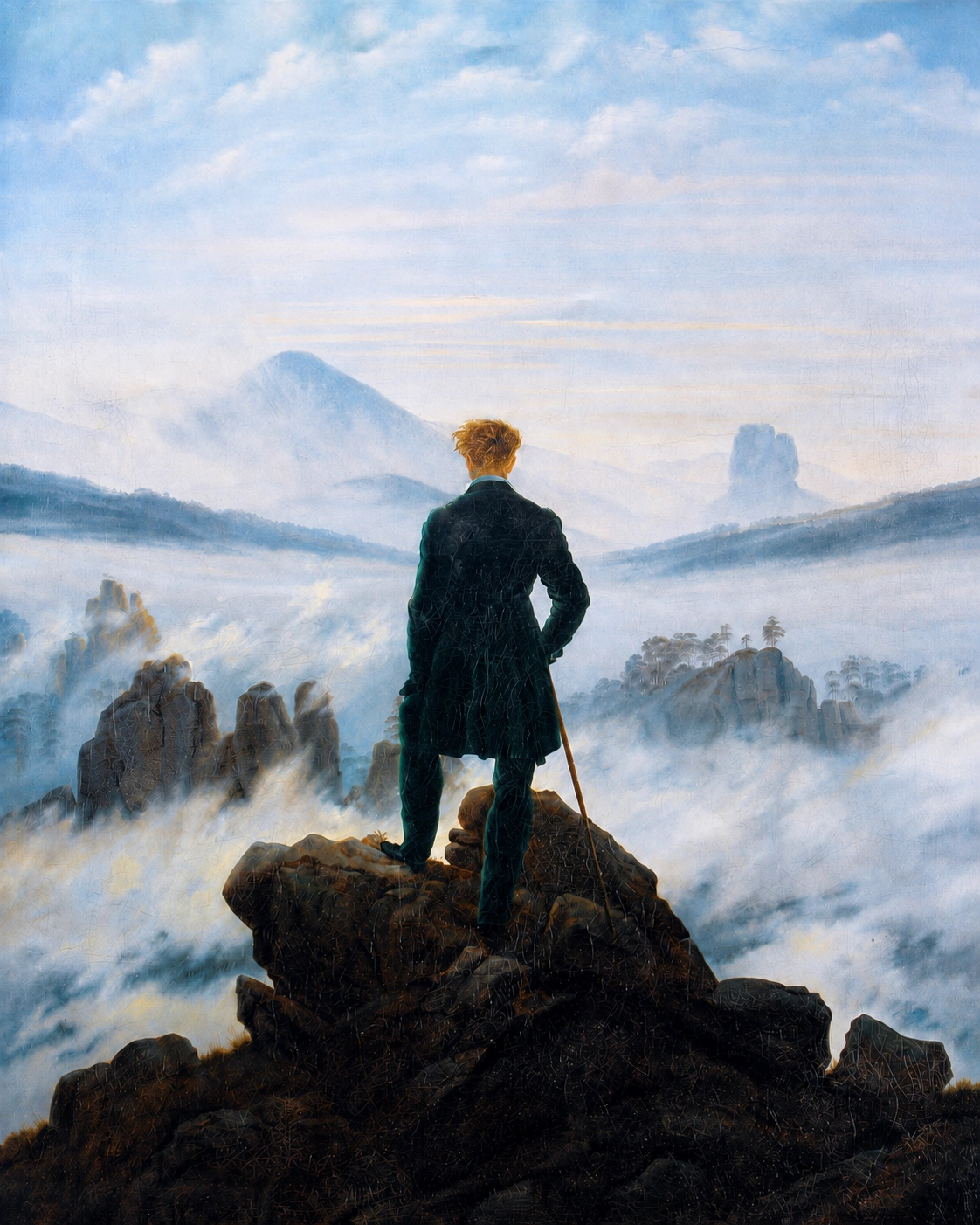
Caspar David Friedrich’s “The Wanderer Above the Sea of Fog,” painted in 1818, is one of the defining images of German Romanticism. The painting shows a solitary man standing on a rocky summit, his back turned toward the viewer as he looks across a vast landscape of mist, cliffs, distant mountains, and pale sky. Although the scene appears simple at first, it has become one of the most powerful visual statements about nature, solitude, self-reflection, and the mystery of human existence.
The figure, often called the wanderer, occupies the center of the composition. He stands firmly on the dark rocks, dressed in a dark green coat, holding a walking stick in one hand. His posture is confident yet still. He has climbed above the fog, but what lies before him remains unclear. The world stretches outward in layers of vapor and stone, creating a space that feels both real and dreamlike. This balance between physical presence and spiritual uncertainty is central to the painting’s lasting power.
A Masterpiece of German Romanticism
“The Wanderer Above the Sea of Fog” belongs to the Romantic movement, which placed strong emphasis on emotion, imagination, nature, and the individual’s inner life. Friedrich was one of the most important Romantic painters because he used landscape not merely as scenery, but as a mirror of the soul. In this painting, nature is not decorative. It becomes a vast, overwhelming force that invites contemplation.
The Romantic idea of the sublime is especially important here. The sublime refers to experiences that are beautiful but also immense, mysterious, or even intimidating. Friedrich creates this feeling through the scale of the landscape. The wanderer is important, yet he is small compared with the world around him. He has reached a high point, but he has not conquered nature. Instead, he stands before it in awe.
This makes the painting very different from a simple heroic portrait. The man is elevated, but the scene does not celebrate power in a straightforward way. His back is turned, so we cannot read his face. We are invited to share his viewpoint, but we cannot know exactly what he feels. This ambiguity makes the painting more universal. The wanderer could be an explorer, a philosopher, a dreamer, or any person standing before the unknown.
Composition and the Power of the Rückenfigur
One of Friedrich’s most famous techniques is the use of the Rückenfigur, a figure seen from behind. In “The Wanderer Above the Sea of Fog,” this device is essential. By turning the man away from us, Friedrich prevents the painting from becoming a portrait of a specific individual. Instead, the figure becomes a substitute for the viewer. We look with him into the foggy distance.
The composition is carefully balanced. The wanderer stands almost exactly in the center, forming a strong vertical shape against the soft horizontal layers of mist and mountains. His dark clothing contrasts with the pale atmosphere, making him visually dominant. Yet the landscape surrounds him on every side, reminding us that his presence is only one part of a much larger world.
The rocks beneath his feet are sharp, dark, and solid. They anchor the lower part of the painting and suggest the difficulty of the climb. Beyond them, the fog softens everything. Distant cliffs emerge and disappear like memories or thoughts. This contrast between the solid foreground and the uncertain background gives the image its psychological depth. The wanderer stands between certainty and mystery, between what can be touched and what can only be imagined.
The Meaning of the Fog
The fog is one of the most important elements in the painting. It covers much of the landscape, hiding valleys and merging earth with sky. Rather than blocking the view completely, it reveals the world only in fragments. Peaks, ridges, and cliffs rise through the mist, suggesting that reality is present but never fully accessible.
This fog can be read in many ways. It may represent the unknown future, the limits of human knowledge, or the spiritual mystery behind the visible world. The wanderer has climbed high enough to look over the fog, but he still cannot see everything clearly. His elevated position gives him perspective, but not complete understanding.
This is one reason the painting feels so modern despite being created in 1818. It captures a feeling many people still recognize: the desire to understand one’s place in the world, combined with the realization that life remains uncertain. The landscape becomes an image of thought itself, with some areas clear and others hidden.
Nature, Solitude, and Inner Reflection
Friedrich’s painting is often associated with solitude, but it is not a lonely image in a purely negative sense. The wanderer is alone, yet his solitude seems chosen and meaningful. He has separated himself from everyday life in order to confront something larger. The silence of the scene gives the painting a meditative quality.
The absence of other people increases the sense of inwardness. There are no buildings, roads, or signs of ordinary society. The man stands in direct contact with nature, which becomes a space for self-discovery. In Romantic art, such moments were often seen as spiritually important. The natural world could awaken feelings that ordinary life suppressed.
At the same time, Friedrich avoids making the message too simple. The wanderer’s stance can seem confident, even triumphant, but the vast fog also makes him vulnerable. He appears powerful because he stands above the landscape, yet he is also surrounded by forces beyond his control. This tension gives the painting its emotional richness.
Color, Light, and Atmosphere
The color palette of “The Wanderer Above the Sea of Fog” is restrained but expressive. Friedrich uses cool blues, grays, whites, and muted earth tones to create a misty, atmospheric world. The sky is pale and luminous, while the foreground rocks are dark and heavy. This contrast draws the eye from the physical weight of the foreground into the open uncertainty of the distance.
Light is diffused rather than dramatic. There is no blazing sun or sharp spotlight. Instead, the entire scene seems filled with a soft, indirect glow. This gives the painting a dreamlike calm. The atmosphere feels suspended, as if time has slowed down.
The wanderer’s dark silhouette is crucial to this effect. His figure gives structure to the otherwise shifting landscape. Without him, the image would still be beautiful, but it would lose much of its psychological force. With him, the viewer senses a human mind confronting the grandeur of nature.
Why the Painting Still Matters
“The Wanderer Above the Sea of Fog” remains famous because it speaks to questions that are not limited to one historical period. What does it mean to stand before the unknown? Is nature something to master, admire, fear, or understand? How does solitude shape the way we see ourselves? Friedrich does not answer these questions directly. Instead, he creates an image that allows viewers to feel them.
The painting also has a remarkable visual clarity. A single figure, a rocky summit, a sea of fog, and a distant horizon are enough to create a complete emotional world. This simplicity makes the image memorable, while its mystery keeps it open to interpretation.
In the end, Caspar David Friedrich’s “The Wanderer Above the Sea of Fog” is not only a landscape painting. It is a meditation on human consciousness. The wanderer stands above the mist, but not beyond mystery. He sees more than he did below, yet the world remains partly hidden. That is the heart of the painting: the beauty of searching, the power of solitude, and the endless pull of the unknown.