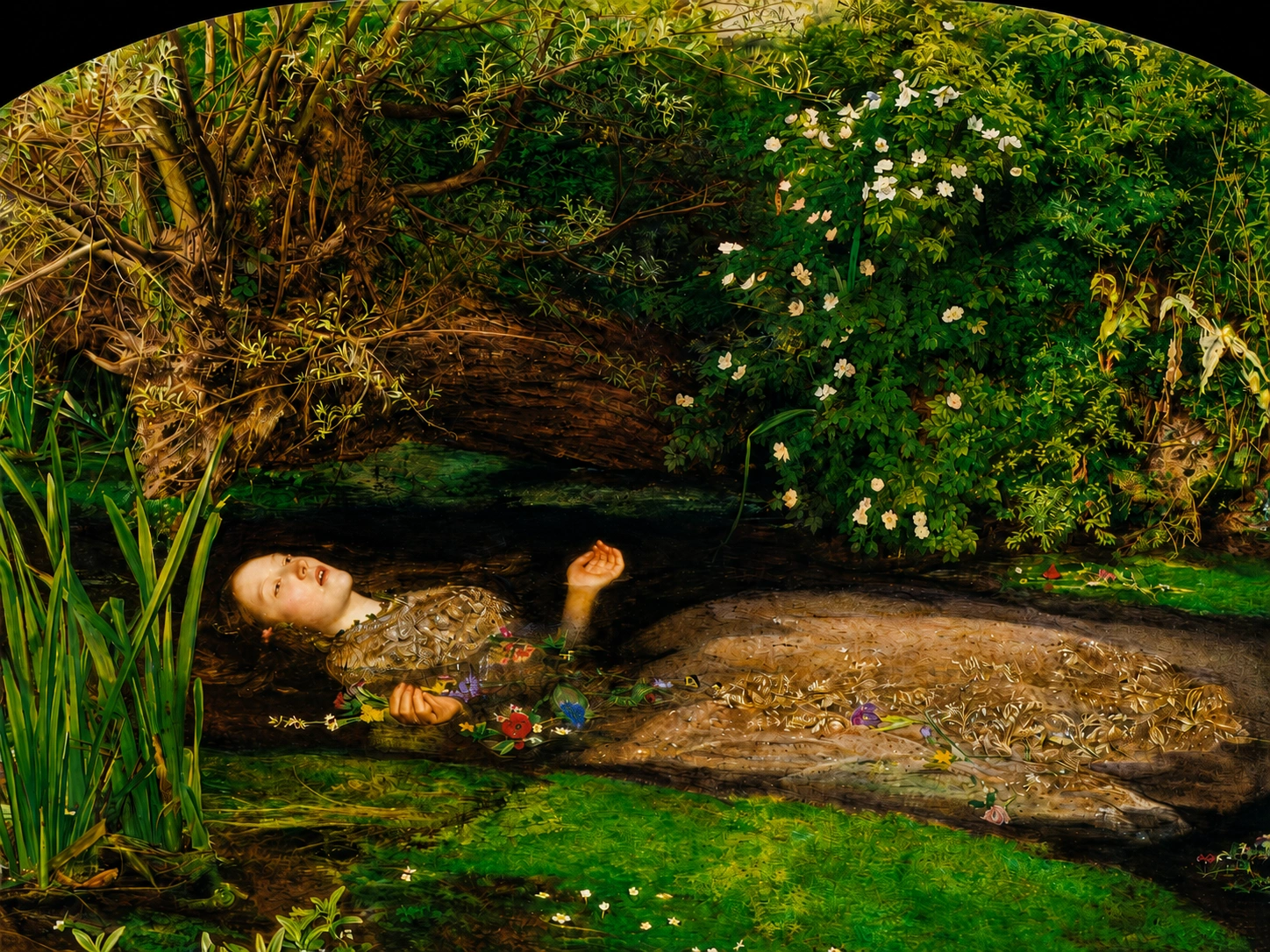
Ophelia by John Everett Millais: Vibrant Color Edit
Free to Download & Reuse: You are welcome to use this image! If you republish or share it online, you must include a direct link back to this webpage for attribution.
Original Image Source: commons.wikimedia.org
A Complete Analysis of “Ophelia” by John Everett Millais
John Everett Millais’s “Ophelia”, painted in 1852, is one of the most celebrated masterpieces of the Pre-Raphaelite Brotherhood and one of the most haunting images in Victorian art. Based on Shakespeare’s “Hamlet”, the painting shows Ophelia floating in a stream, surrounded by dense vegetation, wildflowers, and the bright yet strangely indifferent beauty of nature. Rather than presenting tragedy through dramatic gesture or theatrical darkness, Millais creates a scene of quiet suspension. The result is a painting that feels both intensely realistic and dreamlike, both botanical study and poetic vision.
At first glance, “Ophelia” appears almost overwhelmed by its natural setting. The viewer’s eye is drawn not only to the figure but also to the reeds, branches, leaves, flowers, mossy banks, and shadowed water that fill the composition. Millais’s attention to detail reflects the Pre-Raphaelite belief that art should return to the clarity, precision, and sincerity associated with early Renaissance painting. Every leaf seems individually observed. Every plant appears to have its own texture, weight, and place in the environment. This richness makes the scene feel physically present, as though the viewer could step into the damp riverbank and hear the water moving beneath the foliage.
The Pre-Raphaelite Vision
The Pre-Raphaelite Brotherhood rejected the polished formulas of academic painting and sought a more truthful, intense, and spiritually charged art. In “Ophelia”, Millais combines this commitment to natural truth with a literary subject of deep emotional power. The painting is not merely an illustration of Shakespeare. It is an interpretation of Ophelia’s state of mind, her innocence, her vulnerability, and her transformation into an emblem of beauty, sorrow, and poetic loss.
Millais painted the landscape with extraordinary patience outdoors, working directly from nature near the Hogsmill River in Surrey. This matters because the background does not function as a decorative setting. It is almost a second protagonist. The plants seem to grow around Ophelia with lush abundance, suggesting that nature continues its cycle even in the presence of human suffering. The tension between natural beauty and emotional tragedy is central to the painting’s unforgettable effect.
Ophelia’s Figure and Expression
Ophelia’s body lies horizontally across the water, creating a calm, almost ceremonial rhythm within the composition. Her face is pale and open, her eyes turned upward, her mouth slightly parted. Millais does not portray her with violent drama. Instead, he gives her an expression of fragile surrender, as if she exists between consciousness and dream. This ambiguity is one reason the painting remains so powerful. The viewer is not pushed toward a single emotional response. The scene is sorrowful, beautiful, unsettling, and peaceful all at once.
Her dress is one of the painting’s most striking elements. It glimmers with embroidered richness, catching the light against the dark water. The heavy fabric, decorated with delicate patterns, contrasts with the floating flowers and soft plants around her. Ophelia appears both part of nature and separate from it. She is surrounded by growth, yet her stillness marks her as different from the living movement of the landscape.
Flowers and Symbolic Meaning
The flowers in “Ophelia” are not random details. Millais carefully included plants associated with Shakespeare’s text and Victorian flower symbolism. The scattered blossoms near Ophelia suggest innocence, remembrance, grief, and forsaken love. Their vivid colors stand out against the greens and browns of the riverbank, creating small points of emotional intensity throughout the image.
This floral language deepens the painting’s meaning without making it feel overly obvious. The flowers are beautiful, but they also remind us that beauty can be fragile and temporary. They decorate the surface of the water like natural offerings, turning the scene into a visual elegy. Millais’s handling of flowers also shows his extraordinary technical skill. Each blossom is painted with careful attention, yet the whole scene remains unified rather than cluttered.
Nature as Beauty and Indifference
One of the most fascinating aspects of “Ophelia” is the way nature appears both nurturing and indifferent. The riverbank is full of life. Plants lean, tangle, bloom, and spread in every direction. The water reflects green light and dark shadow. Birds, insects, and unseen natural rhythms seem implied by the density of the setting. Yet this living world does not stop for Ophelia. It surrounds her, receives her, and continues.
This contrast gives the painting its emotional depth. Millais does not turn nature into a simple symbol of comfort. Instead, nature is beautiful because it is alive, but also unsettling because it remains detached from human grief. The viewer senses that Ophelia’s story is both deeply personal and part of a larger cycle of growth, decay, and renewal.
Color, Light, and Composition
The color palette of “Ophelia” is rich and jewel-like. Greens dominate the painting, from the reeds at the left to the flowering bushes at the right and the mossy foreground below. These greens are varied with yellow, brown, red, white, and violet, giving the landscape a dense visual rhythm. Ophelia’s pale face and ornate dress provide contrast, making her figure emerge from the natural world without breaking the painting’s harmony.
The arched shape at the top of the image helps frame the scene, giving the composition an enclosed, almost sacred feeling. The viewer’s gaze moves from the reeds on the left to Ophelia’s face, across her body, and then into the flowering bank at the right. Despite the abundance of detail, the composition remains carefully controlled. Millais uses the horizontal placement of Ophelia to calm the visual energy of the surrounding plants.
Light plays a subtle but important role. It does not fall dramatically from one obvious source. Instead, it seems diffused through the foliage, touching leaves, flowers, fabric, and skin in scattered highlights. This gives the painting a naturalistic brightness while preserving its mood of stillness.
Shakespearean Tragedy Reimagined
In “Hamlet”, Ophelia is one of Shakespeare’s most vulnerable figures, caught in a world shaped by conflict, pressure, and emotional confusion. Millais transforms her from a stage character into a visual icon. His Ophelia is not shown in conversation, action, or confrontation. She is isolated in a private moment, surrounded only by nature. This choice shifts the focus from plot to atmosphere. The painting asks us to contemplate what Ophelia represents rather than simply what happens to her.
The power of the image comes from this stillness. Millais gives Ophelia dignity and poetic presence. She is not reduced to a tragic symbol alone. Her face, hands, clothing, and surroundings invite careful looking. The viewer becomes aware of her humanity, even as the painting turns her into one of the most recognizable figures in nineteenth-century art.
Why “Ophelia” Still Matters
“Ophelia” remains famous because it balances opposites with extraordinary precision. It is realistic and symbolic, beautiful and tragic, detailed and mysterious. Its botanical accuracy appeals to the eye, while its emotional atmosphere stays in the memory. The painting also captures a key Pre-Raphaelite ambition: to make art that is visually exact, morally serious, literary, and emotionally intense.
For modern viewers, “Ophelia” continues to feel fresh because it does not explain itself too completely. Its beauty is immediate, but its meaning unfolds slowly. The more one looks, the more the painting seems to change. The flowers become more meaningful, the water more shadowed, the foliage more enclosing, and Ophelia’s stillness more profound.
John Everett Millais’s “Ophelia” is therefore much more than a famous Shakespearean painting. It is a masterpiece of observation, symbolism, and emotional restraint. Through its luminous detail and quiet sorrow, it turns a literary tragedy into an image of unforgettable visual poetry.