Flaming June by Frederic Leighton: Vibrant Color Edit
Free to Download & Reuse: You are welcome to use this image! If you republish or share it online, you must include a direct link back to this webpage for attribution.
Original Image Source: wikiart.org
Introduction
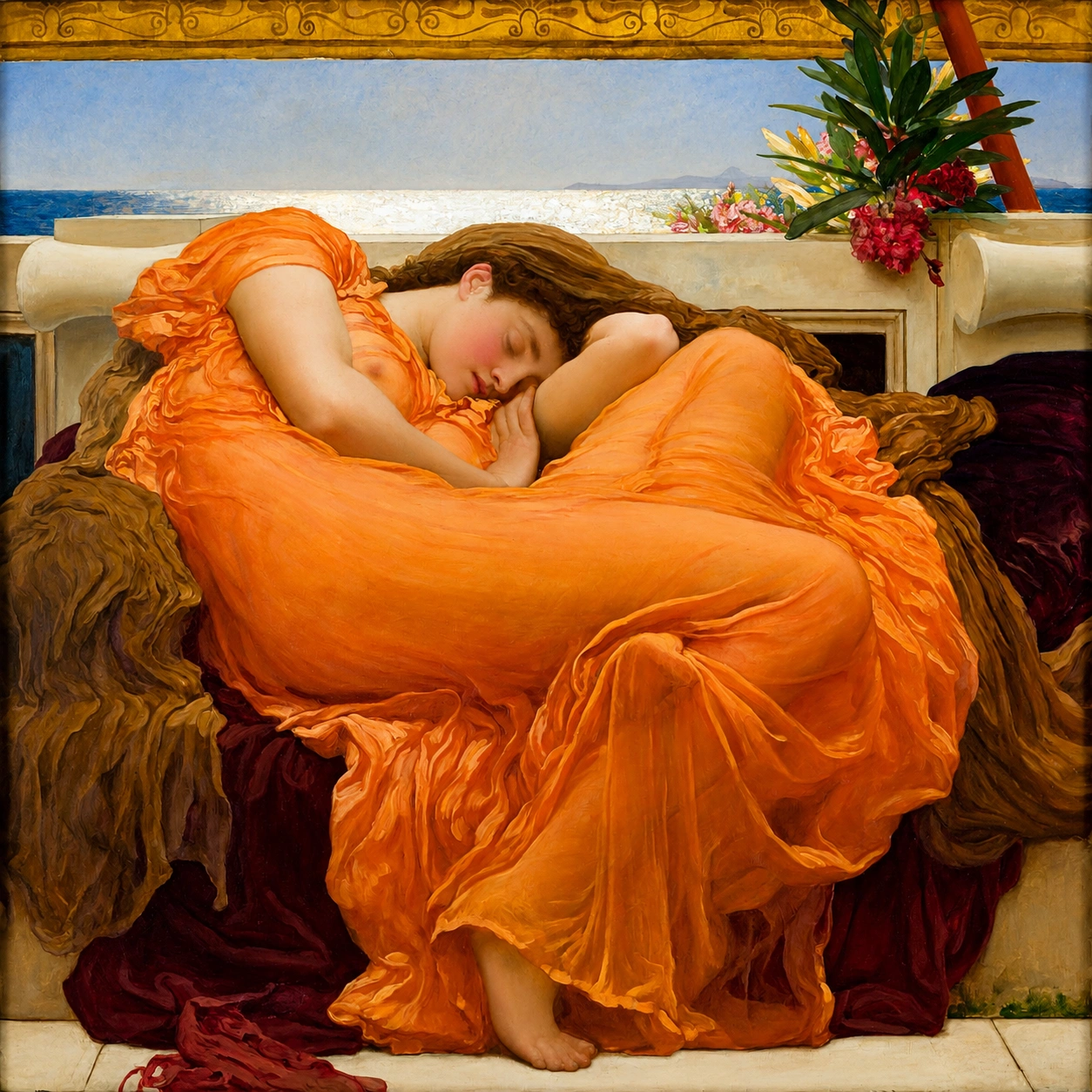
“Flaming June” by Frederic Leighton, painted in 1895, is one of the most radiant images of late Victorian art. The painting shows a young woman asleep on a marble terrace, wrapped in a brilliant orange dress that seems to glow like sunlight itself. Behind her, the sea stretches into the distance, while flowers, a decorative frieze, and the warm Mediterranean atmosphere create a scene of luxury, stillness, and dreamlike beauty. Although the subject appears simple at first, the painting is rich with symbolism, formal elegance, and emotional ambiguity.
Leighton was one of the leading figures of Victorian classicism, and “Flaming June” represents the height of his refined style. The work combines academic precision with sensual color, classical restraint with visual warmth, and realistic detail with an almost mythic atmosphere. It is not merely a portrait of a sleeping woman. It is a meditation on beauty, summer, time, and the fragile boundary between life, sleep, and dream.
The Sleeping Figure and the Power of Stillness
The central figure dominates the composition. She is curled into a compact, circular pose, her body folded gracefully into itself. This pose gives the painting much of its visual power. Instead of presenting the woman standing, posing, or interacting with the viewer, Leighton shows her in a private moment of complete rest. Her closed eyes and relaxed hands suggest deep sleep, while the curve of her body creates a sense of inwardness.
The pose is both natural and highly designed. Her knees bend toward her body, her arms fold gently beneath her head, and the orange fabric wraps around her like a flame, a shell, or a cocoon. This circular arrangement gives the painting a feeling of completeness. The viewer’s eye moves around the figure rather than away from her, returning again and again to the warmth of the dress, the softness of her face, and the graceful rhythm of her limbs.
There is no dramatic action in “Flaming June,” yet the painting feels intensely alive. Its energy comes from color, line, and atmosphere rather than narrative. The woman’s stillness allows everything around her to become more vivid: the shimmer of the sea, the brightness of the flowers, the cool marble, and the golden light of the terrace.
The Meaning of the Orange Dress
The most unforgettable feature of “Flaming June” is the woman’s orange gown. Its color gives the painting its title and much of its emotional force. The dress is not simply orange; it appears to burn with variations of gold, amber, coral, and deep flame. The transparent fabric clings, folds, ripples, and glows, turning the sleeping body into a vision of warmth and light.
Leighton uses the dress to merge the figure with the idea of summer. The woman becomes almost an embodiment of June itself: warm, languid, fertile, and radiant. The fabric suggests sunlight made visible. It also creates a contrast with the cooler background, especially the blue sea and pale marble architecture. This contrast makes the orange even more intense, giving the painting its unforgettable chromatic balance.
The gown also shows Leighton’s technical brilliance. Its folds are carefully observed, yet they never feel stiff. The fabric has movement even though the body is still. It flows over the figure like liquid fire, creating a sensual effect without relying on explicitness. The painting’s beauty comes from suggestion, softness, and atmosphere.
Classical Influence and Victorian Beauty
Leighton was deeply influenced by classical art, Renaissance composition, and the ideals of ancient Greece and Rome. In “Flaming June,” those influences appear in the marble setting, the decorative frieze, the balanced composition, and the idealized figure. The woman is not shown as an ordinary person in a specific modern room. She belongs to a timeless, classical world where beauty, proportion, and harmony are central.
At the same time, the painting is unmistakably Victorian. The polished finish, the controlled elegance, and the fascination with ideal feminine beauty all reflect late nineteenth-century taste. Leighton’s figure is not a mythological goddess with a clear story, but she has the presence of one. She seems both human and symbolic, both real and distant.
This mixture of classical form and Victorian sensibility is one reason “Flaming June” remains so compelling. It does not depend on a single myth or historical episode. Instead, it creates an image of idealized beauty that feels suspended outside ordinary time.
Composition and Visual Harmony
The composition of “Flaming June” is carefully structured. The figure fills most of the foreground, forming a rounded mass of orange against the horizontal lines of the terrace and sea. The background is calm and open, while the foreground is dense with folds, curves, and warm color. This balance between openness and fullness gives the painting its serene rhythm.
The horizontal band of the sea behind the sleeping woman is especially important. It creates a calm visual pause behind the intensity of the orange dress. The distant water and sky suggest space, air, and escape, while the terrace keeps the figure enclosed in an intimate setting. The flowers at the upper right add a note of life and abundance, echoing the warm colors of the gown while introducing reds, greens, and pinks.
The painting also depends on contrasts. The body is soft, but the architecture is hard. The figure is warm, but the sea is cool. The dress is active and flowing, but the woman is motionless. These contrasts make the image feel balanced rather than static.
Symbolism of Sleep, Summer, and Mortality
Although “Flaming June” is often admired for its beauty, there is also a quiet sense of mystery in the painting. Sleep can represent peace, sensual rest, or escape from the world. It can also suggest vulnerability and the passage of time. The figure’s closed eyes make her unreachable. The viewer can look at her, but cannot enter her dream.
The flower arrangement behind her may deepen this symbolic reading. The presence of oleander, a beautiful but poisonous plant, has often been interpreted as a subtle reminder that beauty and danger can coexist. Whether or not Leighton intended a specific symbolic message, the painting does carry a faint tension beneath its surface. The woman appears healthy and radiant, yet her stillness is so complete that it invites reflection on the closeness of sleep and death in artistic tradition.
This does not make the painting dark. Instead, it gives “Flaming June” emotional depth. The image celebrates warmth, beauty, and repose, but it also suggests that such moments are temporary. Summer burns brightly, but it does not last forever.
Light and Atmosphere
The light in “Flaming June” is soft, golden, and enveloping. It does not come from a single harsh source. Instead, it seems to fill the whole scene, touching the figure, the marble, the sea, and the flowers with a shared warmth. This atmospheric unity helps the painting feel like a complete world.
Leighton’s handling of light gives the sleeping woman an almost sculptural presence. Her skin is smooth and luminous, while the dress catches the strongest color. The sea beyond the terrace reflects the brightness of the sun, creating a shimmering band that contrasts with the quiet interiority of the figure’s sleep.
The result is a painting that feels both physical and dreamlike. The marble, fabric, and flesh are tangible, yet the whole scene seems removed from ordinary reality. It is less a moment observed than a vision remembered.
Why “Flaming June” Remains Famous
“Flaming June” continues to captivate viewers because it combines immediate visual pleasure with deeper mystery. Its color is instantly memorable, its composition is graceful, and its atmosphere is peaceful without being empty. The painting is accessible because its beauty is direct, but it also rewards close looking.
The work stands as one of Frederic Leighton’s greatest achievements because it brings together the major concerns of his art: classical beauty, elegant design, polished technique, and emotional restraint. The sleeping woman is not given a specific story, yet she feels unforgettable. She becomes an image of summer heat, private dreaming, and ideal beauty held in perfect balance.
In “Flaming June,” Leighton created more than a beautiful figure study. He created an icon of luminous stillness. The painting glows because of its orange dress, but it endures because of its harmony, ambiguity, and quiet emotional power.