The Luncheon on the Grass by Édouard Manet: Vibrant Color Edit
Free to Download & Reuse: You are welcome to use this image! If you republish or share it online, you must include a direct link back to this webpage for attribution.
Original Image source: wikiart.org
A Modern Picnic That Changed Painting
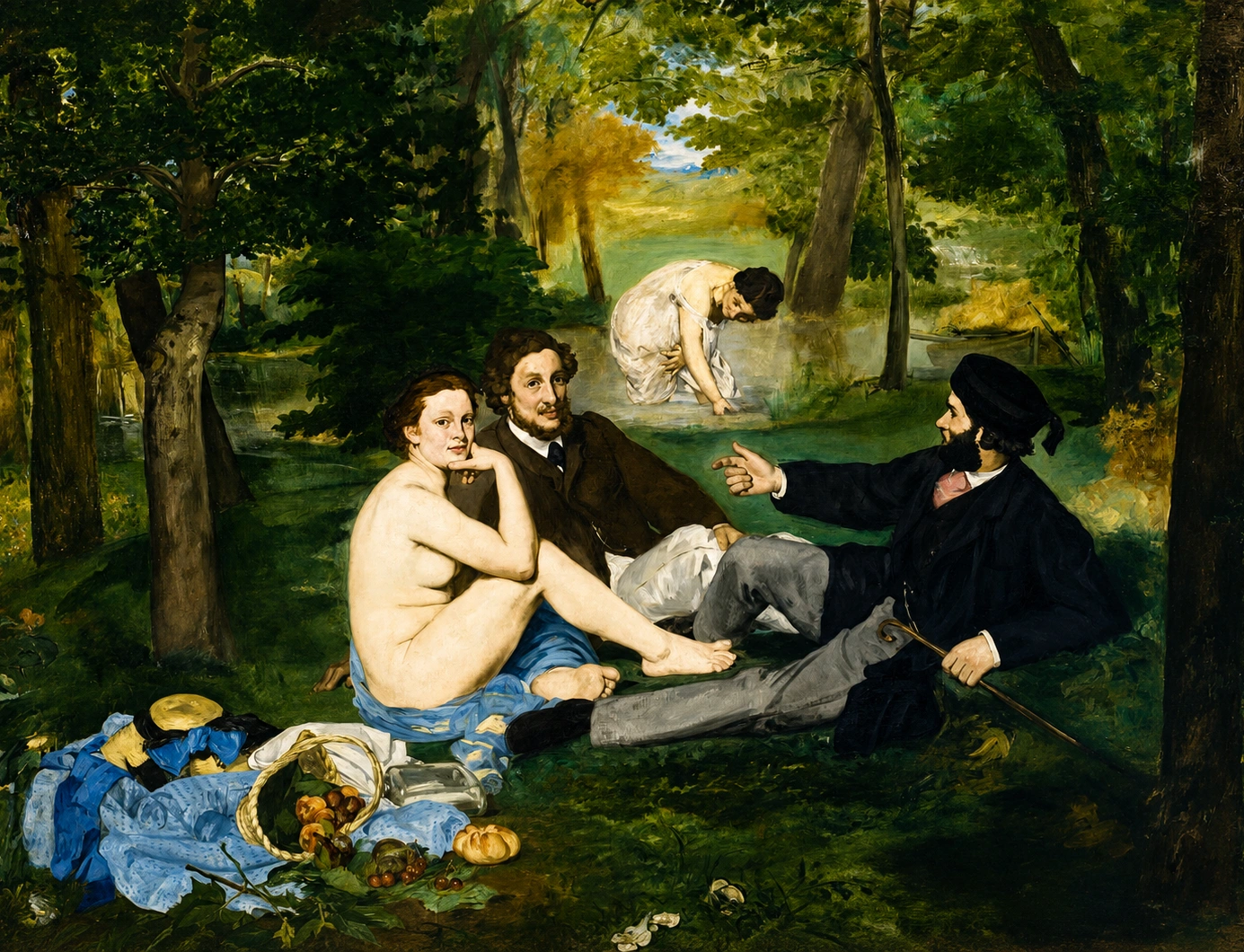
Édouard Manet’s “The Luncheon on the Grass,” painted in 1863, is one of the defining works of modern art. At first glance, it appears to show a simple outdoor gathering: two dressed men, a nude woman, food, clothing, trees, and a bathing figure in the background. Yet the painting’s power comes from how strange and direct this scene feels. Manet takes the familiar subject of a pastoral picnic and transforms it into something unsettling, contemporary, and deliberately difficult to explain.
The painting shocked viewers when it was first shown because it refused to behave like traditional academic art. Nude women had appeared in European painting for centuries, but they were usually placed in mythological, biblical, or allegorical settings. Manet’s nude woman is not Venus, Diana, or a symbolic figure from antiquity. She sits in a modern Parisian landscape beside clothed modern men, looking directly at the viewer with calm confidence. This direct gaze turns the painting into a confrontation. She is not hidden inside a fantasy. She is present, aware, and impossible to ignore.
Composition and Arrangement
The composition of “The Luncheon on the Grass” is carefully staged, even though it may initially seem casual. The three foreground figures form a compact triangular group. The nude woman sits at the left, her pale body strongly illuminated against the darker greens and browns of the forest. Beside her, a bearded man looks outward, while another man reclines to the right and gestures as if speaking. Their relaxed poses create the appearance of conversation, but the emotional connection between them feels ambiguous.
The picnic objects in the lower left corner play an important role. A basket, bread, fruit, blue fabric, and discarded clothing spill toward the viewer. These details bring the scene closer to everyday life. They also connect the woman’s nudity to the immediate reality of the picnic, rather than to distant mythology. Manet places the viewer almost at ground level, as if we have stumbled upon the group.
In the background, a lightly dressed woman bends near the water. Her scale appears unusual when compared with the foreground figures, which adds to the painting’s dreamlike tension. Rather than constructing a perfectly logical space, Manet creates a setting that feels both real and artificial. The forest becomes a stage where modern life, art history, and visual contradiction meet.
Light, Color, and Brushwork
Manet’s use of light is one of the painting’s most striking features. The nude woman’s skin is painted with a pale, almost flat brightness that stands out sharply against the dark wooded setting. Academic painters often used smooth transitions and idealized modeling to make bodies appear sculptural. Manet uses stronger contrasts and more abrupt tonal shifts. This gives the figure a modern immediacy, but it also made the painting seem unfinished to many viewers of the time.
The color palette is restrained but highly expressive. Deep greens, smoky browns, muted blacks, and soft grays dominate the landscape and clothing. Against these subdued tones, the blue fabric, pale flesh, fruit, and flashes of white become especially noticeable. The painting is not decorative in a conventional sense. Instead, its color creates tension between natural atmosphere and theatrical display.
Manet’s brushwork also contributes to the painting’s radical character. The foliage is loose and suggestive rather than meticulously detailed. Some areas feel sketchy, while others are more solidly described. This uneven finish was part of what made the work feel so modern. Manet was less interested in hiding the act of painting than in making the image feel immediate and alive.
The Nude Woman’s Gaze
The central drama of “The Luncheon on the Grass” lies in the nude woman’s gaze. She looks directly outward, meeting the viewer without embarrassment or theatrical modesty. Her expression is calm, intelligent, and self-possessed. This was deeply unusual because traditional female nudes were often posed as passive objects of ideal beauty. Manet’s figure is not simply displayed. She seems to know she is being seen.
This gaze changes the entire meaning of the painting. The viewer cannot remain safely outside the scene. Her look pulls us into it and makes us aware of our own act of looking. The painting therefore becomes not only a representation of a picnic, but also a study of spectatorship. It asks who is looking, who is being looked at, and what kinds of stories painting allows viewers to invent.
The contrast between her nudity and the men’s dark clothing adds another layer of unease. The men appear modern, urban, and socially respectable. The woman’s uncovered body disrupts that respectability. Manet does not explain the relationship between the figures, and this refusal to explain is one reason the painting remains so fascinating.
Art History and Modernity
Although “The Luncheon on the Grass” looked shocking in 1863, Manet was deeply aware of older art. The composition has connections to Renaissance and classical sources, especially scenes in which clothed men appear beside female nudes in a landscape. Manet’s originality lies in how he updates these traditions. He removes the mythological disguise and places the figures in the recognizable world of nineteenth-century France.
This mixture of old and new is essential to the painting. Manet was not simply rejecting tradition. He was challenging it from within. He borrowed the structure of respected art and filled it with modern ambiguity. The result is a painting that feels both familiar and disruptive. It belongs to the museum, but it also seems to question the rules of the museum.
The title itself, “The Luncheon on the Grass,” emphasizes ordinary leisure rather than myth or history. This plainness is part of the provocation. Manet asks whether modern life can be painted on a grand scale with the same seriousness once reserved for gods, heroes, and saints.
Scandal and Lasting Importance
When the painting appeared in the Salon des Refusés in 1863, it became notorious. Many critics and viewers mocked it, partly because of its subject and partly because of its style. The public was not prepared for a nude woman presented so directly in a contemporary setting. The painting seemed to break the agreement between viewer and artwork. Instead of offering a safe ideal, it offered an unresolved modern scene.
Today, “The Luncheon on the Grass” is recognized as a turning point in the development of modern painting. It helped open the path toward Impressionism, not because it is fully Impressionist, but because it challenged academic finish, historical subject matter, and conventional beauty. Manet’s approach encouraged later artists to paint modern life with greater freedom.
The painting remains powerful because it does not settle into one simple interpretation. It can be read as a critique of social hypocrisy, a reinvention of the nude, a conversation with old masters, or a bold statement about painting itself. Its mystery is part of its greatness. Manet gives us a scene that feels clear in its objects but uncertain in its meaning.
Conclusion
“The Luncheon on the Grass” by Édouard Manet is more than a scandalous image from nineteenth-century Paris. It is a painting about modern vision, artistic tradition, and the uneasy relationship between reality and performance. Through its bold composition, direct gaze, loose brushwork, and refusal to explain itself, the work changed what painting could represent. Manet turned a picnic in the woods into one of the most important images in art history, a work that still feels challenging, strange, and alive.