Café Terrace at Night by Vincent van Gogh: Vibrant Color Edit
Free to Download & Reuse: You are welcome to use this image! If you republish or share it online, you must include a direct link back to this webpage for attribution.
Original Image Source: wikiart.org
A Complete Analysis of “Café Terrace at Night” by Vincent van Gogh
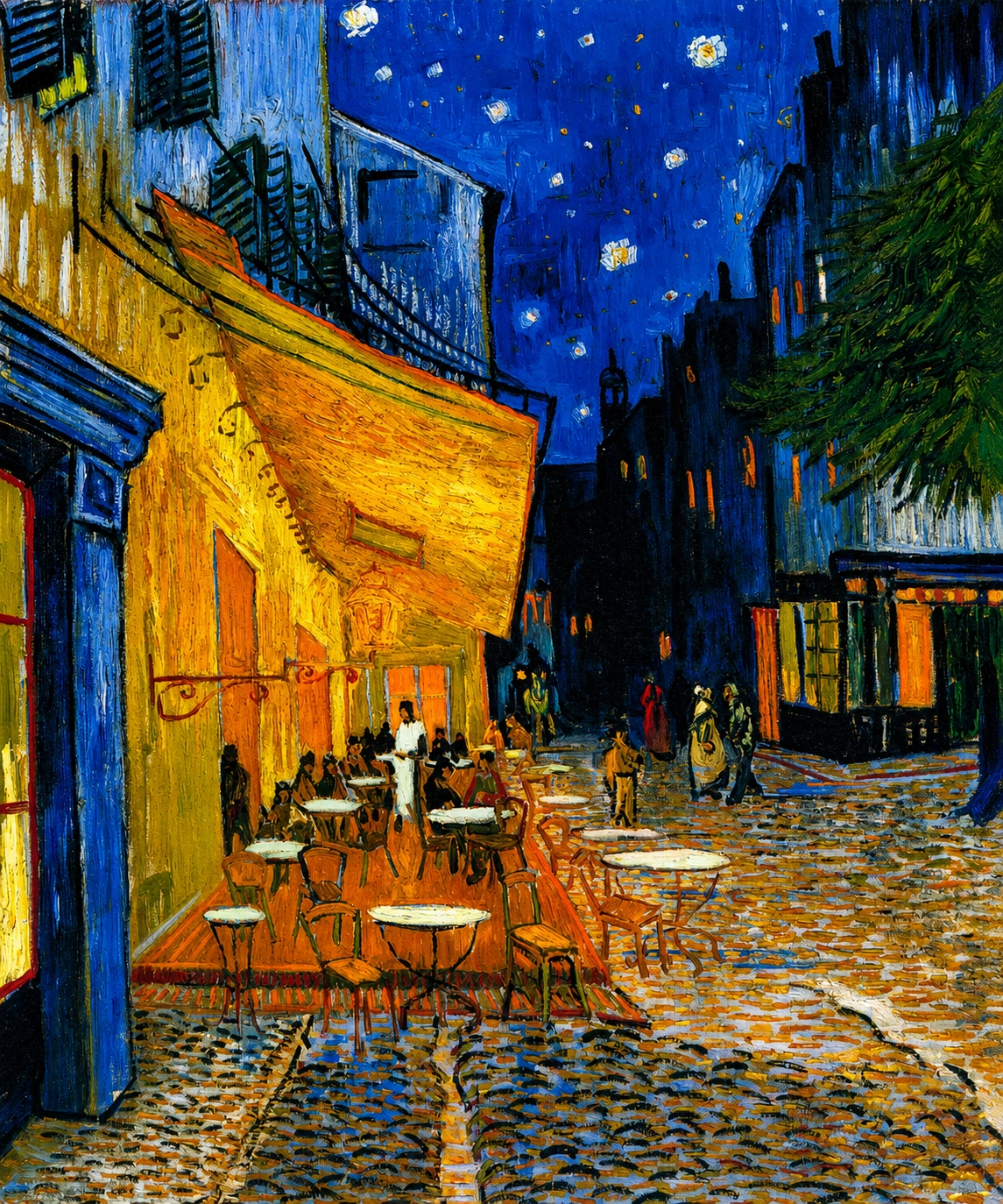
Vincent van Gogh’s “Café Terrace at Night,” painted in 1888, is one of the most inviting and radiant night scenes in nineteenth-century art. Unlike many nocturnal paintings that rely on darkness, mystery, and heavy shadow, this work turns night into a field of color, warmth, and human possibility. The glowing café terrace, the deep blue sky, the cobbled street, and the small figures gathered beneath the awning all create a scene that feels both ordinary and visionary. Van Gogh does not simply record a corner of Arles. He transforms it into a living atmosphere where light, color, and emotion are inseparable.
The painting depicts an outdoor café on the Place du Forum in Arles, a town in the south of France where Van Gogh hoped to create a new artistic life. The setting is specific, but the effect is universal. Viewers are drawn into a narrow street at night, guided by the golden light of the café on the left and the receding line of buildings on the right. The composition has the feeling of a stage, with the café terrace acting as the illuminated foreground and the dark street beyond suggesting depth, movement, and mystery.
The Power of Yellow and Blue
One of the most striking features of “Café Terrace at Night” is its dramatic contrast between yellow and blue. The café glows with intense gold, orange, and lemon tones, while the sky and surrounding architecture are built from deep blues, violets, and greens. This contrast gives the painting its emotional energy. The yellow is not just a realistic effect of artificial light. It feels alive, almost spiritual, as if the café itself were radiating warmth into the night.
The blue sky is equally important. Van Gogh avoids a flat, black night and instead creates a rich, saturated blue that feels expansive and dreamlike. The stars sparkle above the street, not as distant astronomical details but as marks of wonder. Their presence links the everyday café scene to something larger and more cosmic. In this way, the painting becomes both a view of modern life and a meditation on beauty in ordinary experience.
The color harmony is bold but carefully balanced. The yellow terrace would feel overwhelming without the cool blues around it, while the blue night would feel cold without the warmth of the café. Van Gogh’s genius lies in making these opposites depend on each other. The painting feels vibrant because it holds tension between comfort and solitude, brightness and darkness, public life and private feeling.
Composition and Perspective
The composition of “Café Terrace at Night” pulls the viewer into the scene with strong diagonal lines. The awning of the café stretches sharply across the left side, leading the eye toward the center of the painting. The cobblestone street opens outward in the foreground before narrowing into the dark distance. This creates a strong sense of depth, but the perspective is not coldly mathematical. It bends and pulses with Van Gogh’s expressive vision.
The café dominates the left side, while the right side is darker and more mysterious. This asymmetry makes the painting feel dynamic. The viewer is positioned as someone standing just outside the café, close enough to enter but still slightly apart from the people seated at the tables. That emotional position is important. We are invited into the warmth, but we also remain observers, looking at the scene with a sense of longing.
The small figures add life without becoming individual portraits. Waiters, customers, and pedestrians appear as simplified shapes, their bodies absorbed into the broader rhythm of the scene. They help establish the café as a social space, but the painting is not primarily about conversation or narrative. It is about atmosphere. The people are part of the light, movement, and color of the street.
Brushwork and Surface Energy
Van Gogh’s brushwork gives the painting its restless vitality. The cobblestones are painted with short, broken strokes that shimmer with reflected blues, yellows, whites, and oranges. Instead of treating the street as a flat surface, Van Gogh makes it flicker and move. The ground seems to catch light from the café, the stars, and the surrounding buildings all at once.
The buildings are also animated by visible brushstrokes. Their outlines are dark, angular, and slightly unstable, giving the architecture an expressive force. Nothing in the painting feels completely still. Even the sky is textured with strokes that suggest movement and sensation. Van Gogh’s brushwork turns the visible world into a record of emotional intensity.
This approach reflects his larger artistic goal. He was not trying to copy nature with photographic accuracy. He wanted to express how a place felt. In “Café Terrace at Night,” the brushstrokes make the viewer sense the brightness of gaslight, the unevenness of the pavement, the coolness of the night air, and the hum of people gathering in the evening.
A Night Scene Without Black
One of the most remarkable aspects of the painting is Van Gogh’s treatment of night without relying on black. Instead of darkness as absence, he gives the night color. The deep blues and greens are full of life, and the shadows contain subtle variation. This makes the painting feel more luminous than if it had been painted with heavy black tones.
The absence of black also changes the mood. The scene is not frightening or oppressive. It is peaceful, radiant, and slightly enchanted. The night becomes a setting for perception, not concealment. Van Gogh shows that darkness can reveal color rather than hide it.
This choice also helps explain why “Café Terrace at Night” remains so beloved. It presents the nighttime city as a place of beauty and human warmth. The café is not grand or aristocratic. It is a modest public space, yet Van Gogh treats it with the grandeur usually reserved for religious or historical subjects. The glowing terrace becomes almost sacred because of the intensity with which it is seen.
The Emotional Meaning of the Café
The café terrace can be read as a symbol of connection. People gather under the awning, sharing the same light, while the viewer looks in from the street. This creates a quiet emotional tension. The painting celebrates social life, but it also carries a feeling of separation. Van Gogh often sought community and belonging, yet his art frequently reveals the loneliness of someone observing the world from the edge.
That tension gives the painting its depth. It is not simply cheerful, even though it is bright and welcoming. The golden light feels warm because it is surrounded by darkness. The café seems inviting because the street beyond it is so deep and blue. Van Gogh captures the emotional complexity of a public place at night, where strangers gather, lights glow, and the world briefly feels open.
Why “Café Terrace at Night” Still Matters
“Café Terrace at Night” remains one of Van Gogh’s most powerful works because it makes ordinary life feel extraordinary. A café, a street, a few tables, and a starry sky become a vision of color and feeling. The painting shows how modern life, with its artificial lights and urban spaces, could still contain wonder.
It also anticipates some of Van Gogh’s later masterpieces, especially his famous starry night imagery. Here, the stars are not yet swirling with full cosmic drama, but they already suggest his fascination with the emotional power of the night sky. The painting stands at the meeting point between observation and imagination. It is rooted in a real place, yet it feels transformed by inner vision.
Through bold color, expressive brushwork, and a deeply personal sense of atmosphere, Van Gogh created a painting that continues to feel immediate. “Café Terrace at Night” is not only a view of Arles in 1888. It is an image of how light can change a place, how color can carry emotion, and how a simple evening scene can become unforgettable.